
Peach Tree in Blossom: Story, Meaning & Brushwork
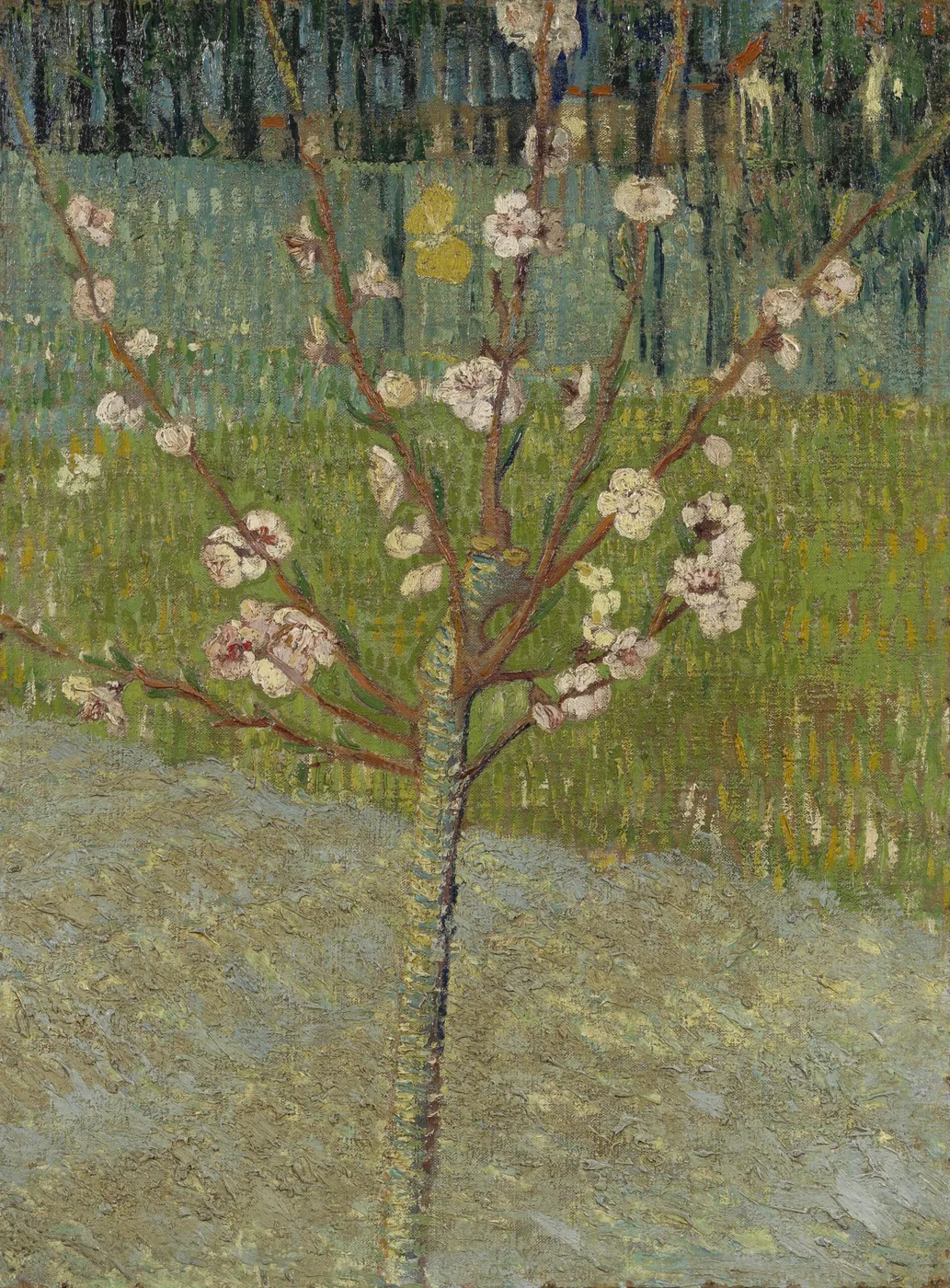
By February 1888 Vincent van Gogh had left Paris behind for Arles, chasing a light he believed the north could never give him. He arrived to a cold snap and a dusting of snow, not the warmth he had pictured, and spent his first weeks largely alone in a town that had no idea what to make of him. Then, within days, the orchards around the town began to flower.
A Town Waking Into Blossom
Almond, apricot, plum and peach came into bloom in close succession through late February and March, and van Gogh treated the whole event as a subject he could not afford to miss. Blossom lasts a matter of days in open wind, so he worked at speed, setting up outdoors whenever the weather allowed and moving from orchard to orchard while the flowers held.
Peach Tree in Blossom belongs to that short, concentrated campaign. It is one of a group of orchard pictures he made in a matter of weeks, each one a record of a particular tree at a particular moment rather than a composite or an invention.
One Young Tree, Newly Staked
The canvas holds a single peach tree, and it is a young one. The trunk is thin, still ringed with the pale bark of a recently planted sapling, and a slender stake rises beside it to hold the new growth steady against the Provençal wind.
From that narrow stem the branches fan out in a wide, asymmetrical spray, reaching further to the left and right than they do upward. Every branch carries clusters of blossom, pale pink shading to near white at the edges of each flower, set against the rust brown of the young wood.
Underfoot the ground is bare and pale, a stretch of grey buff earth rendered in short dry strokes, without a blade of grass. It reads as freshly turned orchard soil, the kind kept clear around a new planting so the tree does not have to compete for water.
Behind the tree the ground changes abruptly to a band of green field, streaked through with yellow and worked in short vertical touches that suggest grass caught by wind rather than grass observed leaf by leaf. A dark line of fencing or hedge closes the composition at the top, with small flecks of orange and blue breaking through, hints of rooftops or figures glimpsed beyond the orchard boundary.
Paint Handled Without Hesitation
Van Gogh built the grass out of short, repeated, almost parallel strokes, laid down quickly enough that the brush marks stay visible as marks rather than dissolving into an even field of colour. The blossom is done differently, in small loaded dabs that sit slightly proud of the surface, so the pink clusters catch real light when seen in person.
The palette turns on a single strong contrast: the cool blue green of the young grass against the warm pink and white of the flowers. It is a pairing van Gogh returned to across the whole orchard series, and here it is kept simple, with none of the pattern or ornament he sometimes allowed himself elsewhere that spring.
The branches themselves are drawn rather than built up in paint, thin lines of brown red pulled across the wet ground with a loaded brush. That linear energy in the branches sits against the stillness of the bare earth below, and the tension between the two is a large part of what gives the picture its quiet charge.
A Small Picture From a Turning Point
Painted in Arles in 1888, Peach Tree in Blossom measures 36 by 48.5 centimetres, a modest scale that suits its subject. This is not a grand orchard vista but a close, almost portrait like study of one tree finding its first spring, and the size keeps the focus there.
The orchard paintings mark the point where van Gogh’s work in the south began to separate itself from what had come before in Paris, faster, brighter, built on direct observation rather than reworking in the studio. Peach Tree in Blossom, now held by the Van Gogh Museum, is one of the clearest small statements of that shift.
What the Painting Gives a Room
Hung at eye level in a quiet room, the picture keeps its scale intimate rather than commanding, closer to something you would come across than something that announces itself from across a space. It rewards a second look more than a first, the way the actual tree would have rewarded a second visit to the orchard.
Morning light draws out the pink of the blossom and the warmth of the young bark. Later in the day, as the light flattens and cools, the green field and grey earth take over, and the tree reads more starkly against them, a single fragile thing holding its ground in an otherwise bare stretch of orchard.
Sizes and materials for Peach Tree in Blossom are listed on its product page.
More from this collection
Bring this painting home
Choose a hand-painted oil reproduction for real brushwork, or an archival canvas print for a crisp museum-image edition. Every size preserves the original proportions.
View this work & options
Further reading
Verify the original in the Van Gogh Museum collection record and continue through related works in the catalogue.