
Harvest in Provence: Story, Meaning & Brushwork
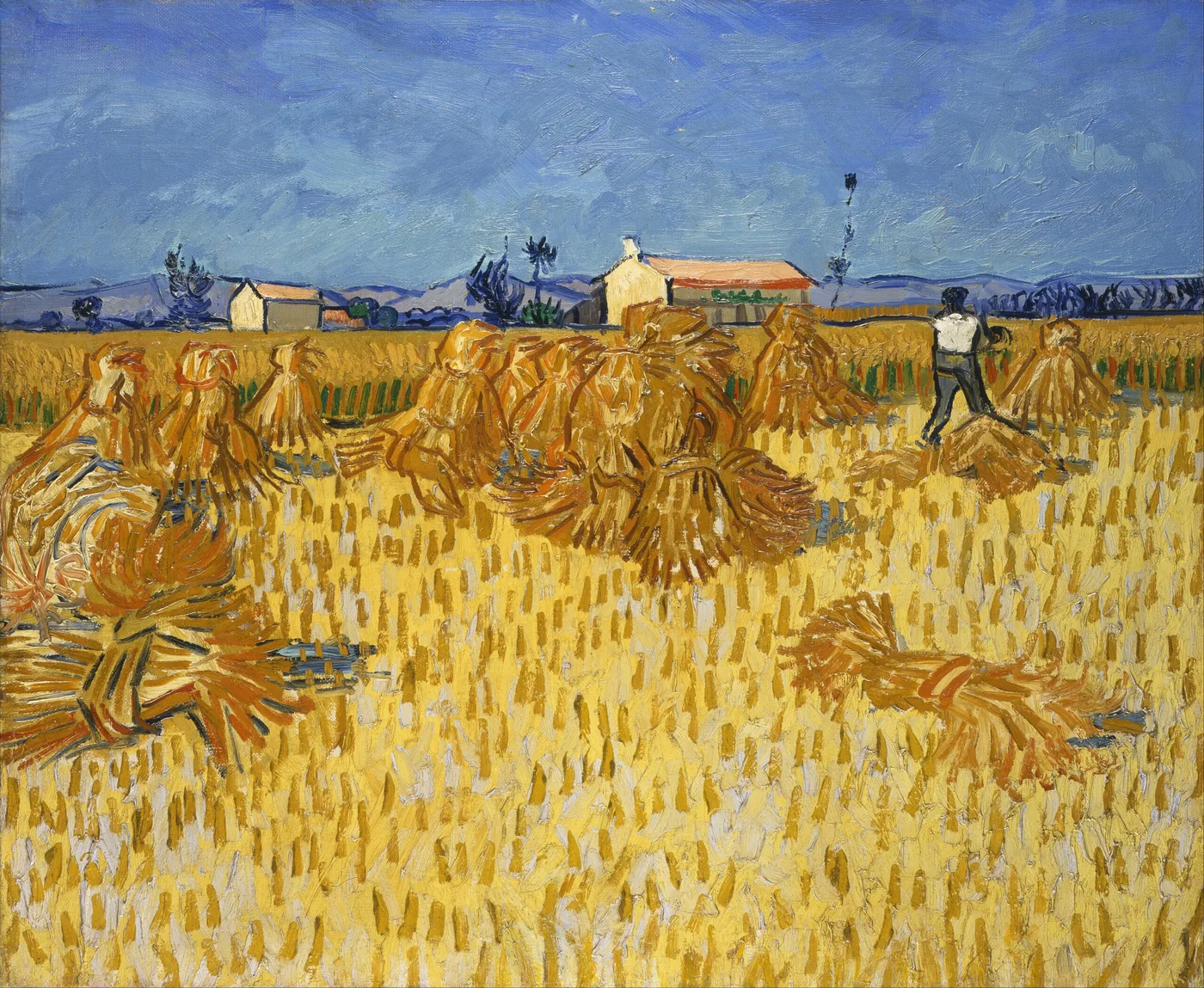
By June 1888 Vincent van Gogh had been in Arles only a few months, but the wheat around the town was already turning, and he knew he had weeks, not months, to catch it. He wrote to his brother Theo about working at a pace he compared to a machine, setting up his easel before dawn and painting straight through the heat because the grain would not wait for him. Harvest in Provence belongs to that short, urgent stretch of the season, a canvas of 60 by 50 centimetres completed in 1888 and now held by the Israel Museum in Jerusalem.
A Painter Working Against the Season
Arles gave van Gogh what Paris never had: flat, wide farmland under a sky he found sharper and more luminous than anything in the north. He had come south partly to find this light, and the harvest gave him a subject that matched his ambition, a whole plain turned gold in a matter of days.
He described the wheat fields around the city as a kind of furnace, and the paintings from these weeks show it. Colour is pushed further than description strictly requires, because he was not simply recording a crop but trying to get down the sensation of standing in it.
The result is one of several harvest canvases from that Arles summer, each taken from a slightly different vantage across the same plain, each catching the grain at a different stage of being cut and gathered.
Stooks, a Farmhouse and a Lone Figure
The foreground is packed with bound sheaves standing in loose stooks, their heads splayed and their straw catching light from several directions at once. They are scattered rather than ranked, as if the eye is looking across a field mid-harvest rather than at a tidy finished job.
Beyond the stooks the cut and uncut grain runs back to a low farmhouse with a red tiled roof, flanked by a scatter of trees and a second, smaller building. A line of pale blue hills closes the plain off in the distance, soft where the stooks in front are hard-edged.
A single reaper stands among the sheaves on the right, small against the scale of the field, his dark trousers and pale shirt the only note of the human figure in an otherwise empty stretch of land. He is working, not posing, caught mid-task the way van Gogh often placed labourers in his Arles landscapes.
Above it all the sky takes up close to half the canvas, a deep, restless blue that presses down on the gold beneath it rather than floating above it. There is no cloud to soften it, only movement built from the brush itself.
Paint Laid Like Grain
Van Gogh painted the wheat in short, loaded strokes set close together, upright and slightly angled, so that the paint itself takes on the rhythm of standing grain. In places the strokes are thick enough to catch real shadow across the surface of the canvas.
The stooks are built up further still, with darker ochre and rust laid over the gold in twisting, overlapping marks that give each bundle its own tangled shape. Nothing in the foreground is smoothed or blended away.
The sky is handled quite differently, in longer, sweeping strokes that run on a diagonal across the upper canvas. That change of rhythm between field and sky, dense and vertical below, loose and diagonal above, is part of what keeps the whole composition in motion.
Gold Set Against Blue
The painting turns on one basic contrast: the near-complementary pairing of golden wheat and blue sky, pushed close to full saturation on both sides. Van Gogh was working with this pairing deliberately across his Arles pictures, aware that yellow and blue set against each other intensify one another far more than either does alone.
Within that scheme he allows himself only small departures, the dull red of the farmhouse roof, a scatter of green in the unharvested rows, a few strokes of white where the light catches the sheaves hardest. None of it competes with the two dominant colours.
There is very little true black anywhere in the canvas. Shadow is built from blue and violet instead, which keeps even the darkest passages of the stooks glowing rather than going flat.
On a Wall, Through the Day
A painting built this directly from thick, angled paint answers to real light rather than sitting still under it. As the light in a room shifts across a morning or an afternoon, the raised ridges of the wheat catch it differently, and the field seems to move even though nothing in the picture changes.
Hung where daylight reaches it, the canvas keeps giving something back hours after a first look, the stooks in the foreground pulling the eye down close to the paint, the sky pulling it back out again. It rewards being walked past repeatedly rather than studied once.
What stays with a viewer is not the farmhouse or even the reaper but the sheer physical presence of the grain, paint laid on paint until the surface itself feels like a harvested field. That is the record van Gogh left of those few weeks in Arles when the wheat was ready and he was racing to keep up with it.
Sizes and materials for Harvest in Provence are listed on its product page.
More from this collection
Bring this painting home
Choose a hand-painted oil reproduction for real brushwork, or an archival canvas print for a crisp museum-image edition. Every size preserves the original proportions.
View this work & options
Further reading
Verify the original in the Israel Museum collection record and continue through related works in the catalogue.