
Green Wheat Field: Story, Meaning & Brushwork
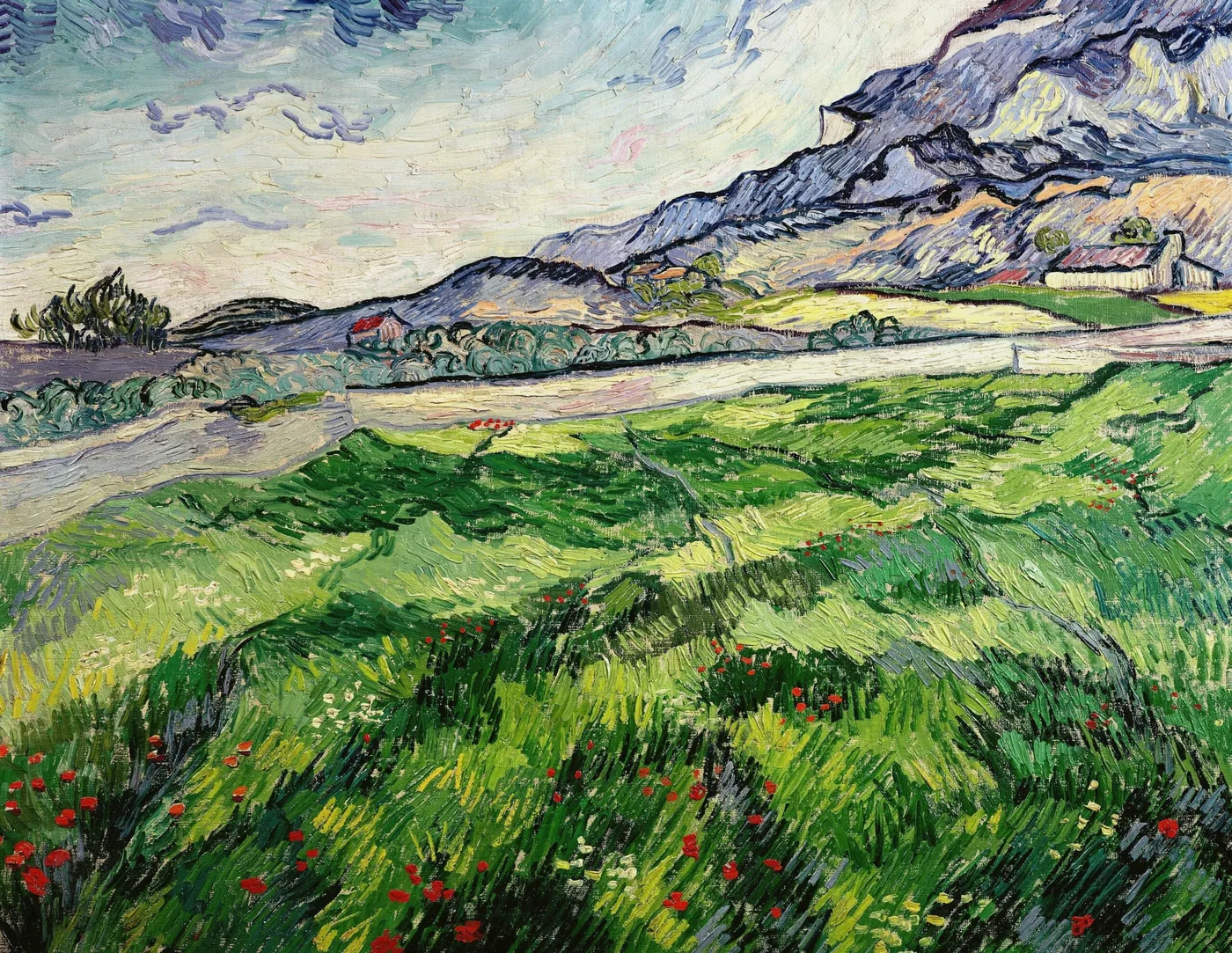
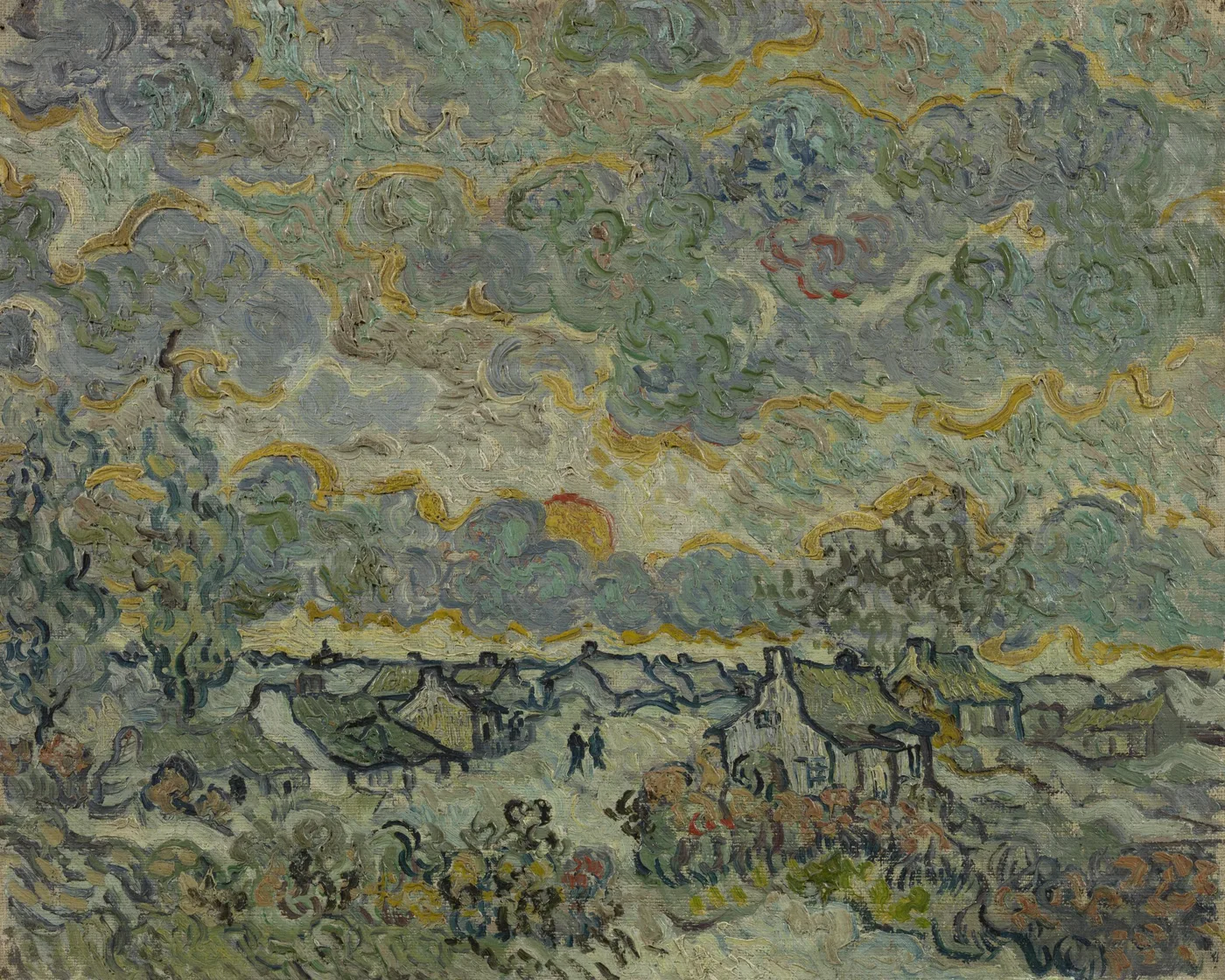
In May 1889, Vincent van Gogh entered the asylum of Saint-Paul-de-Mausole at Saint-Rémy-de-Provence, and it was here, within sight of the walled garden and the wheat fields beyond it, that he painted Green Wheat Field. The canvas, worked in 1889 and measuring 92 by 73 centimetres, shows the crop still short and green, weeks before the harvest that would occupy him again and again that summer.
A Year Spent Watching One Field
Van Gogh had arrived at Saint-Rémy voluntarily, seeking a period of calm after the crisis that ended his time in Arles. The grounds gave him a limited but consistent view: an enclosed field of wheat, a line of hills, and above them the jagged ridge of the Alpilles. Rather than treat this restriction as a limitation, he returned to the same field across the seasons, tracking it from bare earth through to full ripeness and cutting.
Green Wheat Field belongs to the early stage of that sequence, painted while the crop still held its cool colour and had not yet turned to the gold he would paint later in the year. It records a moment easy to overlook: the wheat is grown but not yet heavy, still moving loosely in whatever wind crosses the field.
What Fills the Canvas
The lower two thirds of the picture are given over entirely to the crop. It rises in loose diagonal bands of green, some paler and touched with yellow where light catches the tips, others darker where the stems bunch and shadow gathers between them. A narrow path curves in from the left, cutting a pale track through the green before it disappears into the field.
Poppies break the green at intervals, small strokes of red set down singly and in loose clusters, brightest in the near corners of the canvas. They give the only warm colour in the lower half of the picture and pull the eye first, before it settles into the wider sweep of green around them.
A low stone wall runs across the middle distance, separating the wheat from the gentler hills beyond. Behind it sit a scatter of small buildings and dark trees, painted with far less detail than the field itself, present mainly to mark the change of scale between what is near and what is far.
The Alpilles and the Farmhouse
Above the wall, the hills of the Alpilles rise into a single jagged ridge that dominates the right side of the canvas, painted in blues, mauves and streaks of ochre where sunlight catches the rock. Their outline is far more agitated than anything below, all sharp turns and broken edges, set against the calmer curves of the wheat.
A farmhouse with a red roof sits low against the base of the ridge, one of the few straight lines in the entire composition. Above it all, the sky is pale and busy, laid in short curling strokes of white, grey and the faintest pink, calmer than the skies van Gogh gave to some of his other Saint-Rémy canvases.
How the Paint Was Laid Down
The wheat is built from short, repeated strokes rather than blended colour, each one following the direction a stalk might actually lean. Van Gogh varied the pressure and length of these strokes constantly, so that the field reads as a mass of individual plants rather than a flat area of green, even from a distance.
The paint sits thickly in places, especially where the poppies interrupt the green, and more thinly where the path crosses the field and the canvas ground shows through the strokes. This mix of loaded and scraped paint gives the surface a texture that shifts depending on where light falls across it.
Living With the Field
Hung in a room that gets daylight, the painting changes considerably through the day. Morning or overcast light softens the contrast between the green field and the pale sky, while direct sun picks out the ridges of paint in the wheat and makes the poppies read as small points of colour against the green.
The painting has passed through more than one collection since 1889; it is recorded in the Hermann Göring Collection, a reminder that this canvas of an ordinary field has travelled a long way from the walled ground at Saint-Rémy where it was painted. What stays constant is the field itself, still caught mid-growth, neither bare nor ready for harvest.
Sizes and materials for Green Wheat Field are listed on its product page.
More from this collection
Bring this painting home
Choose a hand-painted oil reproduction for real brushwork, or an archival canvas print for a crisp museum-image edition. Every size preserves the original proportions.
View this work & options
Further reading
Verify the original in the collection record and continue through related works in the catalogue.