
Haystacks in Provence: Story, Meaning & Brushwork
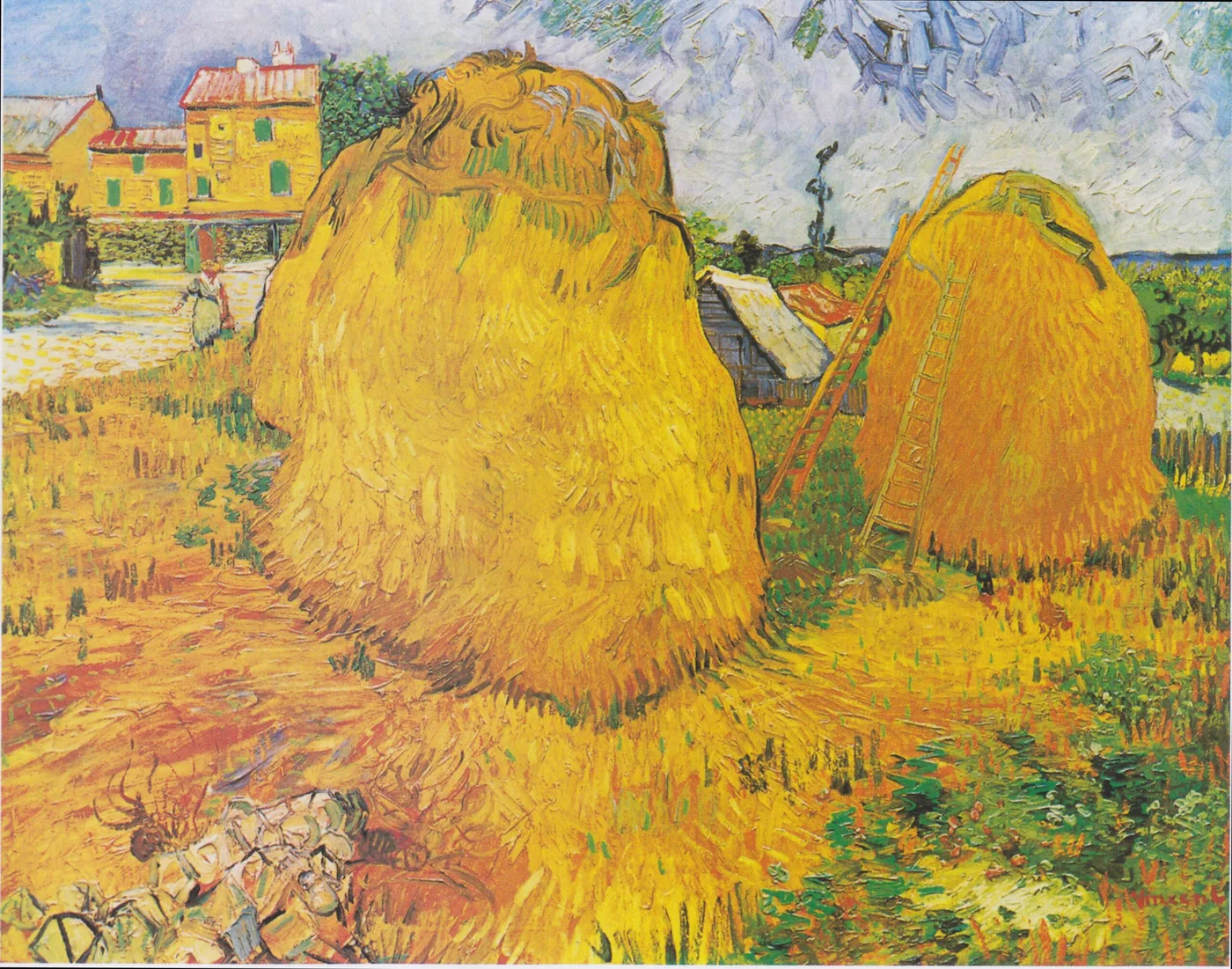
A Farmyard Outside Arles, Midsummer 1888
By the summer of 1888 Vincent van Gogh had settled into a punishing rhythm around Arles, chasing the wheat harvest from field to field before the light or the weather could take it from him. He wrote to his brother Theo about working at a pace he had never managed before, sometimes finishing a canvas in a single sitting because the grain would not wait for a second visit.
Haystacks in Provence, painted in 1888, belongs to that harvest campaign. It is not a distant view of the wheat country but a close, almost intrusive look at what the harvest leaves behind: two great stacks built from the cut crop, standing in a farmyard on the edge of town.
The canvas measures 92.5 by 73 cm, large enough that the ricks reach close to life size at the bottom edge. Van Gogh does not set them in the middle distance for the eye to admire from a safe remove. He plants the viewer right beside them, in the stubble and the heat.
Two Ricks in a Farmyard
The composition is built around a pair of conical haystacks. The nearer one fills most of the left and centre of the canvas, its bound sheaves raked into a dense, textured dome. A second, smaller stack stands to the right, a wooden ladder propped against it as if a labourer has just climbed down or is about to climb up.
Behind the stacks a thatched outbuilding huddles low to the ground, its roof the only soft, muted shape in a picture otherwise built from hard, directional marks. Further back, on the upper left, a yellow house with green shutters and a red tiled roof anchors the scene in a real, inhabited place rather than an abstract field.
A single small figure, a woman in a pale bonnet, walks along a pale track between the house and the stacks. She is barely more than a few strokes of paint, yet she is enough to give the whole farmyard a sense of ordinary, working scale.
Where Blue Meets Gold
Colour carries most of the picture’s charge. The stacks and the trampled field beneath them run through every shade of gold, ochre and burnt orange that ripe straw can hold, with patches of raw red earth showing through at the lower left where the ground has been cleared.
Against all that warmth, Van Gogh sets a sky of restless blue-grey, laid in broad, sweeping strokes that curl and cross like wind moving over the yard. The contrast is deliberate: warm and cool pushed hard against each other so that the haystacks seem to radiate heat even in reproduction.
Green appears sparingly, in the shutters of the house, in low weeds at the picture’s edge, in the trees screening the outbuilding. It is enough to keep the gold from tipping into monotony without ever competing with it for attention.
Paint Laid Like Straw
Van Gogh’s brushwork here does something specific and worth pausing over: it mimics the material it describes. The strokes across the haystacks follow the direction the sheaves would actually lie, short and angled, so the paint itself seems to be made of straw rather than merely picturing it.
The sky is handled quite differently, in longer, looping passages applied with a loaded brush, sometimes scraped or dragged so the canvas texture shows through. That gap between a tightly worked foreground and a loosely handled sky is one of the picture’s clearest structural decisions.
The paint sits thick in places, built up in ridges that catch real light and throw a faint shadow across the surface. This is not a picture that flattens under glass; it keeps a physical presence, a sense of the hand that built it stack by stack, stroke by stroke.
Living with the Harvest
Hung in a room that gets low afternoon sun, the picture answers back. Raking light finds every ridge of impasto in the stacks and turns the whole surface into something closer to relief than to flat paint, the gold deepening as the light drops.
Under cooler, even daylight the blue of the sky comes forward instead, and the picture reads calmer, more structural, the two haystacks settling into their places like architecture rather than harvest. Both readings are legitimate; the canvas was built to hold them.
The original hangs in the Kröller-Müller Museum, where it stands among the fullest holdings of Van Gogh’s work anywhere. What it offers a room of its own is more modest and more immediate: a single, hot afternoon in a Provence farmyard, held in paint thick enough to still feel warm.
Sizes and materials for Haystacks in Provence are listed on its product page.
More from this collection
Bring this painting home
Choose a hand-painted oil reproduction for real brushwork, or an archival canvas print for a crisp museum-image edition. Every size preserves the original proportions.
View this work & options
Further reading
Verify the original in the Kröller-Müller Museum collection record and continue through related works in the catalogue.