
Wheatfield with Sheaves and a Reaper: Story & Meaning
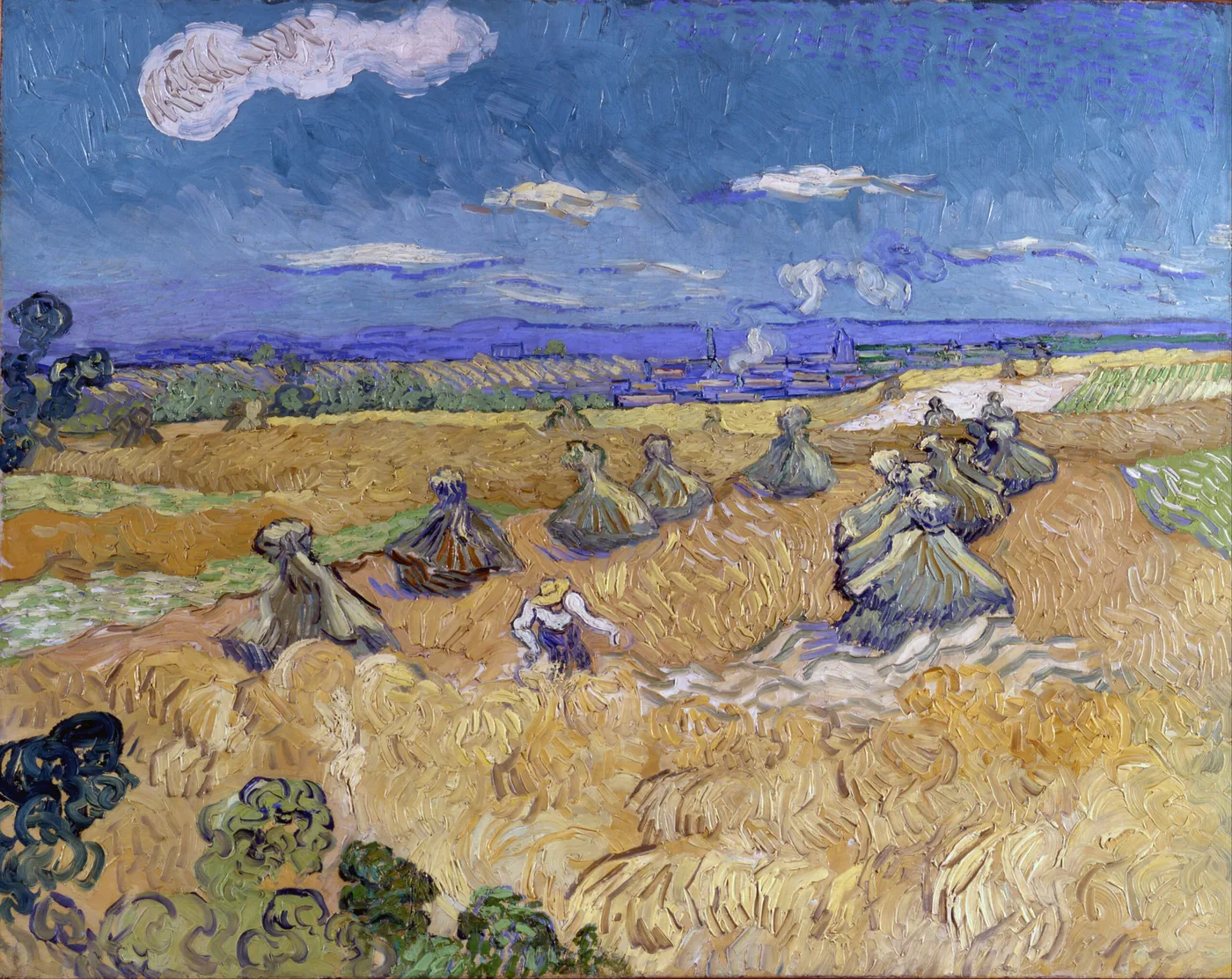
By June 1888 Vincent van Gogh had been in Arles for four months, and the wheat around the town was turning from green to gold. He wrote to his brother Theo that he was working in a continual fever, racing the fields before the reapers finished the cut. Wheatfield with sheaves and reaper belongs to that stretch of the summer, painted in Arles in 1888 at a pace that matched the harvest itself.
Van Gogh returned to the same stretch of land again and again that season, watching it change by the week: green wheat, then ripe wheat, then stubble and bare earth. This canvas, now in the collection of the Toledo Museum of Art, catches the field at its fullest, heavy with cut grain and still full of figures at work.
A Field Painted Against the Clock
Van Gogh had asked Theo to send more canvas and paint that month, aware that the wheat would not wait for him. Harvest in Provence moves fast under a hot sun, and a field standing one week can be stubble the next. He painted outdoors, directly in front of the motif, working through the heat rather than around it.
He described the harvest as one of the subjects that mattered most to him that year, tied to ideas of ripeness, labour and the closing of a cycle. The reaper working alone among the sheaves was, for him, close kin to the sower he had painted earlier in the season, both figures set against the scale of the land and the turn of the seasons.
The painting measures 93 by 73.6 centimetres, a size that let him work quickly on site without the canvas becoming unwieldy in the wind and heat of the open field.
Sheaves Standing Like a Procession
The lower two thirds of the canvas is given over almost entirely to the field. Bound sheaves rise from the stubble in an irregular line that curves back from the foreground toward a small huddle of buildings on the horizon, one of them trailing a thin plume of smoke.
A single reaper, small against the sheaves around him, bends into the grain near the centre of the composition. He wears a straw hat and a pale shirt, the one note of undyed colour set against the ochre of the wheat and the blue-grey of the bundled stalks.
Dark, loosely brushed shrubs anchor the bottom corners of the canvas, framing the field and pulling the eye up and across it. Beyond the sheaves, thin bands of green and violet mark the edge of neighbouring fields before the land gives way to a pale strip of hills.
Above it all sits a wide band of sky, taken up mostly by a single heavy white cloud at upper left and thinner streaks of blue and violet elsewhere. The sky occupies roughly a third of the canvas, calm in a way the field beneath it is not.
Grain Built Stroke by Stroke
Van Gogh laid the wheat down in short, directional strokes of yellow, ochre and gold, each one following the lie of the stalks rather than the shape of the field as a whole. Up close the stubble reads as pure motion; from a distance it settles into the texture of a field caught mid-harvest.
The sheaves themselves are built from cooler strokes, grey-green and blue-violet, which make them stand slightly apart from the warmer field around them. That contrast is what allows nine or ten separate bundles to read clearly against a single continuous expanse of grain.
The sky is handled differently again, in longer, calmer sweeps that curve with the clouds rather than cutting across them. The change in touch between sky and field is one of the clearest ways the canvas separates the two halves of the scene without any hard line drawn between them.
The Painting in a Room
Hung where morning or late afternoon light can reach it, the picture shifts with the room around it. Warm light draws out the gold of the stubble; cooler light brings the blues and violets of the sheaves and sky forward instead.
It rewards looking twice: once for the whole sunlit field, and again for the single figure bent into the grain near its centre, easy to miss on a first pass and hard to overlook once found.
Sizes and materials for Wheatfield with sheaves and reaper are listed on its product page.
More from this collection
Bring this painting home
Choose a hand-painted oil reproduction for real brushwork, or an archival canvas print for a crisp museum-image edition. Every size preserves the original proportions.
View this work & options
Further reading
Verify the original in the Toledo Museum of Art collection record and continue through related works in the catalogue.