
Marguerite Gachet in the Garden: Story & Meaning
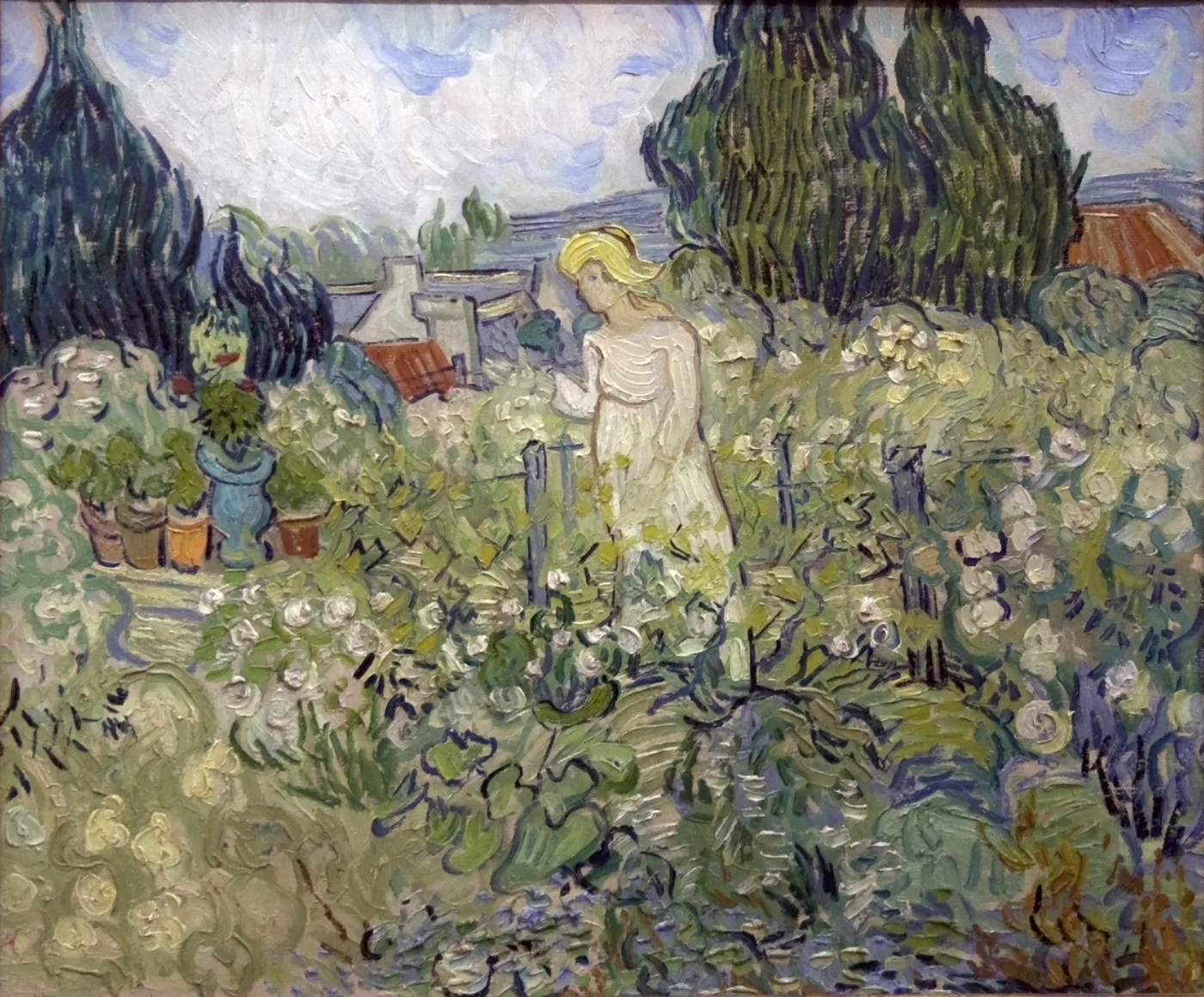
In June 1890 Vincent van Gogh had less than two months left to live, though nothing in this picture gives that away. He had settled in Auvers-sur-Oise that May, drawn there by Dr Paul Gachet, a physician with a taste for painting and a garden full of roses. Within weeks he was working at a furious pace, and one of the pictures he made in that short stretch was a portrait of the doctor’s daughter, standing among the flowers she tended.
Marguerite Gachet in the Garden, painted in 1890 and now held by the Musée d’Orsay in Paris, is a small canvas at 55 by 46 centimetres, but it carries a much larger ambition. Van Gogh wanted to paint modern portraits set against modern gardens, figures who belonged to their surroundings rather than posed in front of them. Here the ambition and the sitter meet in one afternoon’s work.
A household on the edge of Paris
Auvers-sur-Oise sat close enough to Paris for weekend painters and far enough to feel like proper countryside, with thatched roofs, orchards and the kind of light that had already drawn Charles-Francois Daubigny there years before. Dr Gachet had a reputation among artists as a sympathetic and slightly eccentric host, willing to have a struggling painter to dinner and to sit for his portrait afterwards.
Van Gogh moved to Auvers in May 1890, after his stay at the asylum in Saint-Remy, hoping the doctor’s supervision and the change of scene would steady him. The move worked, for a while; letters from that summer describe long working days and a household that welcomed him.
The Gachet garden, by his own account in letters to his brother Theo, offered exactly the mixture of the untended and the deliberate that he liked to paint: paths choked with growth, roses left to climb where they wanted, and a family that did not mind him setting up an easel among the beds. Marguerite appears in his work more than once from that summer, and this garden portrait is the gentler of the two, made without the piano or the parlour walls that frame her elsewhere.
He painted quickly that summer, sometimes finishing a canvas in a single sitting, and the garden pictures share a nervous, hurried warmth that is different from the stiller interiors. There is no record of what Marguerite herself made of sitting for him, only the paintings that resulted and the fact that he kept returning to her family’s garden as a subject.
The girl among the roses
Marguerite stands just off-centre, turned three-quarter to the left, her fair hair loose and catching the light while the rest of her is folded into a plain white dress. Her hands are drawn up near her chest, one of them dark against the pale fabric, as though she has paused mid-task rather than arranged herself for the painter. She does not meet the viewer’s eye; her attention stays somewhere in the middle distance of the garden itself.
Around her the beds crowd right up to the picture’s edge. Roses in white and cream cluster low across the foreground, threaded with darker greens and the odd streak of yellow, and a run of potted plants, terracotta and one taller blue-green urn, lines the left side of the canvas like a still life set into the border of a larger scene. Thin dark posts, part fence and part plant support, rise through the flowers behind her, giving the lower half of the picture a loose vertical structure.
Beyond the garden wall the eye finds a run of red-tiled roofs and pale walls, the kind of modest cottages Auvers was built from, and then a line of dark, flame-shaped cypresses closing off the right side of the composition. The sky above is a soft, restless white and blue, painted in short curling strokes that echo the movement in the foliage below.
Nothing in the background is sharp. The roofs and trees are there to root the garden in a real village, not to compete with the girl standing in front of them, and the whole middle distance sits a register quieter than the flowerbeds pressing against the picture plane.
White against green, stroke by stroke
Van Gogh built the whole picture from short, loaded strokes laid side by side rather than blended, so that up close the canvas reads as incident and texture before it reads as a garden. The greens alone run from near-black in the cypresses to a lit yellow-green in the sunstruck leaves, and he lets very little of the canvas settle into a single flat tone.
The dress is the picture’s brightest passage, a near-white built up with pale blue and grey shadow rather than left blank, so that Marguerite reads as solid against the flicker of the flowerbeds. Her hair is painted in the same loose, curling strokes he used for the sky, a pale gold that links her to the light falling across the whole garden rather than isolating her from it.
There is very little outline in the painting. Figure and flowers are held apart mainly by colour and by the direction of the brushwork, which turns and doubles back on itself in the beds and runs in longer, calmer strokes down the fall of the dress, a fast and confident way of painting that leaves the marks of the hand visible everywhere a viewer looks.
A crowded garden on a quiet wall
At 55 by 46 centimetres the painting is modest in scale, closer to a study than a grand formal portrait, and that size suits its subject: a private corner of a family garden, not a public likeness. Seen from across a room it settles into a single green and white mass with a figure at its centre; only on approach does the crowd of individual roses, pots and fence posts resolve into detail.
The picture changes considerably with the light it is shown in. Under a warm lamp in the evening the greens deepen and the white dress seems to hold on to the last of the light, while daylight brings out the cooler blues worked into the shadows and the sky. A painting built from this much visible brushwork rewards being looked at more than once, from different distances and at different hours.
It belongs, in the end, to a very short stretch of Van Gogh’s life, painted within weeks of his death at Auvers in July 1890, yet it carries none of the strain that shadows some of his other late canvases. What it holds instead is a girl standing still for a moment in her family’s garden, and a painter who, for one afternoon, found a household and a patch of ground that felt like enough.
Sizes and materials for Marguerite Gachet in the Garden are listed on its product page.
More from this collection
Bring this painting home
Choose a hand-painted oil reproduction for real brushwork, or an archival canvas print for a crisp museum-image edition. Every size preserves the original proportions.
View this work & options
Further reading
Verify the original in the Musée d'Orsay collection record and continue through related works in the catalogue.