
Peach Trees in Blossom: Story, Meaning & Brushwork
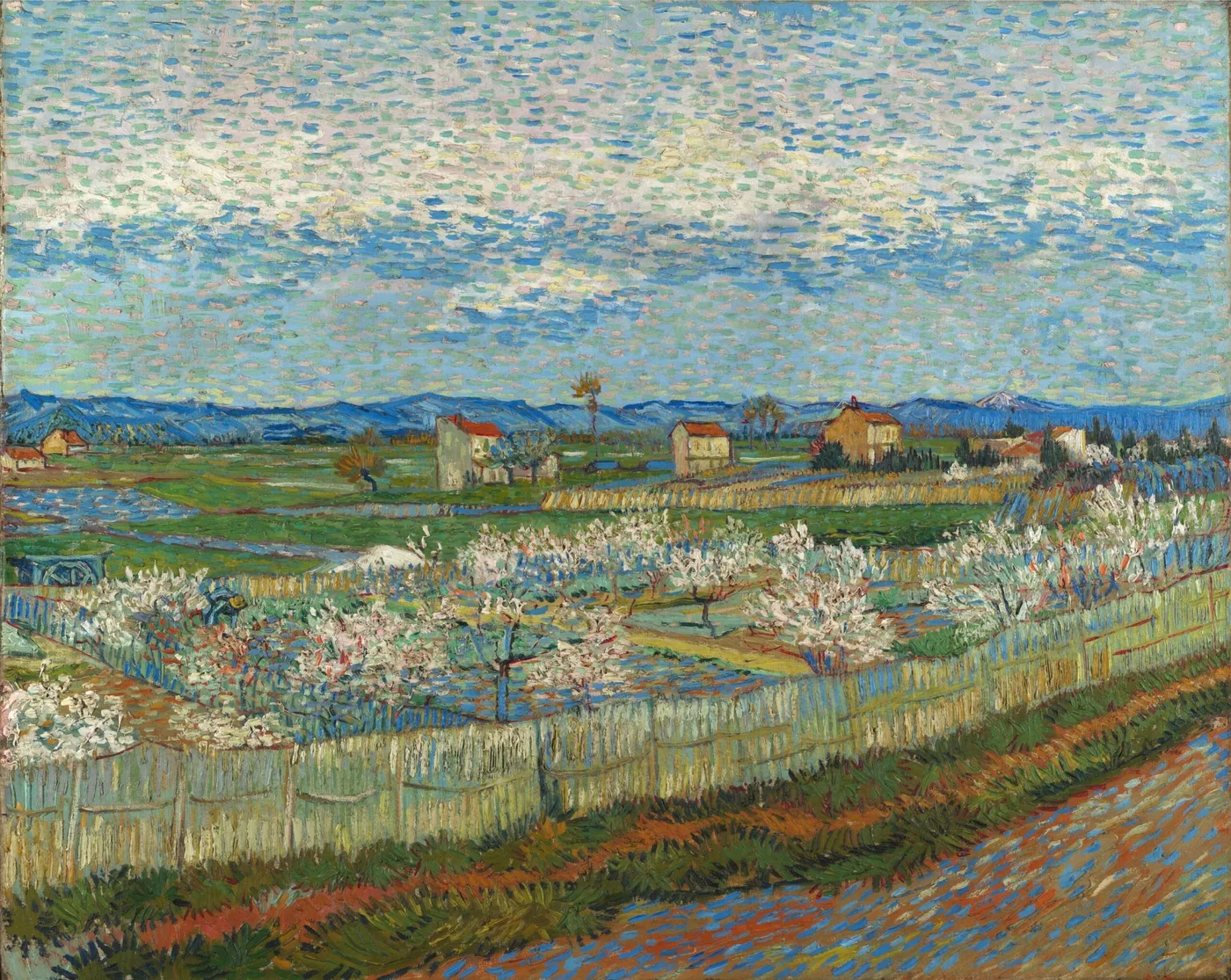
By the spring of 1889 Vincent van Gogh had spent the best part of a year watching the light of Provence do things he had never seen it do in the north. The orchards around Arles came into flower fast, in a matter of days, and he worked to keep pace with them. He knew the blossom would not last, so he painted quickly and painted often, moving from tree to tree and field to field while the pink and white was still on the branches.
Peach Trees in Blossom is one result of that urgency, though it reads differently from the tighter, close-up orchard studies he made in the same run of weeks. Instead of standing inside a single stand of trees, he pulled back to take in a whole stretch of the Arles countryside at once, from a fenced path in the foreground to a line of hills on the horizon. The blossoming peaches become one band in a much longer view.
A Landscape Built in Bands
The canvas is organised in clear, stacked zones, each one doing a different job. A track of ochre and blue-flecked earth runs along the bottom edge, met by a low wooden fence that zigzags across the width of the picture. Behind the fence, rows of peach trees carry their blossom in loose clusters of white and pale pink.
Beyond the orchard the land opens into flat green fields, dotted with farmhouses whose walls are the colour of dried straw and whose roofs are a warm, ruddy orange. A slender tree with a bare, dark trunk rises just off centre, tall enough to break the horizontal pull of the composition. Further back still, a low range of hills turns blue with distance before giving way to the sky.
That sky is not a backdrop. It takes up close to half the canvas, built from the same restless brushwork as the ground below it, so that the whole picture feels like a single continuous surface rather than a view with a horizon line dropped into it.
Weather Written in Paint
Van Gogh lays the sky in short, curling strokes of white, pale blue and grey that never quite settle into a single cloud shape. The paint moves the way weather moves, in drifts and swirls rather than outlines, so that the sky reads as active even though nothing in it is dramatic.
The same restlessness runs through the foreground path, where strokes of orange, blue and green are set close together rather than blended. Up close the road is almost abstract, a field of separate marks; from a normal viewing distance those marks resolve into rutted, sunlit earth.
Between these two zones of visible motion, the orchard itself is comparatively still. The blossom is built from shorter, more contained dabs, and it is this contrast, busy sky and busy road against a calmer middle band of trees, that gives the picture its particular rhythm.
Colour Under Pressure
Green carries most of the canvas: the fields, the fence posts, the grass along the path, all pitched in a range from cool blue-green to warmer olive. Against that green, the blossom reads as a scatter of interruptions, small notes of white and pink that catch the eye precisely because there is so little else in that key.
Blue does the work of tying the picture together. It appears in the sky, repeats in the distant hills, and turns up again as shadow within the orchard and as flecks in the road, so that no single passage of the painting sits in isolation from the rest. The orange-roofed farmhouses and the warm earth of the path answer that blue directly, giving the composition its one strong complementary contrast.
At 81.5 by 65.5 centimetres, Peach Trees in Blossom is large enough for these bands of colour to hold their own weight without the picture ever feeling like a small study. It has belonged to the Courtauld Gallery, whose holdings include some of the strongest Van Goghs outside the Netherlands and France, and the record for the work can be found through Wikidata.
In a Room, As the Light Turns
A landscape built this openly, with such a deep horizon and so much sky, behaves differently depending on where it hangs. In a room with morning light, the blues and greens tend to come forward, cool and slightly damp in feeling, as though the orchard has just been rained on. Later in the day, warmer artificial light draws out the orange in the roofs and the road, and the picture tips toward late afternoon in tone.
What stays constant is the sense of distance. The eye enters at the fence, is walked back through the blossom, and is released into the fields and hills beyond, a passage that a smaller or more enclosed composition could not offer. That is the particular gift of this picture on a wall: it does not just show a spring afternoon near Arles, it gives a room somewhere to look toward.
Sizes and materials for Peach Trees in Blossom are listed on its product page.
More from this collection
Bring this painting home
Choose a hand-painted oil reproduction for real brushwork, or an archival canvas print for a crisp museum-image edition. Every size preserves the original proportions.
View this work & options
Further reading
Verify the original in the Courtauld Gallery collection record and continue through related works in the catalogue.