
Flowering Orchard Surrounded by Cypresses: Story
Arles in the Spring of 1888
Vincent van Gogh had reached Arles in February of that year, worn down by two years in Paris and hungry for a light he associated with Japanese prints. Within weeks the town delivered something he had not expected: an explosion of blossom across the orchards outside its walls, arriving fast and lasting only days before the mistral or a hard rain stripped the branches bare.
He worked against that clock. Between late March and the end of April 1888 he painted roughly a dozen orchard scenes, moving from tree to tree and orchard to orchard as each came into flower, trying to fix a season he knew would not hold still for him.
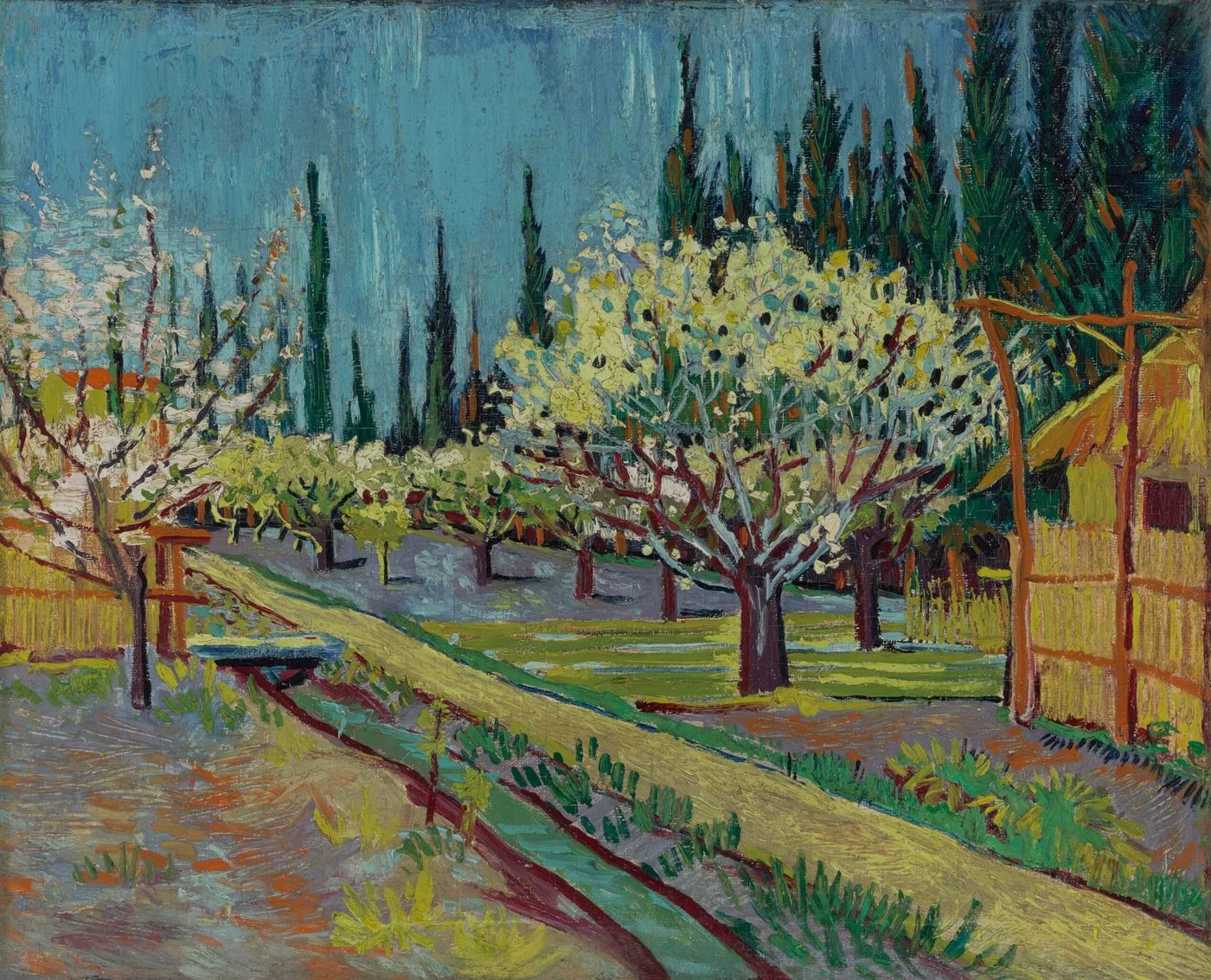
Flowering orchard, surrounded by cypress, painted that same spring, belongs to this run of pictures. It is a modest canvas, just 40 by 32.5 centimetres, made to be carried out and finished on the spot rather than built up slowly in a studio.
A Path Between Blossom and Shadow
A rutted track, orange and violet in the shadow of its own furrows, cuts diagonally across the lower half of the canvas and pulls the eye straight into the orchard. Beside it runs a narrow irrigation channel, the kind used throughout the Arles countryside to water fruit trees through the dry months.
Fruit trees line the path on both sides, their blossom rendered in dense clusters of white touched with cream and the faintest pink. Slim reddish-brown trunks hold the flowering crowns above a floor of green and violet-grey grass, and a low reed fence, the same cane construction used on farms across Provence, runs along the right edge past a small outbuilding with an ochre roof.
Behind the orchard a screen of cypresses closes the middle distance, their dark green spires breaking the horizon in an uneven row. Above them the sky is a flat, slightly chalky blue-green, brushed in long unbroken strokes that leave the canvas weave visible in places.
Colour Laid Fast, Before the Flowers Fell
Van Gogh built the blossom out of short, loaded touches of white and pale yellow, dabbed rather than blended, so that each cluster of flowers keeps its own separate mark. Looked at closely the trees dissolve into individual strokes; stood back from, they reassemble into the density of a tree in full flower.
The trunks and branches are drawn in a darker, more fluid line, reddish-brown against the white, giving the trees a wiry structure under all that bloom. This contrast between quick, dabbed colour for the flowers and firmer drawn line for the wood recurs across the whole orchard series and is one of the clearest signs of how fast he was working.
The cypresses are handled altogether differently, in tighter, more upright strokes of near-black green that read almost as a solid wall from a distance. Where the blossom is broken and light, the cypresses are dense and unbroken, and the picture holds its balance in that difference.
Cypress as Counterweight
Van Gogh had already begun to think of the cypress as a tree apart, one he would return to again and again through his time in the south. Here it does not yet carry the weight it would in his later paintings, but it is already doing a particular job: holding the composition still against the movement of the blossom.
Blossom is the shortest-lived thing in a landscape, gone within a fortnight of opening. Cypress is nearly the opposite, a tree that keeps its colour and shape through every season and every year. Setting one against the other, fast bloom in front of a fixed dark hedge, gives the orchard a kind of built-in tension between what is passing and what stays.
The result is less a record of a single afternoon than a small argument about time, made in paint rather than words. It is easy to miss on a first look and hard to unsee once noticed.
On a Wall, Through the Day
The painting is small enough to sit close to eye level in an ordinary room, which changes how it reads. At that scale the orchard is not a view to stand back from but something nearer a window, low and framed, that a person passes several times a day.
Morning light picks out the white of the blossom and the raw orange of the track; by evening the same canvas settles into its cypresses and the blue-green of the sky, the darker half of the picture coming forward as the room dims. Few paintings shift that much with nothing more than the change in daylight across a room.
The original hangs today at the Yale University Art Gallery, one small canvas among the fourteen or so orchards Van Gogh painted that spring before the blossom fell and the season moved on without him.
Sizes and materials for Flowering orchard, surrounded by cypress are listed on its product page.
More from this collection
Bring this painting home
Choose a hand-painted oil reproduction for real brushwork, or an archival canvas print for a crisp museum-image edition. Every size preserves the original proportions.
View this work & options
Further reading
Verify the original in the Yale University Art Gallery collection record and continue through related works in the catalogue.