
The White Orchard: Story, Meaning & Brushwork
Arles, and a race against the blossom
Vincent van Gogh arrived in Arles in February 1888, worn down by two years in Paris and hungry for a light he had so far only seen filtered through Japanese woodblock prints pinned to his studio wall. The town gave it to him within weeks. By the start of April the orchards on its outskirts had broken into flower, and he understood at once that the display would not last.
He worked through that spring at a pace he rarely managed elsewhere, moving from orchard to orchard while the blossom held, sometimes carrying a canvas out at dawn and bringing it back finished by afternoon. Over a dozen orchard paintings survive from those few weeks, each one a slightly different wager against the weather.
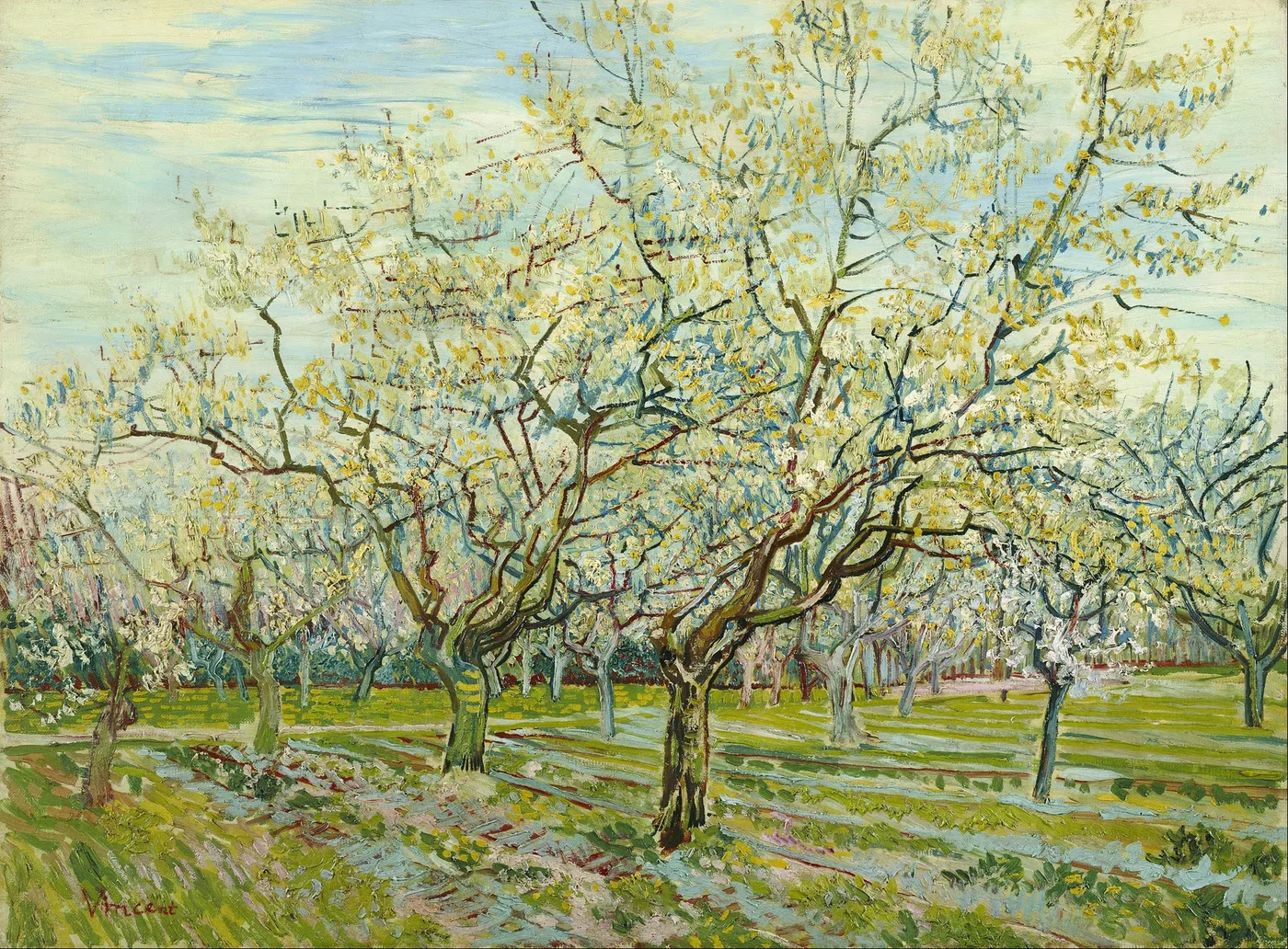
The white orchard, painted in 1888 and measuring 60 by 81 centimetres, belongs to that sequence. It is one of the plainer, quieter pictures in the group, built almost entirely from trees so laden with white flower that their branches seem to dissolve into the sky behind them.
A field of dark trunks and pale flower
The orchard fills the canvas edge to edge. A stand of fruit trees, their trunks gnarled and dark against everything around them, crosses the picture at odd angles, none of them upright, none of them quite matching another.
One trunk leans hard into the foreground just left of centre, thick and twisted at the base, and it is this tree the eye settles on first before it travels up into the tangle of branches above. Behind it the orchard recedes in loose rows, trunk after trunk repeating into a soft distance where individual trees stop being readable as trees at all.
Blossom covers the upper two thirds of the canvas in a pale, broken mass, white flecked with the faintest yellow-green where new leaf is starting to show through the flower. Above it the sky is a cool, washed blue, streaked with loose horizontal cloud that keeps the light even rather than dramatic.
Below, the ground is built from parallel strokes of green and ochre, the furrows of the cultivated orchard floor catching long strips of shadow thrown by the trees. Van Gogh signed the canvas simply “Vincent” in red at the lower left, low enough that it sits almost among the grass.
Paint handled at speed
The brushwork carries the urgency of the season it records. Blossom is built from short, flicked touches of white and pale colour, dabbed rather than blended, so that up close the flowers barely resolve into shapes and only settle into bloom at a normal viewing distance.
The trunks and branches are drawn rather than painted, dark lines dragged across the lighter ground beneath in a manner that owes an obvious debt to the woodblock prints Van Gogh collected and copied. That contrast of hard black line against soft, dabbed colour is what holds the whole picture together.
The grass and furrowed earth are laid in with longer, directional strokes, the paint often thin enough to let the weave of the canvas show through, a sign of how quickly each layer went down. Nothing here is worked over. The picture reads as something painted once, fast, while the light and the flower were still there to paint.
On a wall, through the day
Hung where daylight reaches it, this is a picture that keeps changing. Morning light picks out the cool blue of the sky and the white of the blossom; by evening, the same canvas warms toward the ochre in the ground and the red-brown of the trunks, and the whole orchard tips slightly toward autumn even though nothing in it has moved.
It sits well in a room that already leans toward green, where the wall colour extends the picture rather than fighting it, and it rewards being looked at both from across a room, where the orchard reads whole, and up close, where it breaks back down into the marks that built it.
The original is held by the Van Gogh Museum in Amsterdam, one of a group of orchard pictures from that same Arles spring now scattered across different collections. Seen on its own, away from the others, The white orchard makes its case quietly: a study of a season that lasted a few weeks, painted by a man who knew exactly how little time he had.
Sizes and materials for The white orchard are listed on its product page.
More from this collection
Bring this painting home
Choose a hand-painted oil reproduction for real brushwork, or an archival canvas print for a crisp museum-image edition. Every size preserves the original proportions.
View this work & options
Further reading
Verify the original in the Van Gogh Museum collection record and continue through related works in the catalogue.