
Wild Roses: Story, Meaning & Brushwork
A Painter Confined to a Garden
In May 1889 Vincent van Gogh committed himself to the asylum of Saint-Paul-de-Mausole, on the edge of Saint-Rémy-de-Provence. He had left Arles after the breakdown that cost him part of an ear, and for much of that first summer he was not permitted to paint beyond the asylum’s walls.
The walled garden became his subject by necessity as much as choice. Irises, ivy, cypresses and the flowering shrubs along its paths turn up again and again in the canvases of that year, painted from close range because there was little else within reach.
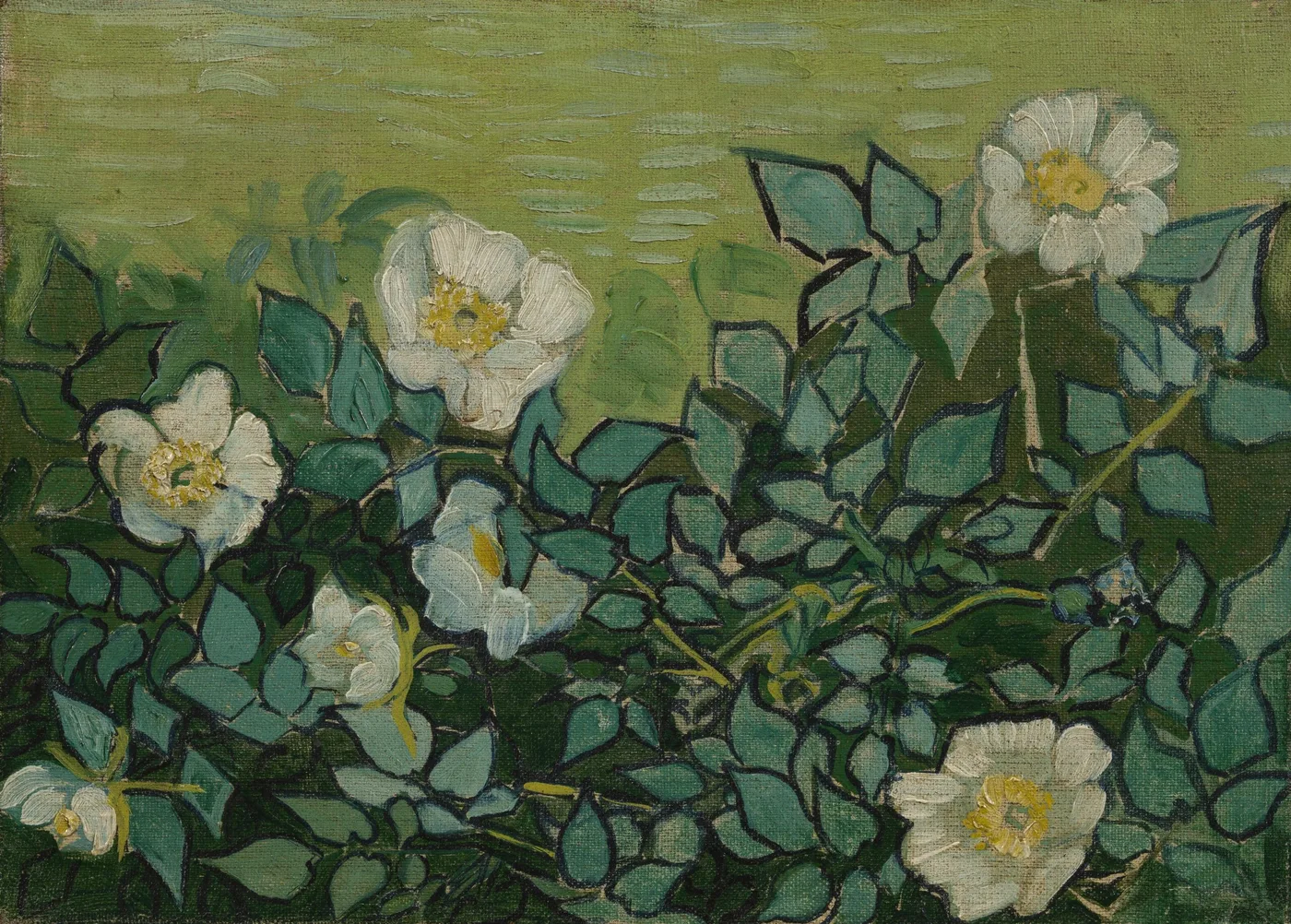
Wild Roses, painted in 1889 and now held by the Van Gogh Museum, belongs to that group of close-up studies. At 33 by 24.5 centimetres it is a small canvas, scaled to a single patch of hedge rather than a view.
No Horizon, Only Hedge
There is no sky in this picture, no path, no wall to place it in a garden at all. The canvas is filled edge to edge with a tangle of rose branches, so that the eye has nowhere to rest except on the flowers themselves.
Seven blooms open across the surface, pale and full-faced, with a few smaller buds still closed among the leaves. They are not arranged in a bouquet or a vase; they sit where the branches happened to carry them, low in the frame and pressed close to the picture plane.
The effect is of a hedge that keeps going past the edges of the canvas. Van Gogh has cropped so tightly that the wild rose bush reads less as a described object than as a fragment lifted straight out of the garden.
White Against a Field of Green
Each rose is built from a handful of loaded white strokes around a small gold centre, the petals catching light that seems to come from everywhere and nowhere in particular. Against the surrounding green they read as bright, slightly irregular stars.
Behind the hedge, the background is not sky or wall but a flat field of yellow-green, brushed in short horizontal touches with no attempt at depth or distance. It sits close behind the leaves, more like woven cloth than open air.
The leaves themselves run from pale blue-green to a near-black green in the shadowed lower half of the canvas, where the hedge grows dense and the paint thickens. White, yellow and green are really the whole of the palette, pushed hard against one another rather than blended.
Outlines Borrowed from Glass and Print
What separates this canvas from a straightforward flower study is the drawing. Every leaf is closed off with a dark, continuous contour, laid down almost like the leading in stained glass or the black key-line of a woodblock print.
Van Gogh had studied this kind of outline in Émile Bernard’s and Louis Anquetin’s cloisonnist paintings and in the Japanese prints he collected in Paris, and by 1889 it had become one of his own working methods for dense, leafy subjects. The line does not describe every vein or edge accurately; it simplifies the leaf into a flat shape and locks it in place.
Inside those outlines the brushwork stays loose and thick, laid on in short, directional strokes that catch the light unevenly across the surface. The result is a picture that behaves like a pattern at a distance and breaks into real paint the closer you look.
Living With Wild Roses
Hung in a room with changing daylight, this kind of surface keeps shifting. Morning light along the ridges of paint picks out the white of the petals and the raised contour lines; by evening the same canvas settles into a darker, more uniform mass of green.
It asks to be looked at more than once, from across a room and then close up, because the two views show almost different pictures: pattern first, then the evidence of a hand working quickly under real constraints.
The original Wild Roses remains in the collection of the Van Gogh Museum, one small record of a garden that a confined painter turned into nearly a year of steady work.
Sizes and materials for Wild Roses are listed on its product page.
More from this collection
Bring this painting home
Choose a hand-painted oil reproduction for real brushwork, or an archival canvas print for a crisp museum-image edition. Every size preserves the original proportions.
View this work & options
Further reading
Verify the original in the Van Gogh Museum collection record and continue through related works in the catalogue.