
View of the Sea at Scheveningen: Story & Meaning
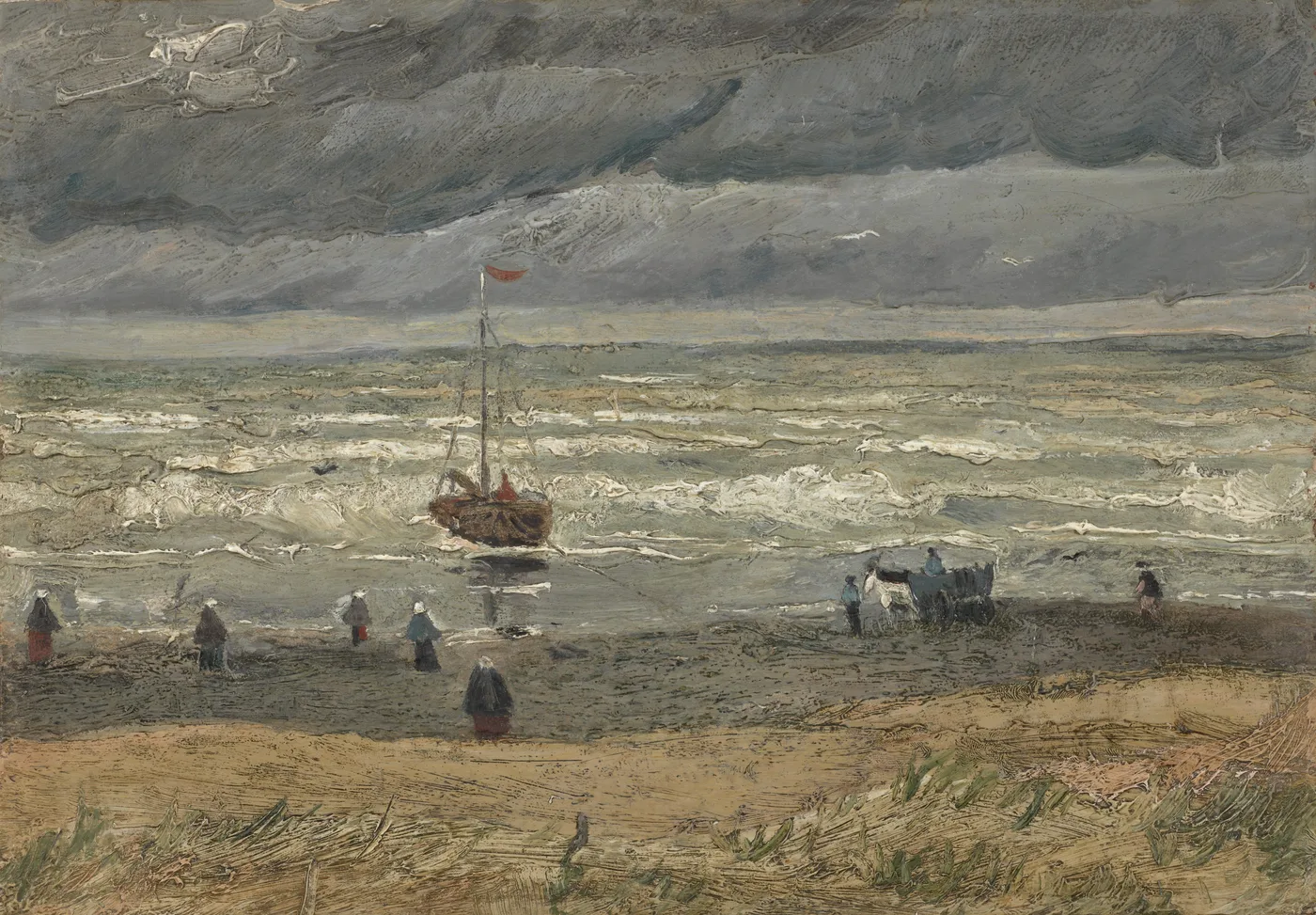
In the summer of 1882 Vincent van Gogh was living in The Hague, newly serious about painting and still finding his hand under the guidance of his cousin-in-law, the painter Anton Mauve. View of the Sea at Scheveningen belongs to that period. He had spent the previous years drawing labourers, weavers and the rural poor of Brabant, and oil paint, and colour itself, were still new tools to him.
That August he walked out to Scheveningen, the fishing village on the coast west of the city, in weather bad enough that most people would have turned back. He set up his easel on the beach anyway and painted the sea as it actually was that day: heaving, grey-green, and lit by a break in a heavy sky.
A Boat Held in the Swell
A single fishing boat, a flat-bottomed craft of the kind that worked this coast, sits low in the water at the centre of the canvas. Its mast carries a small red pennant, the one warm note of colour against an otherwise cold sea, and its dark hull is nearly swallowed by the waves rearing around it.
The water itself does the work of the picture. Ridges of white foam break across a sea painted in strokes of green, slate and grey, and the horizon sits low, so that sea and sky between them take up nearly the whole canvas.
Above, the sky is heavy with fast-moving cloud, dark at the top edge of the canvas and paling toward a band of light near the horizon, the kind of gap in bad weather that a coastal painter learns to watch for and use. It gives the picture its sense of a single held moment, not a generalised stormy day.
Figures Along the Tideline
Along the wet sand in the foreground, a handful of figures are scattered rather than posed: women in dark cloaks and pale caps walking the beach, a horse and cart drawn up near the water on the right, a single gull low over the sand. None of them is more than a few brushstrokes tall.
Their smallness is the point. Van Gogh sets them against a sea and sky that dwarf them, so the picture reads less as a scene of people at the shore and more as weather with figures caught inside it.
Sand Worked Into the Paint
Van Gogh painted this scene on the spot, in the open air, in a wind strong enough to blow grit off the dunes and onto the wet canvas. That sand is still there, worked into the paint itself, a physical record of the conditions he was working in rather than a flaw to be regretted.
The brushwork throughout is thick and fast. He built the waves and the sky with a loaded brush and, in places, a palette knife, laying paint on in short urgent strokes rather than blending it smooth, so the surface itself has the texture of disturbed water.
This was early work for him as a painter in oils, done at speed and under pressure from the weather rather than worked up carefully in a studio. The haste shows, and it is exactly what gives the picture its life.
A Narrow Range of Grey and Green
The palette is deliberately narrow. Grey, green, ochre and white carry almost the entire canvas, with the red flag on the mast and a touch of red in one figure’s skirt as the only real departures from that register.
That restraint suits the subject. A stormy coast is not a colourful place, and Van Gogh paints the sand, sea and sky as variations on a single cold key rather than reaching for incident or brightness that was not there.
Painted at 51.9 by 36.4 centimetres, the canvas is modest in size, closer to a study than a showpiece. That scale suits how it was made: quickly, outdoors, in response to conditions that were not going to hold.
On a Wall, Through Changing Light
Hung in a room, this is not a picture that settles into the background. The high-contrast sky and the churn of the water keep pulling the eye back to the centre, to that one small boat holding its position against the swell.
Morning light picks out the impasto in the waves and gives the foam real texture; evening light flattens the sky and lets the grey-green sea come forward. Either way, the picture keeps something of the outdoor, weather-beaten quality it was made with.
The original, painted in 1882, is held by the Stedelijk Museum Amsterdam. Seen at any scale, it remains one of the clearest early statements of the painter Van Gogh was becoming: quick, physical, and unwilling to soften what he saw.
Sizes and materials for View of the Sea at Scheveningen are listed on its product page.
More from this collection
Bring this painting home
Choose a hand-painted oil reproduction for real brushwork, or an archival canvas print for a crisp museum-image edition. Every size preserves the original proportions.
View this work & options
Further reading
Verify the original in the Stedelijk Museum Amsterdam collection record and continue through related works in the catalogue.