
Flowering Garden (Arles): Story, Meaning & Brushwork
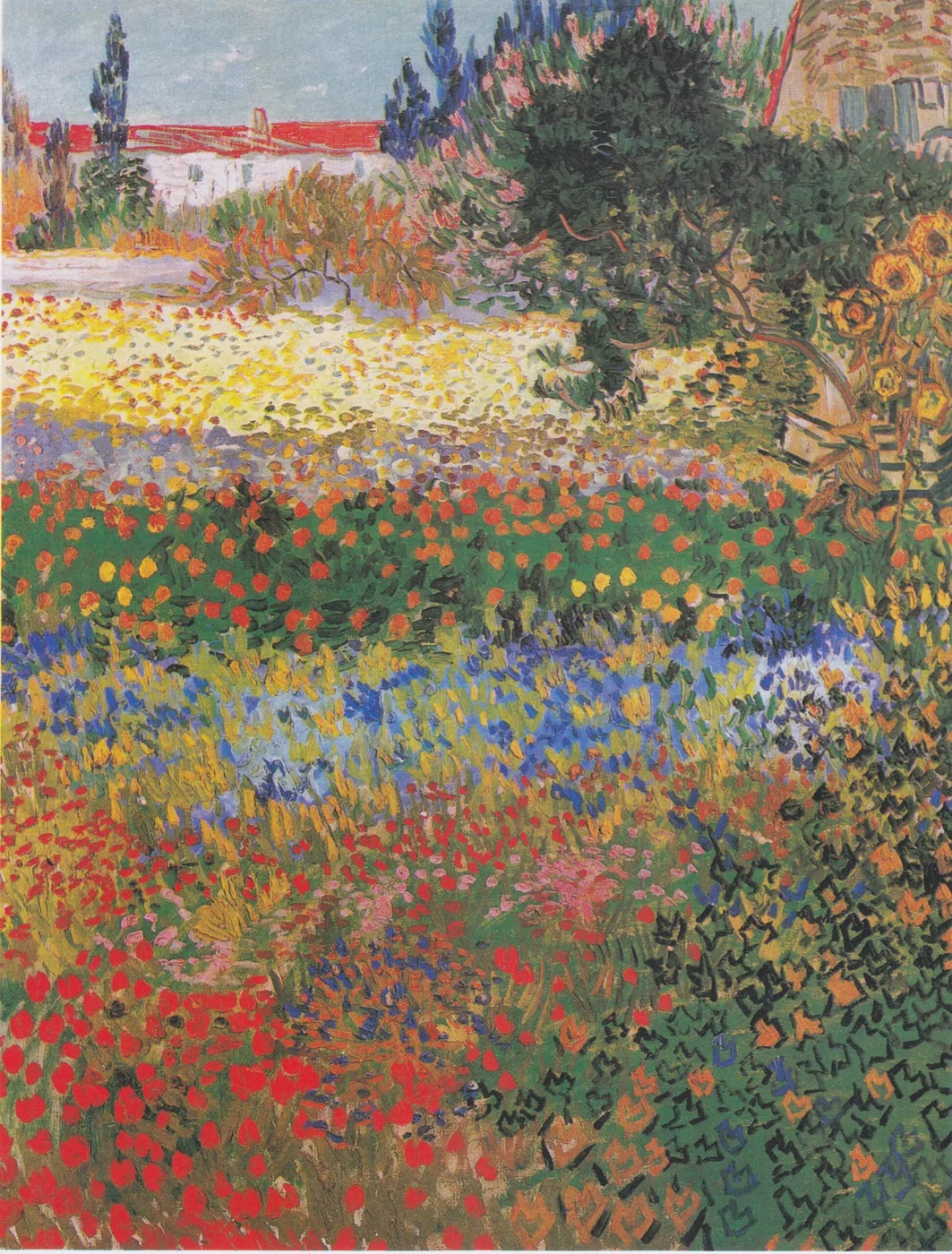
By the summer of 1888 Vincent van Gogh had been in Arles for several months, chasing a light he had not found in Paris. He had spent April and May painting the orchards outside town in blossom, working fast while the flowers lasted, and when the fruit trees finished he turned to the gardens closer to where he lodged. Flowering Garden belongs to that run of pictures, painted in 1888 as the town moved from spring into high summer.
He was not composing a view so much as recording what stood in front of him. These garden canvases were painted quickly, in the open air, with the beds and hedges as they actually grew rather than arranged for effect. The result is a picture that feels found rather than built.
A garden with no horizon
There is almost no sky in this painting. A thin pale strip of blue shows at the top left, above rooftops, and everything below it, nearly the whole canvas, is garden. The effect is of standing close to a hedge and looking straight into it rather than across a landscape.
The flowers are laid out in bands rather than a single bed. Red poppies and scattered blooms fill the lower third, a line of blue flowers crosses the middle distance, and above that a broad drift of small cream and pale yellow blossom catches the strongest light in the whole picture.
The eye tends to enter at the bottom, among the reds, and climb through the blue band into the pale glow behind it before reaching the darker green of the trees and the buildings at the top of the canvas. Nothing in the picture is empty; every inch carries paint.
Colour laid against colour
Van Gogh builds the picture on contrasts he had been studying since his years in Paris: red against green, blue against orange. The poppies sit inside grass and leaf greens that make them ring out, and the band of blue flowers is set directly against warm orange-toned stems and earth.
The paint is handled in short, separate strokes, dabs and dashes rather than blended passages. In the dark green mass at the lower right the marks tighten into small hooked strokes, almost a shorthand for foliage, while the pale blossom band above is built from looser, softer touches.
Seen close to, the surface breaks into distinct marks of raw colour that barely describe individual flowers. Stood back from, those same marks settle into a garden thick with bloom, the way the eye does when looking at a real bed of mixed flowers from a few paces off.
The house behind the hedge
Beyond the flowers, low buildings anchor the scene: a red-tiled roof over a white wall to the left, and a paler house with a shuttered window at the top right, half hidden behind a dark, heavily worked tree. A line of tall, slim cypress-like trees stands along the left edge, dark against the sky.
At the right, tall sunflowers rise on their stems close to the house wall, their heads turned toward the light. They are a minor detail in this canvas, but they point to the sunflower paintings Van Gogh was about to begin that same summer in Arles.
The buildings give the garden its scale and its ordinariness. This is not an ornamental park but a planted plot behind houses, the kind of ground a household might have kept for cutting flowers and growing what it could.
On a wall, through the day
The original canvas measures 73 by 92 centimetres, a size built for density rather than distance; it rewards standing close enough to see the individual strokes and stepping back to watch them resolve into flowers. The painting is recorded in the Collection of Max Emden.
Hung where daylight reaches it, the picture changes hour by hour. Morning light favours the pale blossom band and the sky fragment at the top; a warmer, lower light in the evening pulls the reds and oranges of the poppies and the roof tiles forward, and the blues sink back into shadow.
That shifting balance is part of what keeps the picture alive on a wall rather than settled. It was painted outdoors, in changing light, over however many sittings the weather allowed, and it still seems to hold a little of that instability, a garden caught rather than fixed.
Sizes and materials for Flowering Garden (Arles) are listed on its product page.
More from this collection
Bring this painting home
Choose a hand-painted oil reproduction for real brushwork, or an archival canvas print for a crisp museum-image edition. Every size preserves the original proportions.
View this work & options
Further reading
Verify the original in the Collection of Max Emden collection record and continue through related works in the catalogue.