
Portrait of Trabuc: Story, Meaning & Brushwork
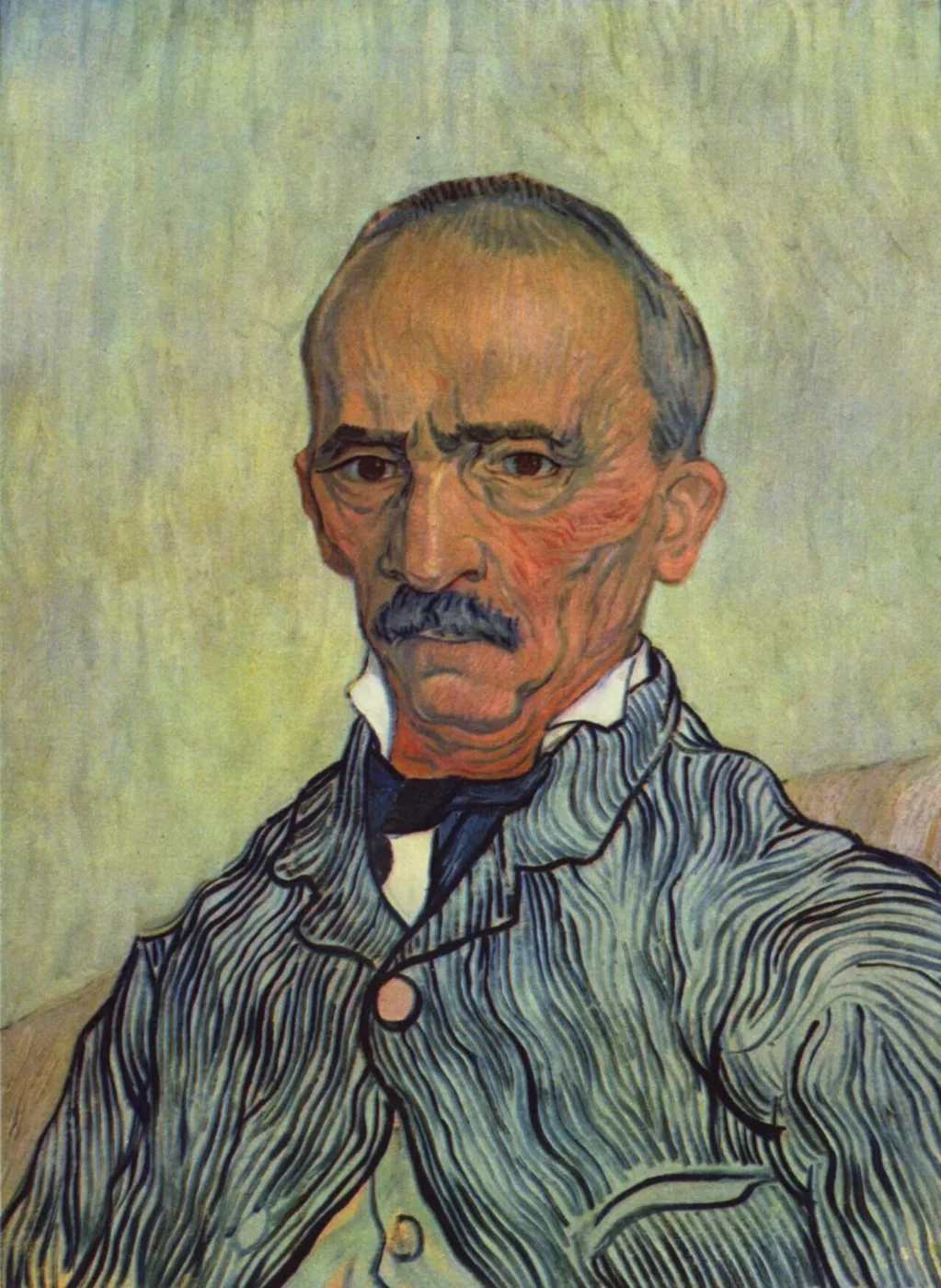
Confinement and Concentration at Saint-Paul
By May 1889 Vincent van Gogh had admitted himself to the asylum of Saint-Paul-de-Mausole, on the edge of Saint-Rémy-de-Provence. He had asked to go there after the crisis in Arles, and he arrived with almost no illusions about what the place could offer beyond quiet and a locked door between himself and the world.
The regime was spare. Van Gogh was given two rooms, one to sleep in and one to paint in, and for long stretches the asylum grounds, the view from his barred window and the handful of people around him were the only subjects at hand.
Portraits were rare in this period precisely because sitters were rare. Patients did not want to be looked at, and the staff had work to do. When the head attendant agreed to sit, van Gogh treated it as an opportunity not to be wasted.
The Superintendent Trabuc
Charles-Elzéard Trabuc ran the daily life of the ward as its superintendent, the man responsible for order, medication and the countless small frictions of an institution holding people who had not chosen to be there. He had spent years doing this work by 1889.
Van Gogh wrote of him as someone who had witnessed a great deal of suffering and death at close range, and that sense of accumulated exposure is the whole subject of the portrait. This is not a study of an interesting stranger but of a man the painter had watched, day after day, doing a hard job without flinching from it.
The picture carries its full original title for a reason: Portrait of the superintendent Trabuc in the Hospital Saint-Paul. It is not a generic head. It names an institution, a role and a specific man, and it was painted, in 1889, inside the walls it describes.
A Face Built in Firm Strokes
Trabuc’s head dominates the canvas, bald at the crown with grey-dark hair combed flat at the temples. The brow is deeply lined and drawn together, and the eyes, set slightly unevenly, hold the viewer with a fixed, appraising directness that never softens into warmth.
The skin is not painted as a single flesh tone but as a weathered surface: ruddy across the cheeks and nose, mottled with broken red veining, paler at the temple and jaw. It is a face read as work rather than as likeness for its own sake.
A heavy grey moustache covers the upper lip and sits above a mouth held firm and closed. Van Gogh modelled all of this in short, deliberate strokes and a restrained palette, none of the loose flourish he allowed himself elsewhere, as though the sitter’s own steadiness demanded a steadier hand.
The ears, reddened at their edges, and the slightly asymmetrical set of the eyes keep the face from any hint of idealisation. This is a specific, ageing, unglamorous man, painted as exactly that.
Stripes Against a Rippling Field
Below the face, Trabuc’s jacket is built from long, undulating lines in blue-black over a blue-grey ground, a striped fabric turned into something closer to a current of water or wind-bent grass. A single button and the edge of a breast pocket anchor the pattern.
A white collar and dark cravat break the movement of the jacket and frame the throat, giving the eye a plain, still point before it climbs back to the face. The formality of the collar sits oddly, and effectively, against the roughness of the man wearing it.
The background repeats the trick in a different key: pale green-yellow, worked in vertical, faintly striated brushstrokes that echo the ripples of the jacket without competing with them. Figure and setting are painted with the same hand and the same rhythm, so the whole surface feels of a piece even though nothing in it is decorative for its own sake.
At 46 by 61 centimetres, the canvas is modest in scale, closer to the size of a single sheet of paper doubled over than to a grand institutional portrait. That size keeps the encounter intimate. There is no room in it for anything but the man.
On a Wall, in Shifting Light
The original is held today by the Kunstmuseum Solothurn, in Switzerland, one stop in a life this small canvas has had well beyond the asylum room where it was painted. A reproduction of it carries that same compact intensity into an ordinary room.
Hung where morning light reaches it, the greens of the background lighten and the striped jacket seems to loosen, almost to breathe. Under evening light or a warmer bulb, the reds in Trabuc’s face deepen and the whole picture pulls inward, the gaze becoming harder to hold.
It rewards a spot where someone will actually stand close enough to see the strokes rather than just the shape of a face from across a room. Trabuc was not painted to be glanced at. He was painted by someone who had looked at him for a long time, and the portrait asks the same of whoever looks back.
Sizes and materials for Portrait of Trabuc, Attendant at Saint-Paul Hospital are listed on its product page.
More from this collection
Bring this painting home
Choose a hand-painted oil reproduction for real brushwork, or an archival canvas print for a crisp museum-image edition. Every size preserves the original proportions.
View this work & options
Further reading
Verify the original in the Kunstmuseum Solothurn collection record and continue through related works in the catalogue.