
Still Life with Brass Cauldron and Jug: Story
Nuenen, Winter Into Spring
In the early months of 1885, Vincent van Gogh was living with his parents in the parsonage at Nuenen, in the Dutch province of North Brabant, working through a long, deliberate apprenticeship in tone and weight. He was not yet the painter of sunflowers and swirling skies. He was a man teaching himself, object by object, how a surface catches and holds light.
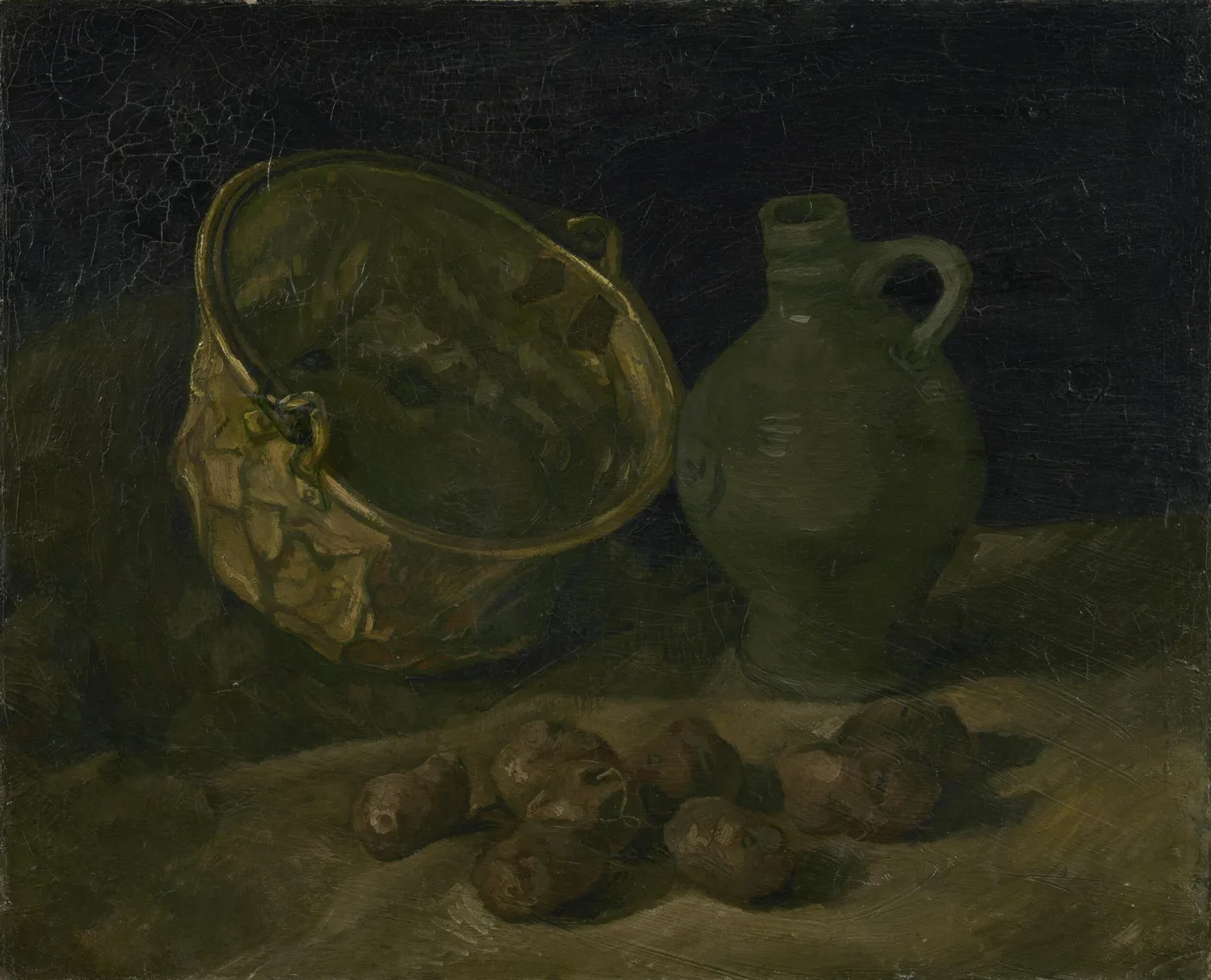
The kitchens and cottages of Nuenen gave him his subjects that winter: peasants at table, weavers at their looms, and the plain vessels that furnished a working household. Still Life with Brass Cauldron and Jug, painted in 1885, belongs to a run of pictures from this period in which he set a handful of humble objects on a table and worked at them until the paint itself carried their weight.
These were not decorative exercises. Van Gogh treated the kitchen still life as a discipline, a way of training his eye and hand before he trusted himself with the human figure. Cauldrons, pots, jugs and baskets of potatoes recur across the Nuenen pictures, rearranged and repainted as he searched for the right balance of tone.
A Cauldron Tipped on Its Side
At the centre of the canvas a brass cauldron lies tipped on its side, its two curved handles hanging loose, its dented body catching what little light reaches the table. Beside it stands a dark, glazed earthenware jug, narrow necked and round bellied, with a single looping handle. In front of both, a loose scatter of potatoes spills across the cloth, their skins painted in the same brown-black register as the shadows around them.
The composition is built on contrast of surface rather than colour. Brass answers cloth, cloth answers pottery, and every object sits close to the picture plane, pressed against a background so dark it reads almost as void. There is no window, no wall, no hint of the room beyond the table.
Light enters from the upper left and lands hardest on the rim and belly of the cauldron, where van Gogh has dragged pale ochre and warm gold across the dented metal. Everywhere else, in the jug, the cloth, the potatoes, the tone drops into greens, browns and near-blacks, so that the brass becomes the one passage the eye can rest on.
The dimensions are modest, 80.5 by 65.5 centimetres, close enough that the objects sit at something near life size. That scale matters: this is a table a viewer could believe they are standing at, not a stage set arranged for effect.
Paint Laid Thick and Dark
Van Gogh’s brushwork here is heavier and more searching than it would become later in his career, but habits that would define his mature style are already visible. He builds the cauldron’s surface from short, loaded strokes that follow the curve of the metal, letting ridges of paint stand up from the canvas to catch actual light in the room, not just painted light.
The jug is handled more smoothly, the paint thinned and blended so that its rounded body reads as solid and heavy, a counterweight to the cauldron’s battered energy. The potatoes are barely more than dabs, laid down fast, their forms held together by shadow rather than outline.
Colour throughout is drawn from a narrow, earthbound range: bitumen brown, bottle green, dull ochre, black. This was the palette Van Gogh associated at the time with the dignity of peasant labour, the same range he used that year for The Potato Eaters. Nothing here is bright by accident; the restraint is the point.
The dark ground is not empty space so much as pressure. It closes in around the objects and pushes them forward, so that the brass rim and the pale flesh of the potatoes seem to glow rather than simply reflect light.
On a Wall, After Dark
Hang this still life somewhere the light changes over the course of a day and it behaves differently by the hour. In direct light, the gold of the cauldron’s rim asserts itself and the picture reads almost as a study in one colour. In dim light, that same gold recedes, and the painting becomes a study in near-black, the cauldron and jug barely separating themselves from the ground behind them.
That responsiveness to low light is not a flaw of a dark, early canvas. It is close to how Van Gogh would have seen the objects himself, by lamp or by the grey daylight of a Brabant winter. A room that dims in the evening suits this painting rather than working against it.
The original hangs today in the Van Gogh Museum, which holds one of the deepest collections of the artist’s Nuenen years and lets this modest kitchen scene be read alongside the works that immediately preceded and followed it. Seen there, or in reproduction, it rewards close, patient looking rather than a glance.
What stays with a viewer is not narrative, there is none, but the sense of a young painter working out how far tone alone could carry a picture. Years before Van Gogh’s colour would light up entire canvases, he was already choosing his fights carefully, one dented brass cauldron at a time.
Sizes and materials for Still Life with Brass Cauldron and Jug are listed on its product page.
More from this collection
Bring this painting home
Choose a hand-painted oil reproduction for real brushwork, or an archival canvas print for a crisp museum-image edition. Every size preserves the original proportions.
View this work & options
Further reading
Verify the original in the Van Gogh Museum collection record and continue through related works in the catalogue.