
Skull of a Skeleton with Burning Cigarette: Story
In 1884 Vincent van Gogh was living at his parents’ parsonage in Nuenen, working his way through the human figure with a discipline he had given himself no teacher to enforce. He had committed fully to painting only a few years earlier, and the pictures from this stretch of his Dutch period share a common ground: heavy, earthen colour, weavers and peasants caught in low light, and a restless habit of drawing bones, hands and skulls to understand what sat beneath the skin he was trying to paint.
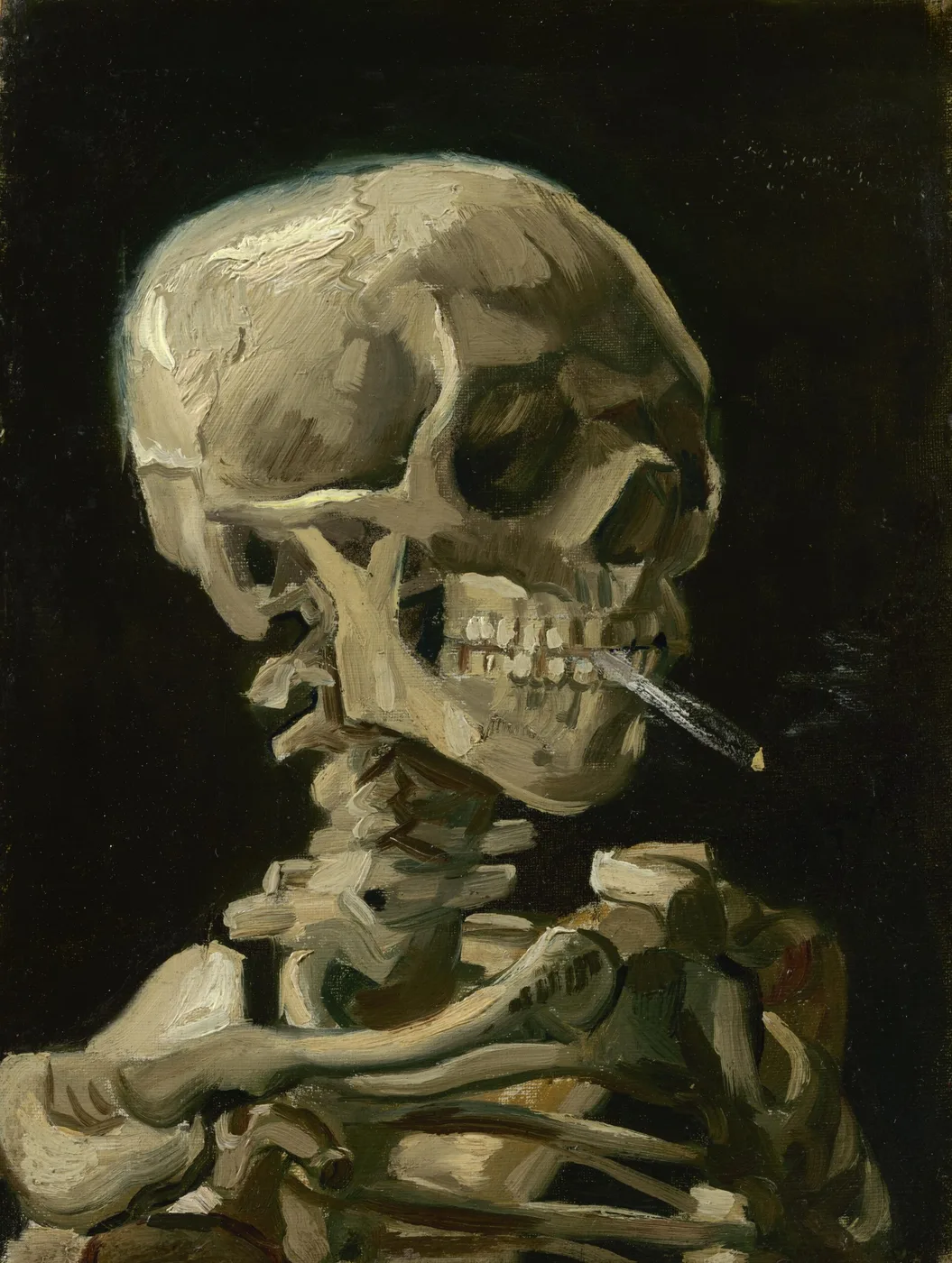
Among those studies is this small, quick oil sketch of a skull with a lit cigarette clenched between its teeth. It is not a grand statement. It reads more like something dashed off in an evening, half exercise and half joke, and that is exactly what gives it its bite.
A Skull Caught Mid-Turn
The skull sits close to the picture plane, turned to a three-quarter angle and tipped slightly forward, so the eye meets the deep hollows of the eye sockets before anything else. Below them the jaw drops open just enough to let the cigarette rest between the teeth, and the first few vertebrae and a stretch of collarbone appear at the bottom edge, loosely blocked in rather than fully resolved.
Light falls from the upper left, catching the crown of the skull and the ridge of the brow in warm bone-white, then sliding away fast across the cheek and jaw into shadow. The rest of the head and the whole background disappear into a near-black ground, so the skull seems to surface out of the dark rather than sit in front of it.
A Lit Cigarette in a Dead Man’s Teeth
The cigarette itself is painted with a few economical strokes, a pale shaft angled down and out from the jaw, its tip touched with a small flick of orange and a whisper of grey smoke. It is the one bright, warm note in an otherwise cold, bony picture, and it is impossible to look at the skull for long without your eye being pulled back to it.
Skulls in European painting had carried a moral weight for centuries, reminders that flesh is temporary and vanity is foolish. Van Gogh’s skull does not moralise. Giving a jawless, eyeless head a cigarette to smoke turns the old memento mori into something closer to a private joke, death carrying on with its bad habits regardless.
Bone, Shadow and a Few Loaded Colours
The palette is narrow and deliberately so: bone whites and warm ochres for the skull, greenish greys where the shadow pools in the sockets and along the jaw, and a black ground that swallows almost half the canvas. It is the same dark, earth-bound colour sense running through Van Gogh’s other Nuenen work, applied here to a stranger subject.
The paint handling is fast rather than smooth. Individual brushstrokes stay visible across the dome of the skull, ridges of paint catching the light where the brush changed direction, and the collarbone and vertebrae at the base are little more than a few confident, unblended marks standing in for anatomy the artist clearly already understood.
Nothing here is laboured over. The picture has the pace of someone testing an idea quickly, in oil, before it could get away from him.
A Small Canvas, 24.5 by 32 Centimetres
The original measures just 24.5 by 32 centimetres, close in scale to a sheet of writing paper. At that size the skull all but fills the frame, cropped close enough that there is nowhere for the eye to rest except on the bone and the small burning point of the cigarette.
That tight framing is doing real work. A larger canvas would have given the skeleton room to become a figure in a setting; this one refuses that, pressing the subject right up against the viewer so the joke and the darkness both land at close range.
What It Does on a Wall
Hung in a room with low or shifting light, the black ground behaves almost like a void, and the skull seems to hang there on its own rather than sit inside a painted rectangle. Under stronger, more direct light, the individual brushstrokes across the bone become legible, and the picture turns from a silhouette into a study of how paint was actually laid down.
It is not a picture that asks to be looked at once and filed away. The dry humour of a smoking skull tends to catch first-time viewers off guard, and it rewards a second, closer look at how economically Van Gogh built a whole head out of a handful of tones.
The original is held by the Van Gogh Museum in Amsterdam, one of the more unexpected pictures from an artist still finding his own hand, using an old subject to make a joke nobody had quite told that way before.
Sizes and materials for Skull of a Skeleton with Burning Cigarette are listed on its product page.
More from this collection
Bring this painting home
Choose a hand-painted oil reproduction for real brushwork, or an archival canvas print for a crisp museum-image edition. Every size preserves the original proportions.
View this work & options
Further reading
Verify the original in the Van Gogh Museum collection record and continue through related works in the catalogue.