
Orchard in Blossom: Story, Meaning & Brushwork
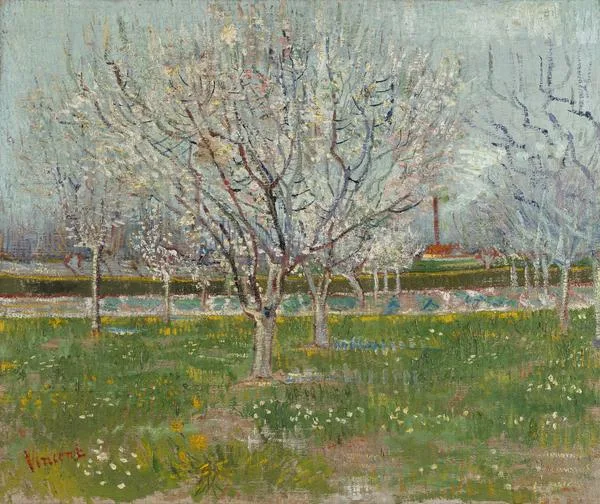
Vincent van Gogh reached Arles in February 1888, worn down by two grey Paris years and hungry for colour. Within weeks the orchards around the town broke into flower, and he threw himself at the sight with something close to urgency. He knew the blossom would not last, so he worked fast, moving from tree to tree and canvas to canvas before the wind or the rain finished what the season had started.
Orchard in Blossom, painted in 1888, belongs to that short, driven campaign. The canvas measures 65.2 by 54 centimetres, a size he could carry out to the orchards and back in a single sitting, and it now hangs in the collection of National Galleries Scotland.
A Sky Held Low and Grey
The sky here is not the high cobalt blue of Van Gogh’s later Provence pictures. It sits pale and close, brushed in short grey-green strokes that press down on the orchard rather than opening above it, the kind of half-cleared spring weather that can turn either way by afternoon.
Against that flattened sky, a single tree takes the middle of the canvas, its trunk dark and slightly bowed, its bare branches forking upward in a tangle of thin black and violet lines. Clusters of white blossom catch on the branch ends, thickest at the crown, with a warmer note of pink showing where the light lands directly.
Behind and around it, further trees repeat the same rhythm at smaller scale, their trunks reduced to pale vertical marks that fade toward the edges of the picture. The grass beneath runs in strokes of green shot through with yellow and white, the first wildflowers of the orchard floor.
A Factory Chimney Behind the Trees
Look past the blossom and the picture admits something unexpected: a factory chimney rises on the right, a thin trail of smoke drifting from it, and a row of buildings with red-tiled roofs sits low along the horizon. Arles in 1888 was not an untouched idyll, and Van Gogh did not edit the town out of his spring.
A couple of small figures walk a path in the middle distance, barely more than a few strokes of colour each. They give the orchard a working scale, a place people crossed on their way somewhere else rather than a garden set aside for looking at.
That combination, blossom in front and industry behind, is quietly typical of how Van Gogh saw Arles: not as a picturesque retreat but as a real town he was determined to paint honestly, chimney and all.
Paint Laid Down at Speed
The brushwork changes character across the canvas. The sky is thin and dragged, the paint scraped almost to the weave of the canvas in places. The blossom, by contrast, sits in small loaded dabs, applied wet and left with their own texture, so the white catches real light off the surface of the paint itself.
The branches are drawn rather than filled, quick dark lines pulled in one motion, the kind of mark that comes from a hand moving faster than careful description would allow. Van Gogh signed the canvas “Vincent” in red at the lower left, the single name he used on the works he judged finished.
Nothing here is smoothed over or corrected into polish. The picture keeps the evidence of how quickly it was made, and that speed is part of what it is about: a painter trying to fix a fleeting thing before it changed.
What It Does on a Wall
Hung where morning light can reach it, the picture’s pale sky and white blossom pick up brightness quickly, the whole surface seeming to lift a shade. In the low light of evening, the same canvas settles into its greens and greys, the blossom still visible but quieter, closer to how the orchard would have looked at dusk.
It is a picture that rewards a second and third look rather than one glance. The chimney in the distance, the walking figures, the change from thin sky to thick blossom, none of these announce themselves immediately, and a room that lets you sit with the painting will keep giving them up.
For a quiet room, a bedroom or a reading corner, that slow unfolding suits the pace such spaces are meant to have. The orchard does not shout for attention; it waits to be noticed properly, much as Van Gogh himself waited two grey years for a spring like this one.
Sizes and materials for Orchard in Blossom are listed on its product page.
More from this collection
Bring this painting home
Choose a hand-painted oil reproduction for real brushwork, or an archival canvas print for a crisp museum-image edition. Every size preserves the original proportions.
View this work & options
Further reading
Verify the original in the National Galleries Scotland collection record and continue through related works in the catalogue.