
Skull (1887): Blue Outlines and Cracks in an Ochre Ground
A Paris Still Life, Painted in 1887
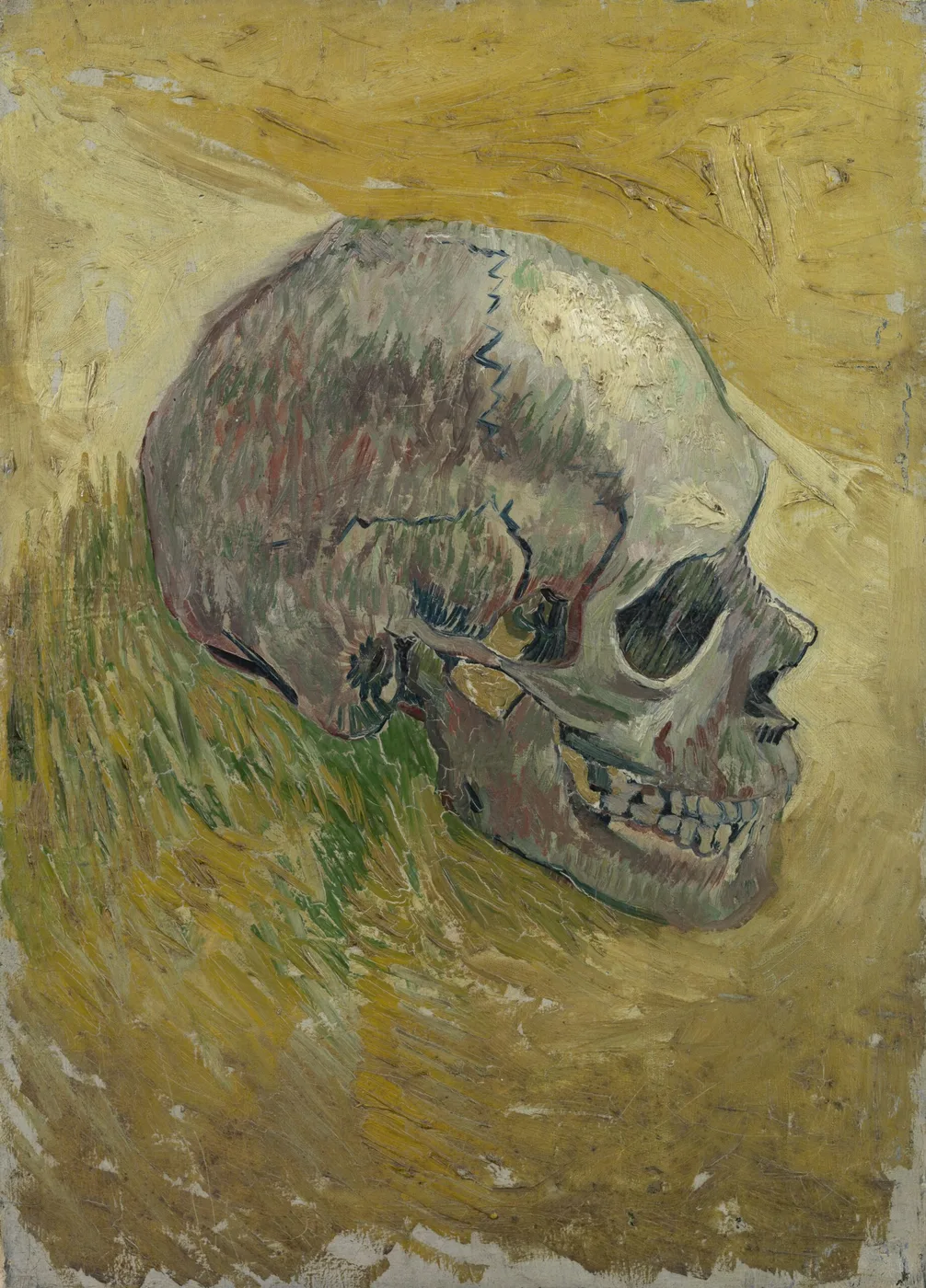
Skull is an oil on canvas Vincent van Gogh painted in Paris in May 1887. The Van Gogh Museum holds this upright painting, 30.4 cm wide and 42.4 cm high, under inventory number s0123V1962. It shows one skull facing right against ochre and green.
Van Gogh also painted a skull with a burning cigarette. That cigarette does not appear here. Both versions on the product page are made from this painting.
Van Gogh was living in Paris with his brother Theo that spring. In Paris he saw Impressionist and Neo-impressionist paintings. His palette, which had started in the dark browns of his early years in the Netherlands, was brightening then, a shift visible too in self-portraits such as Self-Portrait with Grey Felt Hat.
For another close study from these Paris years, see Self-Portrait with Straw Hat, and for another everyday object treated as a still life, see Still Life, Plate with Bread.
Grey, Green and Ochre: How This Skull Is Built
The skull turns in profile toward the right, cranium rounded at the crown and narrowing down to the jaw. The head is roughly centred across the width and set above centre, with the widest band of ground beneath the jaw.
Its eye socket is a dark, almost black hollow. The back of the skull reads as a dark mauve-brown, and the nasal opening and the shadow under the cheekbone are just as dark.
Light falls from the upper right and catches the crown in a pale, near-white highlight. The jaw and the underside of the skull sit in cooler shadow, built from mauve, grey and green.
Below the eye socket the nose is reduced to a dark triangular gap, and the closed jaw shows a row of teeth picked out in short pale strokes. The cheekbone catches a narrow band of the same near-white highlight that lights the crown.
A dark, zigzagging line runs down the crown, the suture where the bones of the skull meet, drawn in a blue-black that sits on top of the lighter strokes beneath it.
Behind the head the ground is a warm ochre yellow, laid in long diagonal strokes across the upper two-thirds of the painting. A band of green runs down the left side and crosses in a diagonal beneath the jaw. The strokes stand upright and overlap the ochre where the two colours meet.
In the upper right corner the strokes turn short and agitated, breaking the long diagonal sweeps of the rest of the ground.
Van Gogh builds the cranium from short, crossing strokes of grey, green and dull rose, each stroke left visible, closer to the cross-hatching of a drawing than to smooth oil modelling. A brown-red contour runs along the crown, the back of the skull and the underside of the jaw, holding the hatching there inside a firm line.
Along the lower edge and down the left side the paint thins to almost nothing, and a pale grey ground shows through in patches under the yellow and green.
Van Gogh outlined the head with a narrow brush in blue paint, and those boundaries remain visible beside the grey and green hatching. Where an outline curves around the crown or crosses the jaw, it keeps the bone distinct from the warmer field behind it. On the crown, the pale marks stand above the coloured strokes around them, while the thinner dark passages let the paint underneath show.
Bone, Bright Colour and an Unmarked Setting
The skull sits against bare colour, with no table edge or cloth around it. The closed teeth and dark eye socket make the subject recognisable, while the short grey and green strokes keep attention on the painted surface.
A human skull can suggest mortality to a viewer. Here the blue outlines run cold against the warm ochre, while the rose-grey hatching breaks the bone into separate strokes. The ochre ground keeps the skull in bright colour rather than shadow.
The green at the left edge is the same broken touch Van Gogh used on the cranium, so the skull and the ground hold together as one painted surface.
The Canvas in the Van Gogh Museum Collection
The canvas belongs to the Van Gogh Museum, Amsterdam (Vincent van Gogh Foundation). The museum traces its drying cracks to an earlier painting underneath. Van Gogh covered it with zinc white, which dried slowly and went on drying after he had finished the skull, causing cracks in the surface above it.
The museum’s collection groups this canvas with its still lifes and with the Paris paintings of 1887.
Choosing a Hand-Painted Oil or a Print of This Painting
The product page for Skull has two versions. A hand-painted oil reproduction is painted from scratch on canvas by an artist working from the museum image, with real brushwork and no two pieces identical. The archival canvas print puts the same image on canvas, recording the raised paint of the crown as colour on a smooth surface; in the hand-painted oil, the artist builds it as actual paint, so it sits where their brush left it.
A simple frame suits this canvas better than an ornate one: heavy moulding pulls the eye away from the cross-hatched strokes and the uneven ochre ground.
Painting the oil by hand takes 2 to 4 weeks. Delivery then takes 5 to 7 business days. We check the finished piece against the museum image, then send you a photograph of it. Nothing ships before you approve that photograph.
The original is a little larger than a standard sheet of A3 paper. For an existing frame, check the offered reproduction size against the space inside it before ordering; the frame’s outside measurements do not give that opening.
Questions Buyers Ask About Skull
What does Van Gogh’s Skull show?
A single human skull in profile, facing right, painted in grey, green and mauve against a warm ochre ground crossed by a diagonal band of green on the left. The cranium carries a dark zigzag suture line and a pale highlight where the light catches its crown.
Does this version include a burning cigarette?
No. This painting, made in Paris in 1887, shows the skull alone against the ochre ground.
How large is the original painting?
At 42.4 cm high by 30.4 cm wide, it’s a small canvas. Check the selected reproduction size on the product page before ordering.
Should I choose a hand-painted oil or a print?
The hand-painted oil carries real brushwork and texture, close to the hatched strokes seen in the original; the archival canvas print is a flat printed image. Both are shown together on the product page for this painting.
Which room suits this painting?
The ochre stands out beside pale walls or warm wood. The subject may suit a study better than a shared dining area.
More from this collection
Bring this painting home
Choose a hand-painted oil reproduction for real brushwork, or an archival canvas print for a crisp museum-image edition. Every size preserves the original proportions.
View this work & options
Further reading
Verify the original in the Van Gogh Museum collection record and continue through related works in the catalogue.