
View of a River with Rowing Boats: Story
Paris, 1887, and the Pull of the River
By 1887 Vincent van Gogh had been in Paris for the best part of a year, sharing rooms with his brother Theo and working through the shock of everything the city had shown him. He had arrived still painting in the dark, earthbound palette of Nuenen and Antwerp. Within months he was standing beside Signac and Bernard at easels set up on the riverbank, watching what broken colour could do to daylight.
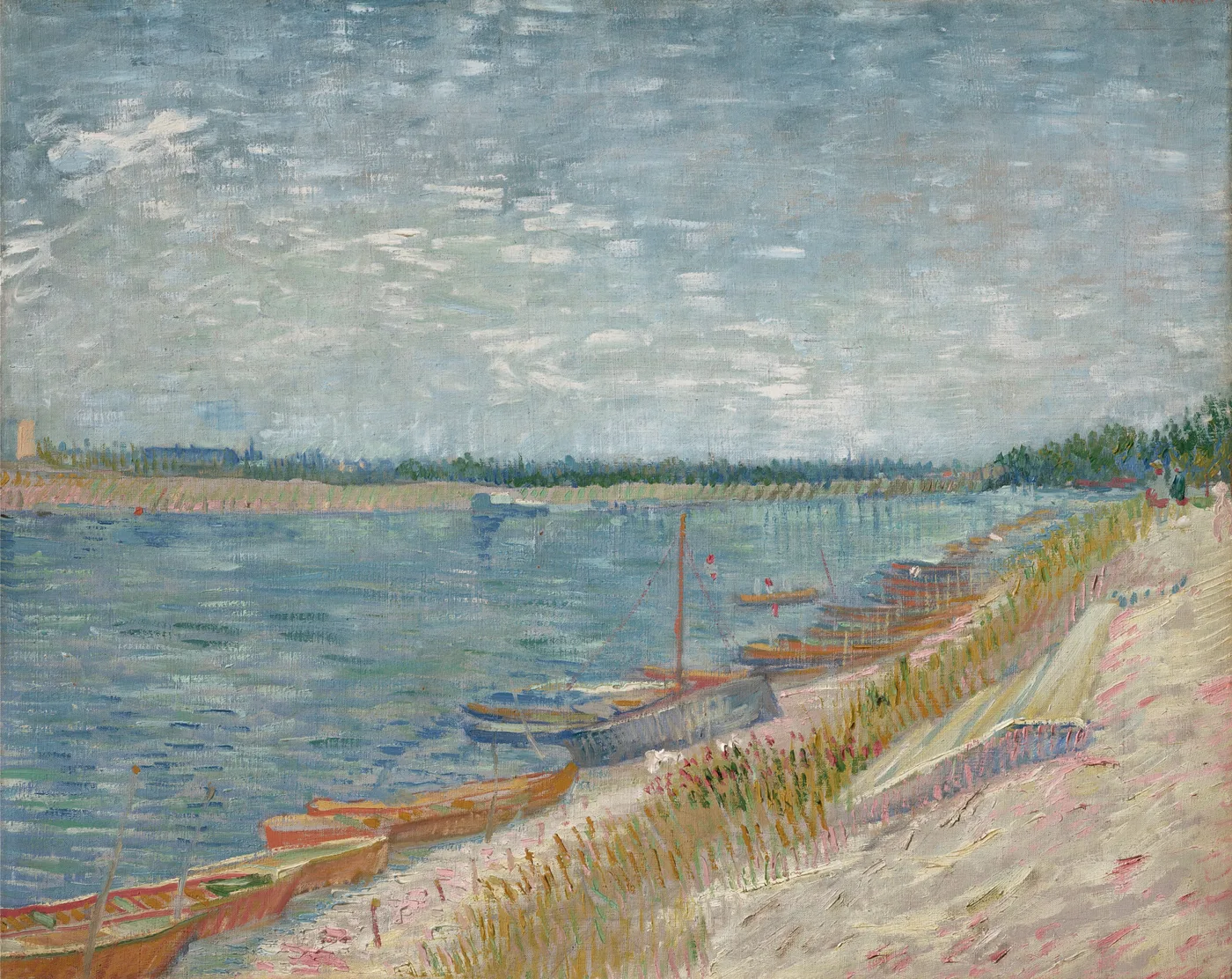
The Seine north-west of the city, around Asnières and Clichy, had become a weekend retreat for oarsmen, picnickers and painters alike. Van Gogh went there repeatedly that year, drawn less by the leisure crowds than by the water itself, the moored boats, the flat light over open ground. View of a River with Rowing Boats, painted in 1887 and measuring 65 by 52 centimetres, belongs to that run of riverside canvases.
It marks a working method as much as a subject. Rather than composing a scene from memory in the studio, he set up close to the bank and painted what was directly in front of him, the mooring, the towpath, the sky pressing down on both. The picture reads as a record of looking, made quickly, in one sustained sitting.
A Bank That Cuts the Canvas in Two
The composition turns on a single diagonal: a pale, sandy towpath running from the lower right corner up towards the middle of the canvas, separating the grey-blue water on the left from a strip of grass and trees on the right. Nothing else in the picture is as decisive as this line. It is what the eye follows first, before it settles anywhere else.
Along that bank, a row of boats sits moored one after another, their hulls painted in warm orange and red against the cooler water. One larger vessel, dark-hulled with a bare mast rising into the sky, anchors the middle distance and gives the row of smaller craft something to gather around.
In the foreground, at the bottom left, two more rowing boats have been pulled up onto the sand, their sterns cut off by the edge of the canvas. They are empty. No oarsman, no passenger, no figure at all disturbs the quiet of the mooring, which gives the scene the feel of a place caught between uses rather than a place being used.
Light Without a Sun
The sky takes up close to half the canvas, painted in soft passages of grey, pale blue and off-white, worked with short, broken strokes that suggest drifting cloud without ever describing a single cloud shape precisely. There is no visible sun, no cast shadow to fix the hour. The light is even, overcast, the kind that flattens a landscape and lets colour do the work that contrast would otherwise do.
The water answers the sky in kind. It is built from the same family of blues and greys, broken by streaks of green and touches of darker pigment where the current or a passing reflection disturbs the surface. Nothing in the water is still; the brush keeps moving even where the subject does not.
Across the river, the far bank dissolves into haze, a low line of trees, a huddle of rooftops and what might be a church spire, all reduced to soft, dry touches of paint that never resolve into architectural detail. Distance here is handled as a loss of definition rather than as a change of scale, which is closer to how the eye actually experiences a wide river on a grey day.
Paint Handled as Colour, Not Description
Van Gogh’s brush is at its most active along the near bank, where short vertical dashes of green, pink and ochre stand in for grass and the low wildflowers growing at the water’s edge. These strokes do not describe individual stems so much as accumulate into the texture of an untended riverbank in early summer.
The palette across the whole canvas stays close to a narrow, considered range: soft pinks and sandy ochres in the path, blue-greys in sky and water, dull reds and oranges concentrated in the boats. Nothing is saturated or forced. The colour holds together because it repeats in small amounts across the whole surface rather than because any one passage is bright.
There is no anecdote painted into the scene, no figures rowing, mending nets or strolling the path. The subject is the mooring itself, empty and settled, and the picture asks to be read through its handling of paint rather than through any story happening within it.
On a Wall, in Shifting Light
Hung in a room that gets ordinary daylight, this is a picture that changes with the hour without ever demanding attention. Its greys and soft blues sit quietly under overcast light and warm slightly under lamplight in the evening, the ochre path picking up whatever warmth the room offers.
What stays constant is the pull of that diagonal bank, drawing the eye back to the water each time it is glanced at rather than fully looked at. It is a painting built for exactly that kind of attention, brief and repeated, the way a river seen from a window gets looked at over years rather than studied once.
Sizes and materials for View of a River with Rowing Boats are listed on its product page.
More from this collection
Bring this painting home
Choose a hand-painted oil reproduction for real brushwork, or an archival canvas print for a crisp museum-image edition. Every size preserves the original proportions.
View this work & options
Further reading
Verify the original in the collection record and continue through related works in the catalogue.