
View of Arles with Irises: Story, Meaning & Brushwork
In February 1888 Vincent van Gogh left Paris for Arles, chasing a light he believed the north could not give him. He arrived to a cold, wet start to the year, and it was not until spring that the country around the town began to show him what he had come for. By May the fields had filled in, and he was out among them almost daily, painting fast, in the open air, trying to fix what he saw before the light moved on.
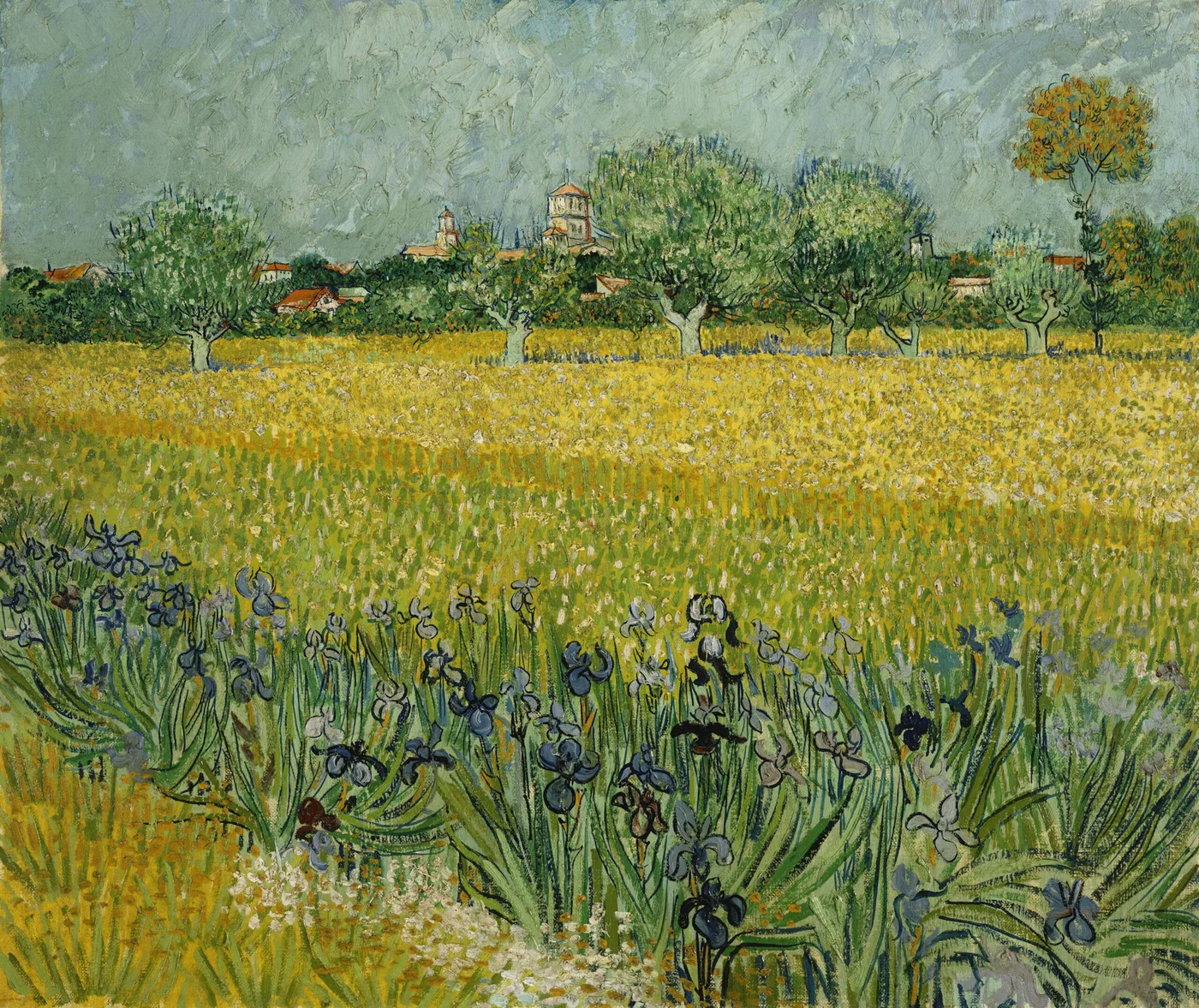
View of Arles with Irises in the Foreground belongs to that run of spring pictures. It is not a view of the town so much as a view past a field, with Arles held at a careful distance, small under a wide band of sky. The town is present, but it is not the subject.
A field read from the ground up
The lower quarter of the canvas is given over entirely to irises. They stand in a dense, uneven line, dark blue-violet heads on pale green stems, with sword-shaped leaves crossing and overlapping in every direction. A few white blooms show low among them, easy to miss on a first look.
Above the irises the ground opens into a wide meadow, rendered in short, close strokes of yellow, ochre and green that read from a distance as a single field of gold. There is no clear boundary between flower bed and meadow. One simply gives way to the other, the way a field does when you are standing in it rather than looking at a plan of it.
At the far edge of the meadow a line of trees carries the eye toward the town. Most are in leaf, one or two still showing the pale blossom of early spring, and on the right a single tree stands apart, its foliage touched with an unexpected warm orange against all that green. Behind the trees, low roofs and two church towers mark the edge of Arles, pushed almost to the top of the canvas.
The sky above takes up nearly a third of the picture and is worked in muted grey-greens, brushed in short diagonal strokes rather than left flat. It is not the clear blue of a postcard south. It reads instead as changeable, the kind of sky that sits over a field for an hour and then moves on.
The canvas itself is modest, just 65 by 54 centimetres, which keeps the whole scene close and legible rather than panoramic. Nothing here asks to be read from across a room.
Paint that keeps its own weather
Van Gogh built the irises from short, curved strokes of dark violet and blue, laid close together so the petals seem to twist rather than sit still. Green for the leaves goes down in longer, straighter marks, almost drawn rather than painted, giving the foreground a wiry, upright energy against the softer field behind it.
The meadow is handled more loosely again, in small flicks of colour that do not resolve into individual stems until the eye gets close. Further back, the trees and rooftops are set down in firmer, more contained touches. The paint gets calmer as the eye moves away from the viewer, which is one of the things that makes the distance feel like distance.
He had been looking hard at Japanese woodblock prints for several years by this point, and the habit shows in how the picture is built. A mass of foreground motif fills the lower edge of the composition, flattening the space and pulling the town behind it into a smaller, framed register, much as a branch or a figure might sit across the front of a print while a landscape recedes behind it.
The colour is pitched as a deliberate contrast rather than a copy of what a camera would have recorded. Blue-violet against yellow-green sits close to opposite on the colour wheel, and Van Gogh knew exactly what that pairing would do to the eye. Neither colour is allowed to dominate the other; they hold the picture in a kind of vibration that a single dominant hue would not produce.
Amsterdam, and what the picture is still doing
The painting has been held by the Van Gogh Museum in Amsterdam, dating from 1888, the year of the artist’s most productive and most closely documented stretch of work. It sits among the run of Arles landscapes from that spring, painted within weeks of each other and sharing the same low horizon and close attention to what was growing at the artist’s feet.
On a wall, the picture does not stay still. In low morning light the violet of the irises deepens and the gold field goes quieter, closer to olive. Under a brighter afternoon light the yellow strokes lift and separate, and the town in the distance becomes easier to read, the two small towers catching the eye again after they had settled into the background.
That change is built into the way the paint was laid down, not added afterwards. A surface worked in short, direct strokes catches raking light differently through the day, so a reproduction that keeps the texture of the brushwork keeps some of that movement too, even in a room many miles and well over a century from the field it was painted in.
Sizes and materials for View of Arles with Irises in the Foreground are listed on its product page.
More from this collection
Bring this painting home
Choose a hand-painted oil reproduction for real brushwork, or an archival canvas print for a crisp museum-image edition. Every size preserves the original proportions.
View this work & options
Further reading
Verify the original in the Van Gogh Museum collection record and continue through related works in the catalogue.