
Doctor Gachet’s Garden in Auvers: Story & Meaning
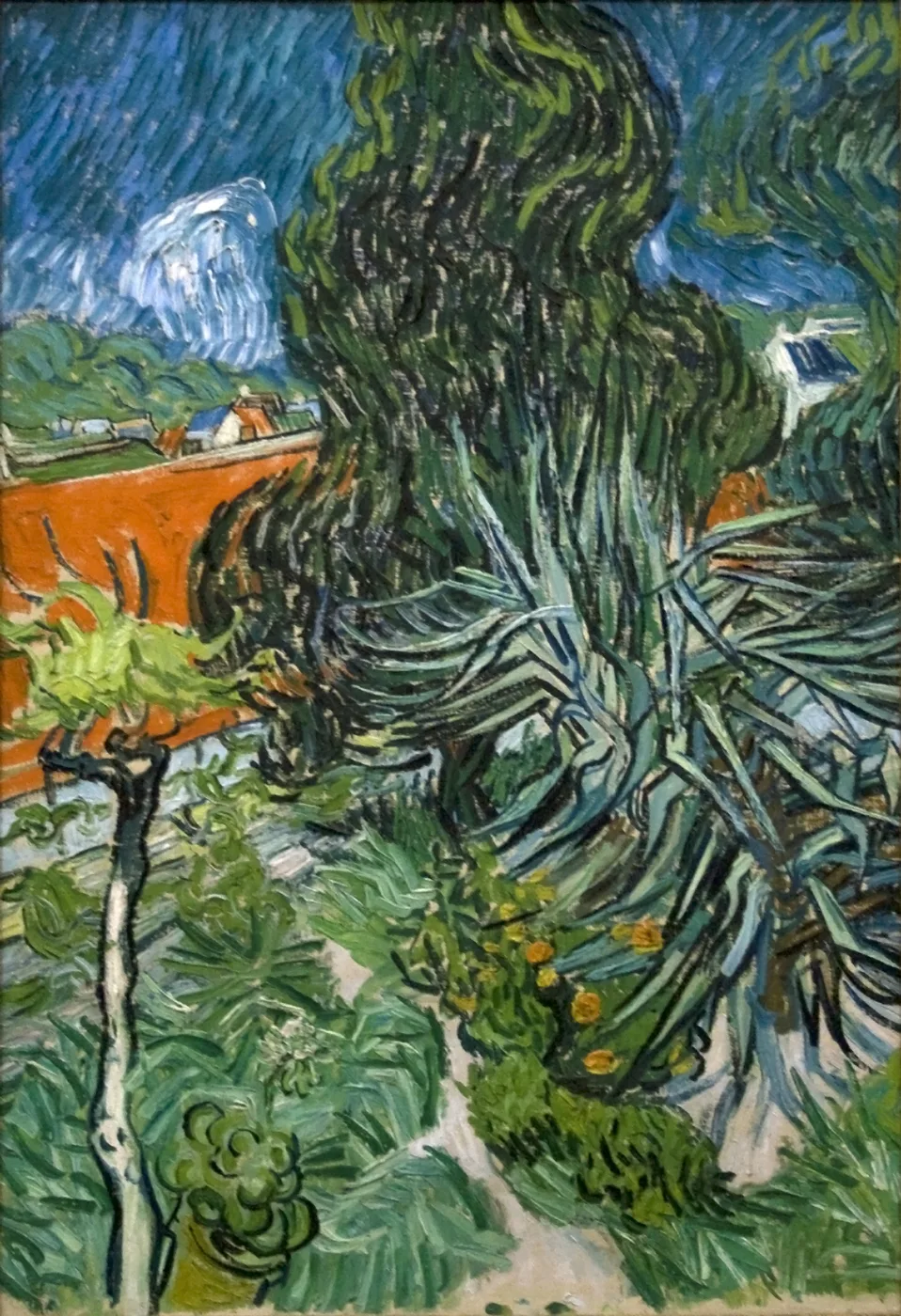
In May 1890 Vincent van Gogh left the asylum at Saint-Rémy-de-Provence and travelled north to Auvers-sur-Oise, a village on the Oise river within easy reach of Paris. He arrived exhausted by two years of crisis but immediately alert to his surroundings, and he placed himself under the care of Dr Paul Gachet, a physician with a long-standing interest in artists and their nervous complaints. Gachet kept a house on the hill above the village, with a garden that climbed steeply behind it, thick with self-seeded growth. Van Gogh painted that garden more than once in his first weeks at Auvers, and this canvas, Doctor Gachet’s Garden in Auvers, is among the most concentrated of the group.
He had spent the southern years painting olive groves and wheat under a hard white light. Auvers gave him something else: a damp, crowded, northern greenery, thatched roofs, orchards and kitchen gardens running wild between houses. The change suited him. He worked at extraordinary speed that spring and early summer, and the Gachet garden, close at hand and endlessly various, offered a subject he did not have to travel to find.
A garden seen from within its own thicket
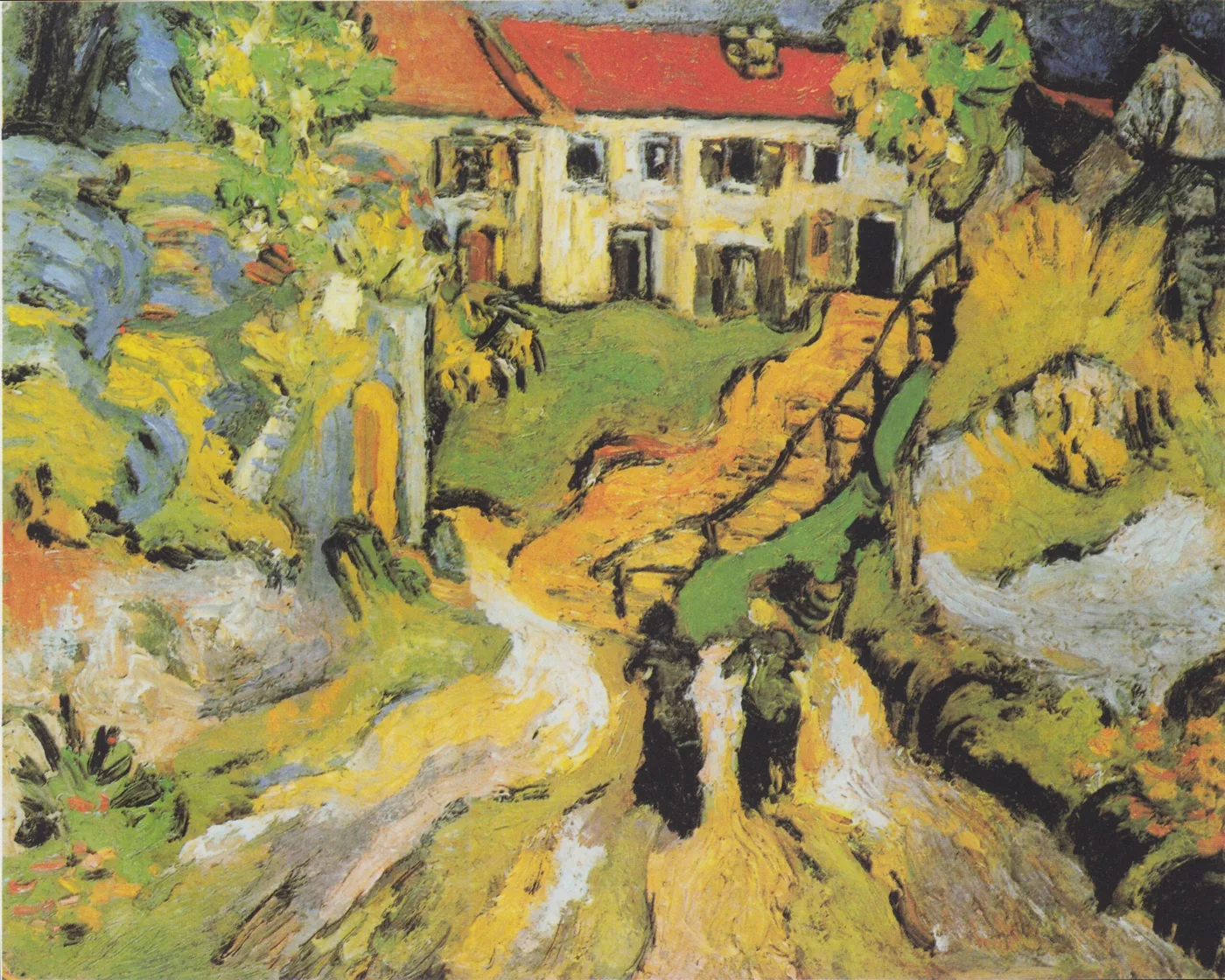
The painting has no horizon to speak of. Van Gogh has set his easel low, inside the planting rather than above it, so the whole 52 by 73 centimetre canvas reads as a wall of growth pressing toward the viewer. There is no open sky to rest in and no clear middle distance; the garden simply fills the frame from the pale path at the bottom to the swirling blue air at the top.
A tall dark cypress, or something close to it, rises through the centre of the canvas and dominates the composition, its foliage handled as a single restless mass of near-black and bottle green. Around its base a stand of aloe or yucca throws out long, blade-like blue-green leaves in every direction, some catching a scatter of small orange and yellow flowers where they meet the light.
To the left, a low wall or terraced bank painted in raw orange and red cuts a hard diagonal across the picture, one of the few flat, unbroken passages of colour in the whole canvas. Beyond it, small white houses with grey roofs sit on the hillside, rendered in a handful of quick strokes, and a patch of green rooftop shows through the branches on the right. In the foreground, a bare pale stem with a few tufts of leaf stands alone against the wall, almost the only vertical in the picture drawn with any restraint.
Above all this, the sky is not calm. Van Gogh has painted it in the same short, curling strokes he uses for the foliage, deep blue broken by a pale, cloud-like swirl in the upper left, so that the air itself seems to move with the same energy as the plants below it.
Why the doctor’s garden mattered
Gachet was not simply a physician. He painted a little himself, collected work by Cézanne, Pissarro and others he had come to know, and understood the temperament he was treating better than most doctors of his generation could have. His garden, left to grow with little formal shaping, gave Van Gogh a subject that needed no arrangement and no permission, just close and repeated looking.
For a painter who had spent the previous two years largely confined to hospital grounds, a private garden he could enter freely and paint from the inside was not a small thing. The pictures he made there in May and June 1890 have a directness that comes from familiarity rather than composition, as though he simply sat down in the middle of the growth and painted what was in front of him.
That directness is part of what makes this canvas convincing. There is no attempt to tidy the garden into a view. The orange wall, the houses, the aloe and the cypress sit together with the slight disorder of a real corner of ground that nobody has trimmed for a visitor.
How the paint itself behaves
Van Gogh builds the entire surface from short, directional strokes, laid wet into wet and rarely blended. The cypress is made of dense vertical marks in near-black green; the aloe leaves are drawn in longer, curving strokes of blue and grey-green that follow the shape of each blade; the ground and path are scumbled in pale ochre and white, almost bare by comparison with the foliage above.
Colour is used structurally rather than descriptively. The orange wall does not simply record a coloured surface, it holds the whole left side of the canvas together and gives the eye a place to land before it is pulled back into the green. The small orange and yellow flowers among the aloe leaves work the same way in miniature, marking out depth within a mass of colour that would otherwise read as flat.
There is very little pure black or pure white in the painting. Even the darkest passages of the cypress carry blue and green within them, and the palest areas of sky and path are warmed with ochre. The result is a canvas that has almost no resting point, every part of it worked with the same urgency.
Living with the painting
Hung where morning or afternoon light crosses it at an angle, the picture changes character within a few minutes. The raking light catches the ridges of paint in the cypress and aloe leaves and throws small shadows across the surface, so the brushwork becomes physically present rather than just visible. Under flatter light, the same passages settle back into their green and blue masses and the orange wall reads more calmly.
Seen close, it is a study of a few square metres of overgrown ground. Seen from across a room, the same canvas resolves into a single dense green form against a moving sky, with the orange wall as the one plane of quiet. That shift between the close and the distant view is part of what keeps the painting worth returning to on a wall, in a way a reproduction on a page cannot quite give.
The original is held by the Musée d’Orsay in Paris, one of many works from Van Gogh’s final months that the museum keeps together. Painted in 1890, in the last weeks before his death that July, Doctor Gachet’s Garden in Auvers stands as one of the clearest records of how he saw the place that took him in.
Sizes and materials for Doctor Gachet’s Garden in Auvers are listed on its product page.
More from this collection
Bring this painting home
Choose a hand-painted oil reproduction for real brushwork, or an archival canvas print for a crisp museum-image edition. Every size preserves the original proportions.
View this work & options
Further reading
Verify the original in the Musée d'Orsay collection record and continue through related works in the catalogue.