
The Langlois Bridge (Road Version): Story & Meaning
Vincent van Gogh reached Arles in February 1888, arriving in the middle of a cold snap that had left snow on the fields, hoping the light of the south would sharpen a way of painting he had only begun to work out in Paris. Within weeks of settling in, he found the Pont de Langlois, a small wooden drawbridge over the canal running out toward the sea, and kept returning to it that spring with a persistence he gave to few other motifs. He worked it in oil several times, in different weather and with different figures crossing, and made drawings and a watercolour of it besides.
The bridge took its name from the lock-keeper who tended it, a working structure rather than a picturesque one, set on the road south of town where carts and canal traffic met. That ordinariness seems to be part of what held van Gogh’s attention. It gave him a subject built from strong, simple shapes, the kind that could carry flat, declarative colour without any fuss of invention.
He wrote to his brother Theo that spring about how much the flat, canal-cut country around Arles recalled the Brabant landscape of his own childhood, drawbridges and locks included. Painting the Langlois bridge let him work through that memory of home in a register of colour Holland had never offered him, closer to the clear, unshaded palette he had been studying in Japanese woodblock prints.
A Cart on the Road, Not a Wash-Day Scene
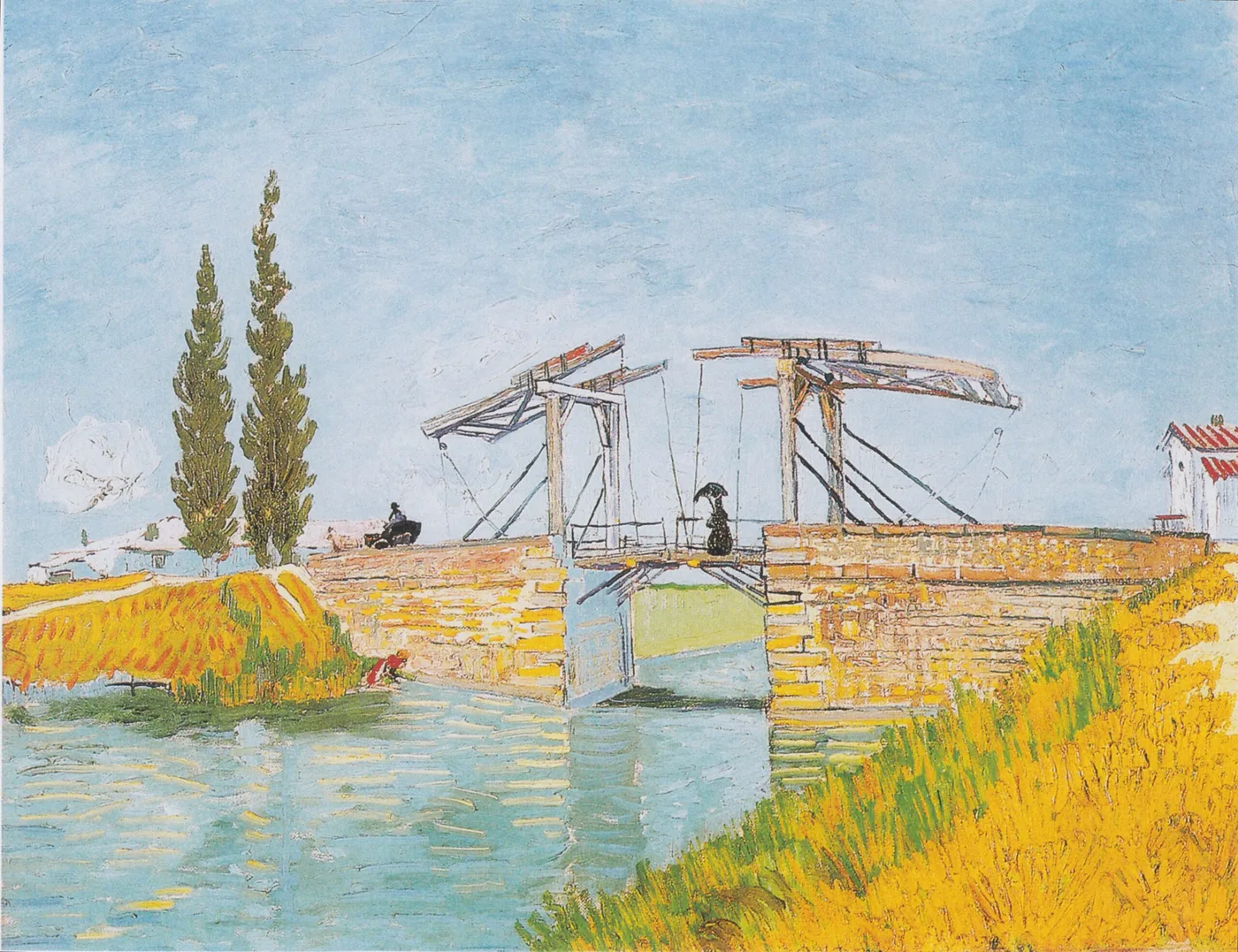
This canvas is the version that shows the bridge doing its ordinary daily work. A horse and cart make their way along the road on the left, a figure walking beside them, while a second figure in dark clothing stands further along, near the crest of the bridge deck where the road crosses. Other paintings from the same weeks show women kneeling at the water washing laundry; here the bridge is simply a crossing point on a working road.
The drawbridge itself sits just off-centre, its twin timber gantries raised overhead like an open pair of scissors, ropes and counterweights strung taut between them against a high, pale sky. Below, the canal opens out in bands of pale blue and green, the surface broken into short curling strokes that suggest the bridge’s reflection without ever drawing it out in full.
A single figure crouches at the water’s edge on the near bank, a small dab of red against the green. Two tall, slender trees rise at the left, dark and upright, the only strong verticals in a picture otherwise built from long horizontals of road, water and field.
The right two-thirds of the canvas belong to the towpath and the fields beyond it, laid in hot ochre and gold and threaded through with short green strokes that read as grass or young grain moving in the wind. A single house with a red tiled roof sits at the far right edge, cropped by the frame, a small domestic note beside the working structure of the bridge. Across the whole scene the light falls evenly, almost without shadow, the clear midday light van Gogh kept telling Theo he had found in the south.
A Small Canvas Built From Four Bands
At 64 by 49.5 centimetres, the canvas is modest, close in scale to the other Langlois bridge paintings van Gogh made that same spring. The composition fills that small space with unusual economy: sky, bridge, water and field, each given roughly its own quarter of the surface, so that nothing crowds the eye even though every part of the canvas carries visible paint.
That economy is what lets the picture read so quickly and so clearly from across a room. There is no incident to search out, no narrative detail hidden in a corner. The bridge is the picture, and everything else is arranged to support it.
Colour Kept in Separate, Clean Notes
Van Gogh drew the bridge’s timbers with firm, near-graphic outlines in blue and dark brown, a debt he openly acknowledged to the Japanese prints he had been collecting and copying the year before in Paris. Colour is laid down largely unmixed, blue beside yellow beside green, so the eye reads distinct notes of hue rather than blended tone.
The brushwork changes with what it is describing. Tight, short strokes carry the water, longer sweeping ones carry the road and the grass of the fields, small dabbed touches build the foliage of the two trees. Worked out here, on a small canal bridge in his first spring in Provence, this habit of letting the mark of the brush do as much of the describing as the drawing beneath it would stay with van Gogh for the rest of his working life.
Blue water, gold field, a red roof, dark green trees: each colour holds its own patch of canvas rather than dissolving into its neighbour, which is exactly the clarity van Gogh had set out that year to achieve. It is a picture that keeps its structure at a glance and rewards a second, slower look precisely because so little of it is hidden.
On a Wall, Through the Changing Light
Hung in a room, the painting behaves like a window left ajar onto a bright day somewhere else. Its long horizontal bands sit calmly against a wall, equally at ease in a study or a sitting room, and because the colour is kept so clean and unmixed it holds its clarity under artificial light rather than sinking into shadow the way darker nineteenth-century canvases tend to.
Morning light draws out the cool blues of the canal and sky; a warmer, lower light in the evening leans into the gold of the towpath and the red of the distant roof. The picture shifts mood through the day without ever losing the plain, sturdy structure that holds it together, the bridge itself standing steady at the centre of it all.
The original, catalogued as Langlois Bridge at Arles, is held today by the Wallraf–Richartz Museum, one record among the small group of canvases that mark van Gogh’s first, formative months in the south. A lock-keeper’s drawbridge on a working road became, in his hands, one of the clearest early statements of the way he wanted to paint for the rest of his life.
Sizes and materials for The Langlois Bridge (Road Version) are listed on its product page.
More from this collection
Bring this painting home
Choose a hand-painted oil reproduction for real brushwork, or an archival canvas print for a crisp museum-image edition. Every size preserves the original proportions.
View this work & options
Further reading
Verify the original in the Wallraf–Richartz Museum collection record and continue through related works in the catalogue.