
Vase with Oleanders: Story, Meaning & Brushwork
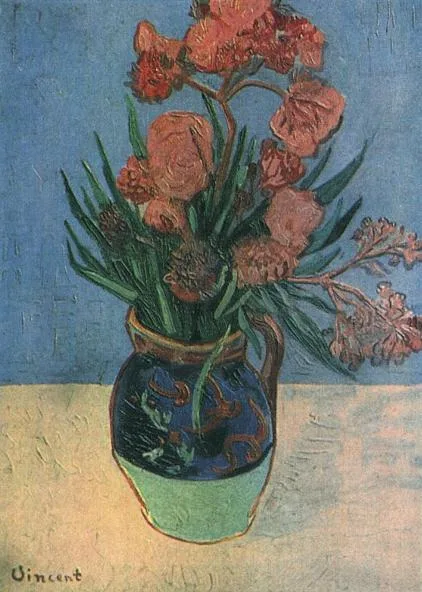
By the summer of 1888 Vincent van Gogh had been living in Arles for several months, working at a pace that alarmed even him. He had come south chasing light and colour he could not find in Paris, and flowers gave him a subject he could return to again and again without waiting on a sitter or a season. Still Life: Vase with Oleanders, painted that year, belongs to this run of work, a picture made quickly, from a plant he could cut in the garden and set on a table before the blooms wilted.
A cut branch brought indoors
Oleander flowers through the hottest months and keeps flowering when gentler plants give up, and van Gogh returned to it more than once that summer. He was drawn to subjects that carried on regardless, and a shrub that bloomed through heat he found oppressive suited the mood of his letters from that period, full of urgency and short of patience for anything that did not hold up under pressure.
There is no still life apparatus here beyond the jug and the flowers themselves. No fruit, no drapery, nothing borrowed from a studio prop cupboard. It reads as a single afternoon’s work, cut, arranged and painted before the light changed.
That directness is part of what makes the picture, at 36 by 56 centimetres, feel larger than its dimensions suggest. The composition runs the full height of the canvas, the flowers reaching almost to the top edge, so the eye travels up the picture the way it would travel up an actual plant left standing in a room.
What sits on the table
A stoneware jug holds the arrangement, its body glazed a deep blue-black and banded with loose ochre scrollwork, the kind of everyday earthenware van Gogh kept using because he liked its weight and colour against flowers. The glaze thins to pale green near the base, and a curved handle swings out to one side, catching a line of warm light along its rim.
Out of the jug’s neck the oleander rises in an open, slightly unruly cluster. Clusters of pink and coral-red blossoms crowd the upper half of the canvas, some fully open, others still knotted as buds, with one loose spray of blooms breaking away to the right as though the arrangement had simply been set down rather than composed.
Dark, spear-shaped leaves thread up through the stems in deep green, almost black in places, giving the pink flowers something to push against. A few bare stalks cross the jug’s neck at odd angles, the kind of detail that survives only when a painter is working from the object in front of him rather than tidying it up.
Van Gogh signed the canvas at lower left, just his first name, in the same loose hand he used across the Arles pictures.
Colour carrying the weight
The background is a flat, slightly greyed blue, close in tone to the jug itself, and it is this closeness that lets the pinks and reds of the flowers step forward so sharply. Below, the table is rendered in a warm, chalky cream, so the whole canvas divides into two broad fields of colour with the still life balanced across the seam.
Van Gogh was reading colour theory closely in these years, and the picture shows it in practice rather than in any diagram. Red and green sit at opposite ends of the wheel, and here they are pushed against each other at full strength, the blooms and the leaves fighting for the same attention rather than one simply decorating the other.
Nothing in the picture is mixed to a neutral middle tone. Even the shadowed side of the jug carries a saturated blue rather than a grey, which keeps the whole surface humming rather than settling.
The hand behind the paint
The paint itself is loaded and worked wet, laid on in short, decisive strokes that follow the direction of each petal and leaf rather than filling in an outline. Look closely at the jug and the brushwork turns almost calligraphic, ochre lines dragged over the blue ground to suggest the glaze pattern without describing it in any real detail.
The flowers are built the same way, each bloom a handful of loaded strokes rather than a blended form, so the picture holds its energy even at close range. Van Gogh was not interested in polishing the surface smooth. He wanted the marks visible, evidence of a hand moving fast while the light and the flowers still held.
Stand back and the strokes resolve into petals and leaves; move in and they separate again into raw, individual gestures. That shift is part of what keeps the picture active rather than settled, and it is one of the harder qualities to carry through in a reproduction, since it depends on real paint sitting proud of a real surface.
On a wall, through the day
A picture built from this much saturated colour behaves differently depending on what light falls on it. In direct daylight the pinks and reds sit forward almost aggressively, the blue background receding behind them. Under lamplight in the evening the same canvas softens, the contrast between flower and background narrowing until the jug and its blooms feel more like a single warm mass.
It is a picture suited to a room where something happens close by, a kitchen, a dining table, a corner near a window, rather than to a space meant for quiet contemplation from across a room. The scale of the brushwork rewards proximity, and the subject, a jug of cut flowers on a table, is domestic enough to sit comfortably in a space actually used for eating and gathering rather than one set aside purely for looking.
What it offers, wherever it hangs, is the sense of a plant caught at a particular moment rather than an arrangement composed for permanence. The flowers were cut, put in water and painted before they could fade, and that urgency is still there in the paint more than a century later.
Sizes and materials for Still Life: Vase with Oleanders are listed on its product page.
More from this collection
Bring this painting home
Choose a hand-painted oil reproduction for real brushwork, or an archival canvas print for a crisp museum-image edition. Every size preserves the original proportions.
View this work & options
Further reading
Verify the original in the collection record and continue through related works in the catalogue.