
A Pair of Shoes: Two Worn Boots and One Loose Lace, Paris 1886
A Dutch palette carried into Paris in 1886
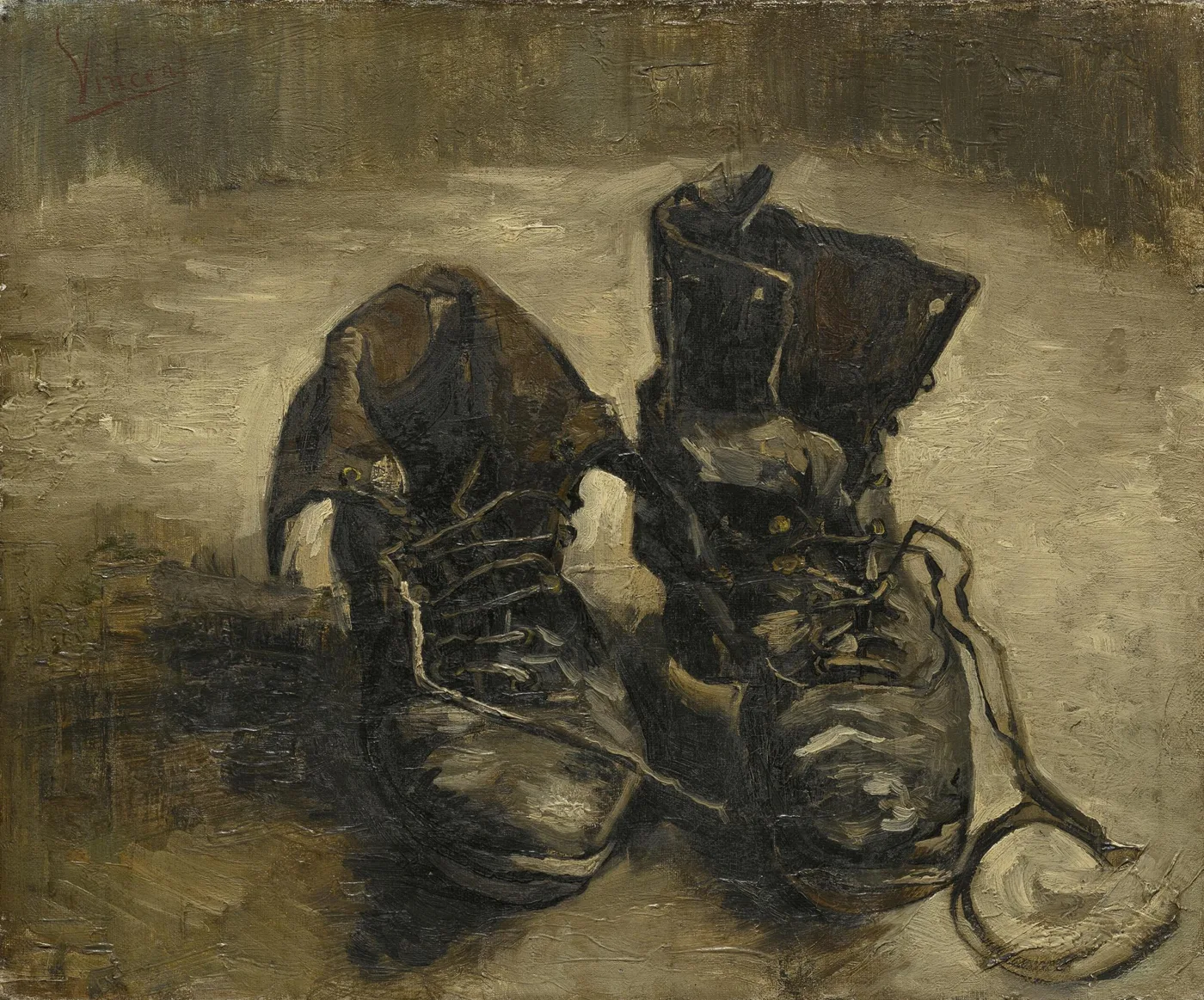
A Pair of Shoes is an oil painting by Vincent van Gogh from 1886, held by the Van Gogh Museum, and it shows two worn laced boots standing on a pale floor. He painted it in Paris, in his first year in the city, and it still uses the browns and blacks of the Netherlands he had just left. The boots are the whole subject.
Born in 1853, Van Gogh came to painting late, after working for an art dealer and spending time as a lay preacher among miners. His Dutch years in Brabant, where he drew and painted weavers and farm labourers, left him with a habit of earth colours: peat brown, bottle green, the near-black of a cottage interior. He brought that habit to Paris.
Van Gogh painted worn shoes more than once, and other paintings carry the same title. This version is dated 1886, measures 45 x 37.5 cm and belongs to the Van Gogh Museum. It has no table, no cloth and no second object, only the pair and a floor, and the name Vincent is signed in dark red at the upper left.
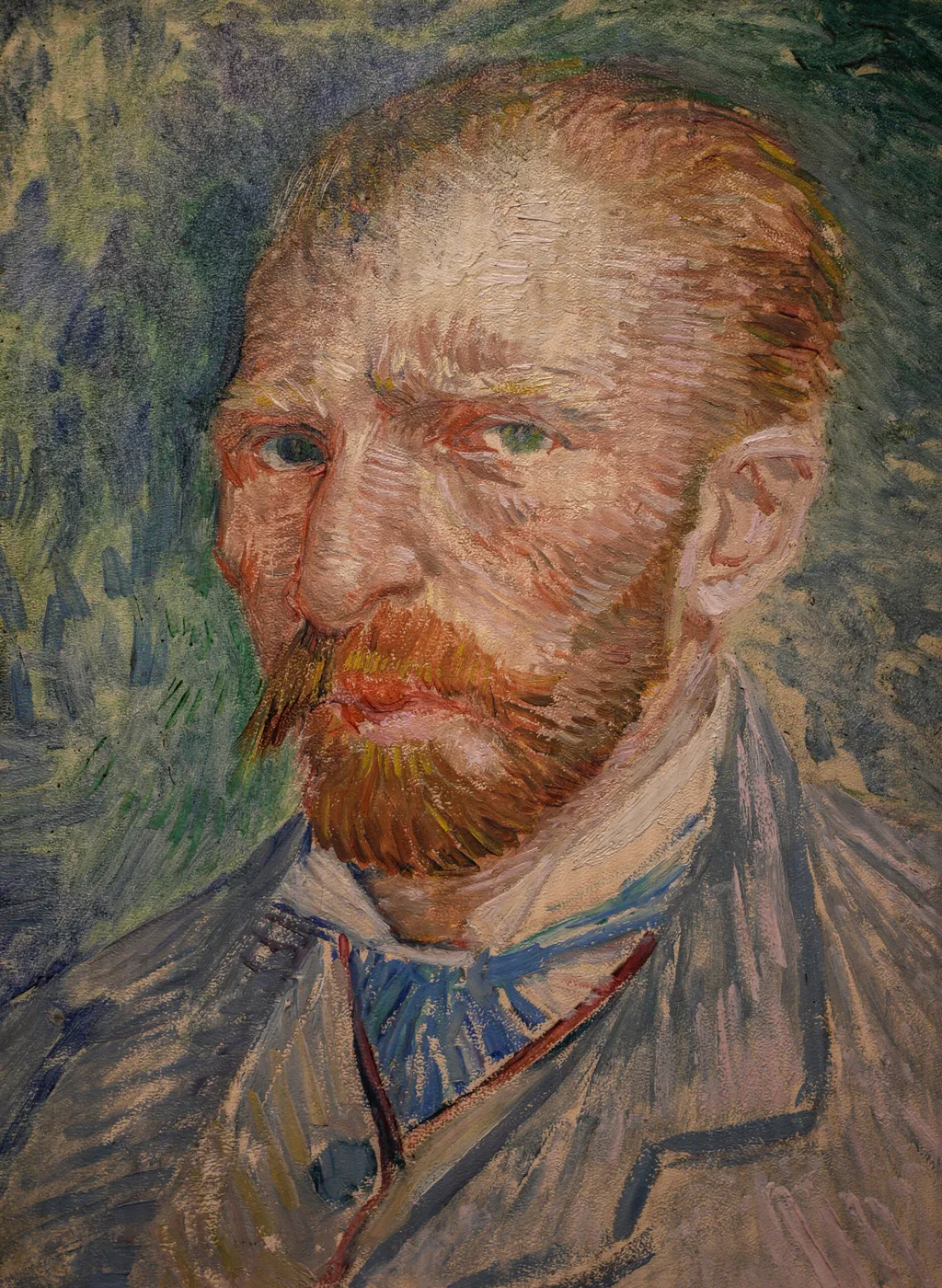
In Paris he lived with his younger brother Theo and saw the Impressionists’ canvases and Japanese prints at first hand, yet the boots are still dark. He had no money for models, so the boots, close at hand, became his subject; his own face followed.
His self-portraits, Self-Portrait with Grey Felt Hat and Self-Portrait with Straw Hat, soon turned brighter, a step this boot picture has not yet taken.
How two black boots are built from umber, olive and buff
Two boots stand toe-forward on a pale floor and fill most of a canvas wider than it is tall. The viewer looks down on them from a little above, so the lacing faces up and the toe caps lead toward the bottom edge. The right boot rises higher, its black shaft standing straight up; the left boot’s cuff folds forward and down, which keeps the pair from reading as a mirror image.
Behind the boots the ground divides in two. The upper quarter is a band of olive and khaki, scrubbed in vertical streaks, and it reads as a wall or a far stretch of floor, since the join between the two bands is soft. Below it the floor is buff and cream grey, dragged in horizontal bars that run under both boots and give the pair a flat, shallow stage.
Light comes from the right. It falls on the floor between and beside the boots, the palest ground in the picture, and leaves a brown-black shadow pooled to the left of the left boot. On the leather it lands as cream and pale grey on the scuffed toe caps and as a dull grey on the tongue of the right boot.
The leather runs through a short list of darks. Chestnut and burnt umber colour the sagging cuff of the left boot and a panel on the shaft of the right. The rest is black, thinned to grey where the toes are rubbed. Cream and grey show at the throat of each boot and give the dark mass its one real light.
The laces are drawn with a thin dark line, crossing and doubling down the front of each boot, with brass-yellow dabs for the eyelets. From the right boot a single lace drops, swings out toward the right edge and curls back into a loop that ends in a brighter patch of cream paint on the floor.
The floor carries the thickest paint: ridges and drags stand up from the surface and keep the direction of each stroke. On the boots the strokes are shorter and denser, following the folds of the cuffs and the creases across the toes, and the canvas weave shows through in places along the left edge. A thin line of cream runs down the front of the left boot where the leather has creased.
In the upper left corner, on the olive band, Van Gogh signed his first name, Vincent, in dark red, with a long looping stroke beneath it. Dark red appears only in the signature.
Boots with no wearer: three ways to read a worn pair
The picture shows a pair of boots and nothing that identifies who wore them. The leather has gone soft and grey at the toe caps, the cuff of the left boot sags, and one lace hangs loose. Where a portrait would give a face, this canvas gives a worn object, and you can read the boots as a stand-in for the person who walked in them.
A second reading starts from Van Gogh’s Dutch years, when he drew and painted people who worked the land and the loom. Boots like these belong to that world of long walks and heavy days, and a viewer who knows his earlier subjects can take the pair as a portrait of labour made without a labourer in the frame.
A third reading is about paint. Nearly everything is dark, and the boots are told apart from the floor and from each other by small changes of tone: black against umber, umber against olive, cream against all three. Read this way, the picture is an exercise in how many darks one object can hold.
The viewing position: the eye sits above the boots, close enough to count the eyelets, at the height of someone looking down at their own feet.
Where the original is held and how large it is
The Van Gogh Museum in Amsterdam holds the original of A Pair of Shoes. It measures 45 x 37.5 cm, a close-to-square format, and it is an oil painting on a canvas whose weave shows at the edges.
At that scale the picture is taken in whole from a couple of steps back, and the boots fill it. Closer in, the ridges in the floor stand off the surface, which no screen image shows, and the eyelets turn out to be small dabs of brass-yellow. Whether the canvas is on the wall on a given day is a question for the museum’s own listings.
Up close, look at where the light catches the paint. The raised cream of the floor and the dragged grey streaks across the toe cap of the right boot read as nearly white, while the black leather around them drops back.
A reproduction can follow that scale. The product page lists the sizes on offer.
A reproduction cannot supply the weight of the paint, but it keeps the arrangement: the whole canvas, uncropped, with the lace loop, the signature and the brown-black shadow beside the left boot all in place. The oil builds ridges into the floor by hand, while the print records them as a flat image.
Choosing oil or print, a size and a frame for these boots
Hand-painted oil is the main version. On the hand-painted version an artist paints A Pair of Shoes from scratch in oil on canvas, taking the museum’s image of the original as the reference. The ridges in the floor and the dragged paint around the toe caps are made with a brush, so copies are never strictly identical. Painting the oil by hand takes 2 to 4 weeks.
The alternative is an archival canvas print that follows the museum image photographically. For a picture built from close darks, that consistency keeps the black, umber and olive apart. Printing takes 2 to 4 business days.
Proportions never change: the image is not cropped or stretched. Choose from the sizes on the product page. At a small size the laces and eyelets shrink to thin lines; at a larger size the brass dots and the loop of lace stay legible.
Options run from rolled canvas to a framed piece ready to hang. The near-square format and the dark mass of the boots take a thin frame well, since it leaves the buff floor as the only light edge. Delivery then takes 5 to 7 business days.
Hang it where a viewer stands close: a kitchen wall beside the table, a dining room sideboard, or an entrance hall where shoes come off. Warm white, pale grey or sage walls keep the khaki and buff clean, while a dark wall swallows the leather.
Questions buyers ask about A Pair of Shoes
How big is the original A Pair of Shoes?
It measures 45 x 37.5 cm, and the Van Gogh Museum holds it.
Do the colours match the museum’s picture?
The reference is the museum’s image of the original. The print follows it photographically; the hand-painted oil is never strictly identical.
What is the difference between the oil and the print?
The oil has real brushwork, and no two are strictly identical. The print is photographically consistent.
Which room suits this picture?
A kitchen, a dining room or a hall where shoes are kept, with warm white, pale grey or sage walls.
Why is a Paris painting from 1886 so dark?
Van Gogh still worked in the earth colours of his Dutch years then. Brighter colour came later in Paris, and it is absent from this picture.
More from this collection
Bring this painting home
Choose a hand-painted oil reproduction for real brushwork, or an archival canvas print for a crisp museum-image edition. Every size preserves the original proportions.
View this work & options
Further reading
Verify the original in the Van Gogh Museum collection record and continue through related works in the catalogue.