
Garden of the Asylum: Story, Meaning & Brushwork
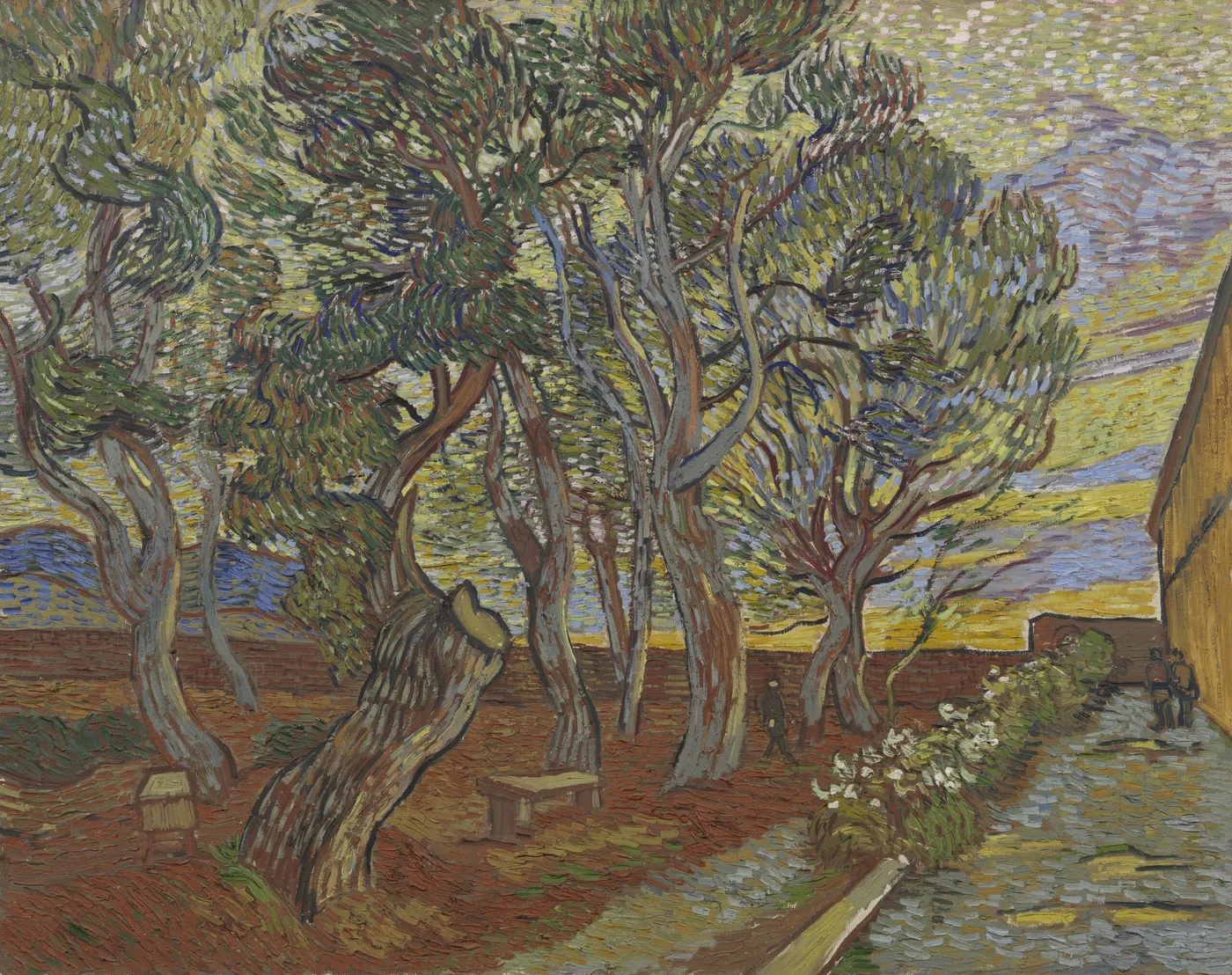
In May 1889, a year before his death, Vincent van Gogh admitted himself to the asylum of Saint-Paul-de-Mausole, on the edge of Saint-Rémy-de-Provence. His doctors kept him close to the grounds, and for months the walled garden behind the old monastery buildings was nearly all the outdoor world he had. He painted it obsessively, in different seasons and different weather, until the same corner of pines and paths became one of the central subjects of his last working year.
Garden of the Asylum, painted in 1889 and now held by the Van Gogh Museum, is one of those views. It shows no distant landscape, no open road, nothing of the Provençal countryside he had painted so freely at Arles. What it shows instead is what was in front of him every day: trees, earth, a low boundary wall, and beyond it a strip of sky.
Trees that crowd the whole canvas
The picture is dominated, almost overwhelmed, by a stand of tall pines whose trunks twist upward in pale grey-blue and rise clear of the dense canopy above. Van Gogh has let them fill nearly the entire height of the composition, so the sky only appears as fragments caught between the branches until the horizon opens out on the right.
In the foreground, just left of centre, one trunk has been cut or broken off, its jagged pale wood left exposed against the surrounding bark. It sits low and blunt among the standing trees, a piece of damage that Van Gogh recorded as carefully as any living branch.
Nearby, a plain wooden bench and a small crate stand on the bare, reddish-brown ground. Neither is grand or picturesque. They read as the ordinary furniture of a garden that people actually used, set down among trees that had clearly grown there for a long time before anyone thought to sit beneath them.
A wall, a path, and two small figures
On the right side of the canvas the trees give way to the ochre flank of the asylum building itself, its ground floor pierced by a shadowed archway. A paved path runs alongside it, catching cool blue-grey light, and a low wall separates the planted garden from the strip of open country beyond.
Along that path a solitary figure walks with his back to us, dwarfed by the trees, while two more figures stand together further off near the building. They are painted with only a few strokes each, but they are enough to set a human scale against the size of the pines and to suggest that this garden, however confining, was still a place people moved through.
A flowering shrub, dabbed in white and green, grows along the path near the wall. It is one of the few soft, unstructured passages in a canvas otherwise built from firm, directional strokes, and it draws the eye toward the light beyond the trees.
Dusk light over the boundary wall
Above the wall, the sky is worked in horizontal bands of violet, gold and pale rose, the colours of a Provençal evening rather than the high blue of midday. A ridge of mauve hills sits low against it, the only hint of landscape beyond the asylum grounds.
That warm, open strip of sky sits in direct contrast to the cool, tangled greens and blue-greys of the garden itself. Van Gogh has set the enclosed world of the trees against the wide world of the sky without ever letting the second one dominate the canvas; the wall stays firmly in place, and the garden stays in front.
The brushwork that carries the whole scene
Every surface in the painting, foliage, bark, earth and sky alike, is built from short, rhythmic strokes laid close together, curling and overlapping rather than blending. The paint sits thickly on the canvas, so that the trunks in particular seem to twist and press forward under the light rather than simply being outlined.
This was the manner Van Gogh had developed through his year at Saint-Rémy, a way of painting that turned even a fixed, familiar view into something restless. The dimensions of the canvas, 90.5 by 71.5 centimetres, are modest, yet the density of the brushwork gives the garden a physical weight well beyond its size.
What this garden does on a wall
Hung in a room, Garden of the Asylum behaves less like a landscape and more like a screen of trees standing between the viewer and the light. In the morning, when a room is coolest, the blue-grey trunks and dark greens tend to read first. Later in the day, as the light warms, the gold and violet of the sky through the branches comes forward instead.
It rewards a second and third look in a way a simple garden view would not, precisely because so much of the canvas is given over to the trees Van Gogh could not walk past without painting. What began as the confined view from an asylum window remains, on a wall a century and a half later, a picture that keeps finding new light to catch.
Sizes and materials for Garden of the Asylum are listed on its product page.
More from this collection
Bring this painting home
Choose a hand-painted oil reproduction for real brushwork, or an archival canvas print for a crisp museum-image edition. Every size preserves the original proportions.
View this work & options
Further reading
Verify the original in the Van Gogh Museum collection record and continue through related works in the catalogue.