
Portrait of Lieutenant Milliet: Story & Meaning
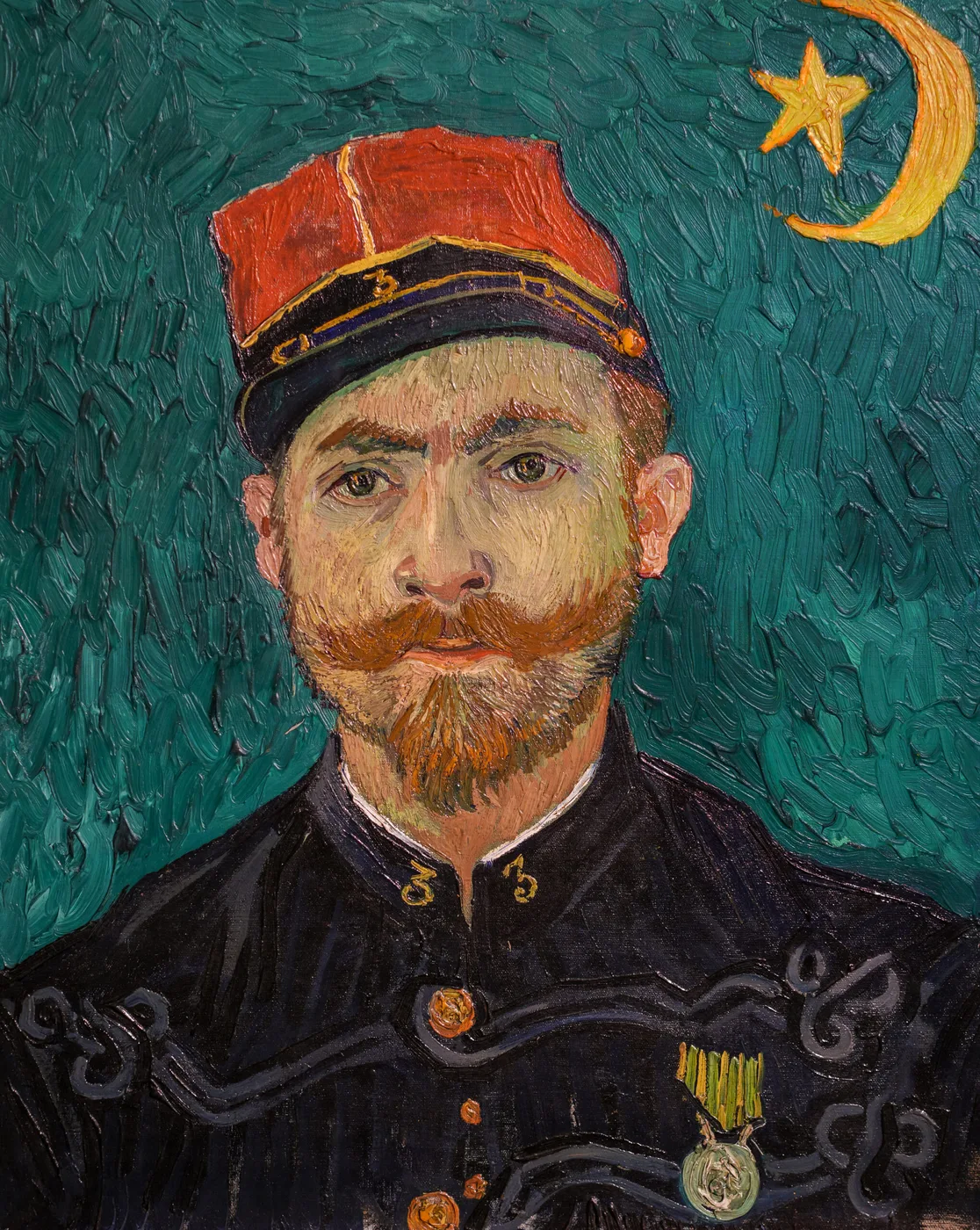
By the summer of 1888 Vincent van Gogh had been in Arles for several months, chasing a light he believed Paris could never give him. He rented rooms, then the Yellow House, and worked at a pace that alarmed people who knew him. What he lacked in Arles was company he could talk to about painting, and that made Paul-Eugène Milliet, a second lieutenant of the Zouaves stationed in the town, one of the few people he genuinely valued that year.
Milliet was a soldier by trade but had some feeling for drawing, and Van Gogh tried, without much success by his own account, to teach him the rules of perspective. The two men got on well enough that Milliet agreed to sit for him more than once. This picture, painted in 1888 and originally titled Portrait of Paul-Eugène Milliet, Second Lieutenant of the Zouaves, is the result.
Van Gogh had told his brother Theo that he wanted to paint a gallery of modern types, ordinary people of his own time rendered with the same seriousness once reserved for saints and nobles. A young officer in dress uniform, garrisoned in a provincial town, fitted that ambition exactly.
A face fixed by a level stare
Milliet looks straight out of the canvas, and the gaze does not waver or soften. His skin is built from strokes of tan, rose and a startling touch of green in the shadows, a combination that reads as sunburnt flesh under strong light rather than any conventional flesh tone.
The beard and moustache are ginger, laid in with loose curling strokes that catch gold where the light hits them. Van Gogh has kept the modelling of the face relatively controlled compared with what happens around it, so the features stay legible and calm at the centre of a canvas that is otherwise restless with paint.
The uniform as a field of dark shapes
Below the face, the dark blue tunic is worked almost flat, broken by pale grey braid that loops and knots across the chest in the ornamental frogging typical of Zouave dress. Small gilt buttons catch warm orange highlights, and a single enamelled medal sits pinned above the row of buttons, a quiet note of ceremony against all that black.
The cap does the opposite job. It is bright red, banded in black with gold piping and a small numeral badge, and it sits square on Milliet’s head, framing the upper part of his face and pulling the eye upward before it settles back on his gaze.
Together the uniform and cap turn the sitter into a specific rank and regiment rather than an anonymous soldier. Van Gogh was precise about that kind of detail even while he pushed the paint itself far from anything descriptive.
A teal ground and a borrowed emblem
The background is a deep, saturated teal, applied in short diagonal strokes that run in overlapping bands, almost like woven matting. It has none of the calm of a studio backdrop; it moves, and it pushes forward rather than receding the way a conventional portrait ground would.
In the upper right corner Van Gogh has placed a gold crescent moon and star, painted flat and decorative, closer to an emblem stitched on cloth than to anything observed in the sky. The motif nods to the North African associations of the Zouave regiments, and it sits on the canvas the way a crest sits on a flag, a symbol rather than a description.
That small passage of pure gold against the teal is one of the first things the eye meets after the face, and it does real work: it lightens a background that could otherwise feel heavy, and it gives the upper canvas somewhere to rest.
Colour pushed hard, drawn with a firm line
Van Gogh was reading and thinking about Japanese woodblock prints throughout his time in Arles, and their example shows here in the confident outlines that separate cap from face, collar from beard, badge from tunic. Every shape keeps a clean edge even where the colour inside it is built from many separate strokes.
The palette leans on a near-complementary pairing of red and green, the red kepi sitting against the teal ground, with the gold of the emblem and the buttons acting as a third, warmer note that stops the contrast from becoming harsh. It is a deliberately loud combination, chosen rather than observed, in keeping with what Van Gogh was telling Theo about using colour to carry feeling rather than simply record appearance.
The brushwork itself varies in temperature across the canvas: tight and directional in the green field, looser and more searching in the beard, smoother and more restrained in the face. That range keeps a fairly small picture, at 49 by 60 centimetres, from ever feeling static.
What the portrait does in a room
At that size, the portrait reads as a close, almost conversational encounter rather than a formal military likeness hung at a distance. Milliet’s eyes meet the viewer at something close to arm’s length, and the red cap and gold emblem keep drawing attention back up whenever the gaze wanders.
Under warm evening light the teal ground deepens toward black at its edges and the gold badge and buttons flare; under cooler daylight the green opens up and the brushstrokes in the background become easier to read individually. Few portraits change mood with the light in quite so pronounced a way.
The original hangs today in the Kröller-Müller Museum, where it remains one of the clearest statements of what Van Gogh wanted a modern portrait to do in Arles: hold a real, named person still for a moment, and surround him with colour strong enough to carry the feeling of having known him.
Sizes and materials for Portrait of Paul-Eugène Milliet, Second Lieutenant of the Zouaves are listed on its product page.
More from this collection
Bring this painting home
Choose a hand-painted oil reproduction for real brushwork, or an archival canvas print for a crisp museum-image edition. Every size preserves the original proportions.
View this work & options
Further reading
Verify the original in the Kröller-Müller Museum collection record and continue through related works in the catalogue.