
Long Grass with Butterflies: Story & Meaning
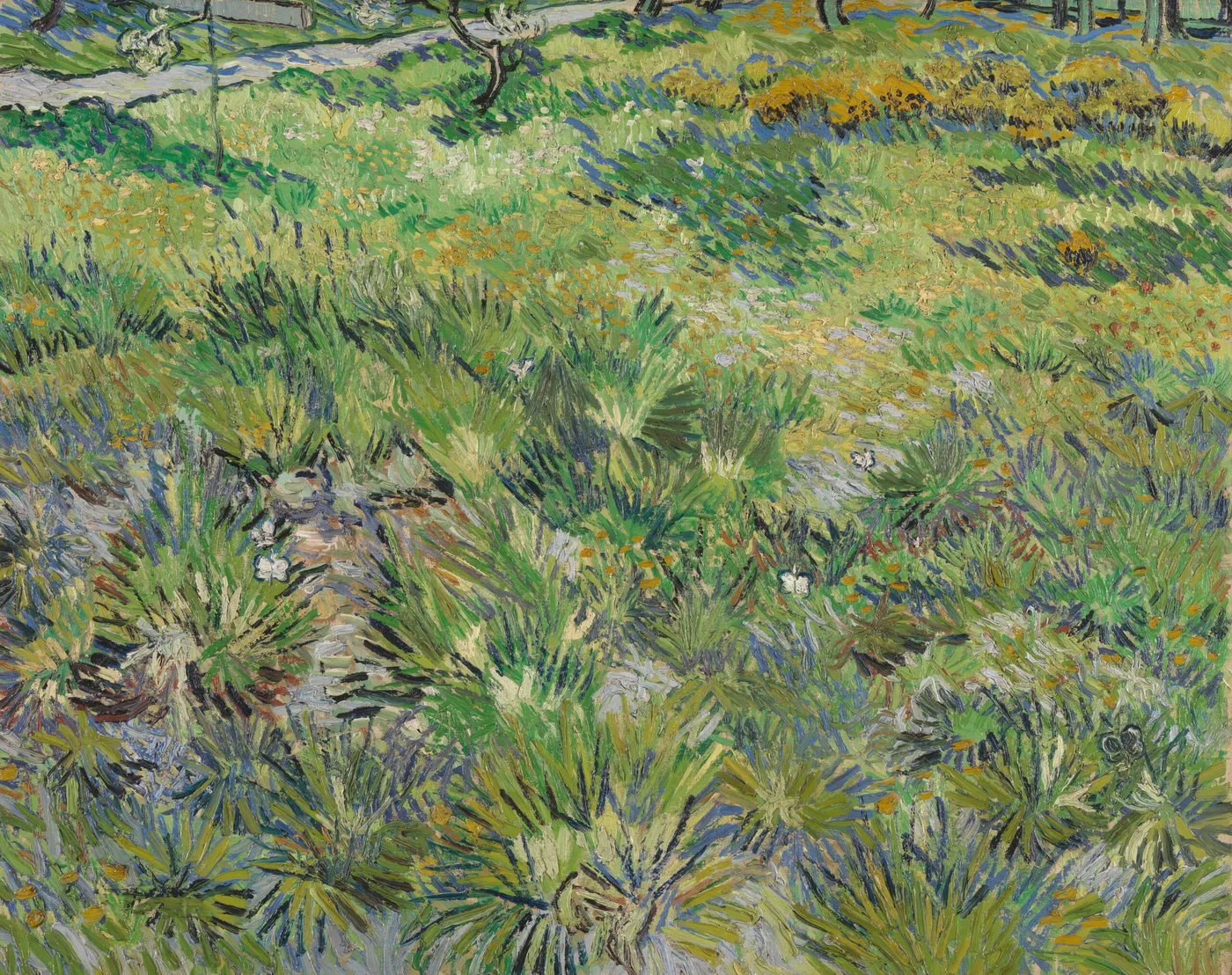
Vincent van Gogh spent most of 1890 as a voluntary patient at the asylum of Saint-Paul-de-Mausole, near Saint-Rémy-de-Provence, allowed out to paint only when his condition permitted and often confined to the grounds themselves. Rather than climbing to a view or seeking a monument, he turned his attention to the neglected corner of the garden outside his window. Long Grass with Butterflies, painted that year, belongs to a small cluster of works in which he set up close to the earth and let a single patch of uncut meadow take over the entire canvas.
It is a modest subject by any conventional measure: grass gone to seed, a few wildflowers, some passing butterflies. Van Gogh had spent the previous years painting cypresses, wheatfields and starry skies on a grand scale. Here he did the opposite, narrowing his focus until the meadow stopped being scenery and became the whole picture.
A Slope of Grass, Not a View
There is almost no horizon in this painting. The tangled grass rises to fill nearly the whole canvas, tilted toward the viewer so that the ground reads less like flat earth and more like a slope climbing away from the eye.
Only at the very top does the eye find anything else: a sliver of gravel path, the corner of a low building, and a loose row of trees, all compressed into a narrow band. It is just enough to place the scene in a real garden without ever letting the viewer look up and out. The rest of the surface, roughly the whole 80.7 by 64.5 centimetres of it, belongs to grass.
That decision to crop out the sky is what gives the painting its odd intimacy. A viewer does not survey this meadow from a distance. They are made to stand in it, or kneel in it, with stems rising past eye level on every side.
How the Grass Is Built
Van Gogh did not paint individual blades so much as clusters of them. Short, flicked strokes fan out from common points across the canvas, each cluster reading like a small green burst or starburst of growth.
Dark strokes of near-black and deep green anchor the shadows between clumps, while lighter yellow-green and olive marks catch where the sun reaches the tips of the grass. Thin lines of blue and grey run through the greenery too, cooling the shadows and stopping the whole field from settling into a single flat colour.
The handling is fast and repetitive in the way that a real meadow is repetitive: no two clumps are identical, but the same short gesture is used again and again until the accumulation itself becomes the subject. Nothing in the paint is smoothed or blended. Every stroke stays visible as a separate mark.
Colour Across the Canvas
Green dominates, but it is not one green. Van Gogh moves between yellow-green in the sunstruck patches, blue-green in the shade, and darker olive where the grass thickens toward the lower edge of the canvas.
Small interruptions break up that field of green. A patch of orange and yellow flowering shrub sits at the upper right, dabs of white and pale pink flowers appear low among the stems, and scattered points of red and rust show through in a few places. None of these accents is large, but together they keep the eye moving across a surface that could otherwise read as a single uniform texture.
The Butterflies Themselves
The butterflies that give the painting its title are small and pale, almost the same value as the lighter grass around them, so that they emerge rather than announce themselves. A close look finds several scattered through the meadow, wings caught mid-flutter in a stroke or two of white and cream.
They are not posed as specimens and there is no attempt to render wing patterns in any detail. Van Gogh treats them the way he treats the flowers, as small bright interruptions in the green, present in the corner of the eye the way real butterflies are present in a real meadow, glimpsed rather than studied.
Seen on a Wall
Because the painting has no sky, no distance and no single focal point, it behaves differently from a landscape hung to be looked at from across a room. It rewards standing close, the way the meadow itself would have been seen by a man working low to the ground with his easel among the stems.
Morning light picks out the pale butterflies and the yellow-green tips of grass first. Later in the day, as shadows lengthen and the room dims, the darker greens and blues in the lower half of the canvas come forward and the whole field reads cooler and denser. Few paintings change so much simply by tracking the light in the room around them.
The original is held by the National Gallery. It remains one of the more unassuming pictures Van Gogh made in his final year, and one of the most exacting studies of a subject that most painters of his time would not have thought worth a canvas at all.
Sizes and materials for Long Grass with Butterflies are listed on its product page.
More from this collection
Bring this painting home
Choose a hand-painted oil reproduction for real brushwork, or an archival canvas print for a crisp museum-image edition. Every size preserves the original proportions.
View this work & options
Further reading
Verify the original in the National Gallery collection record and continue through related works in the catalogue.