
The Good Samaritan (after Delacroix): Story
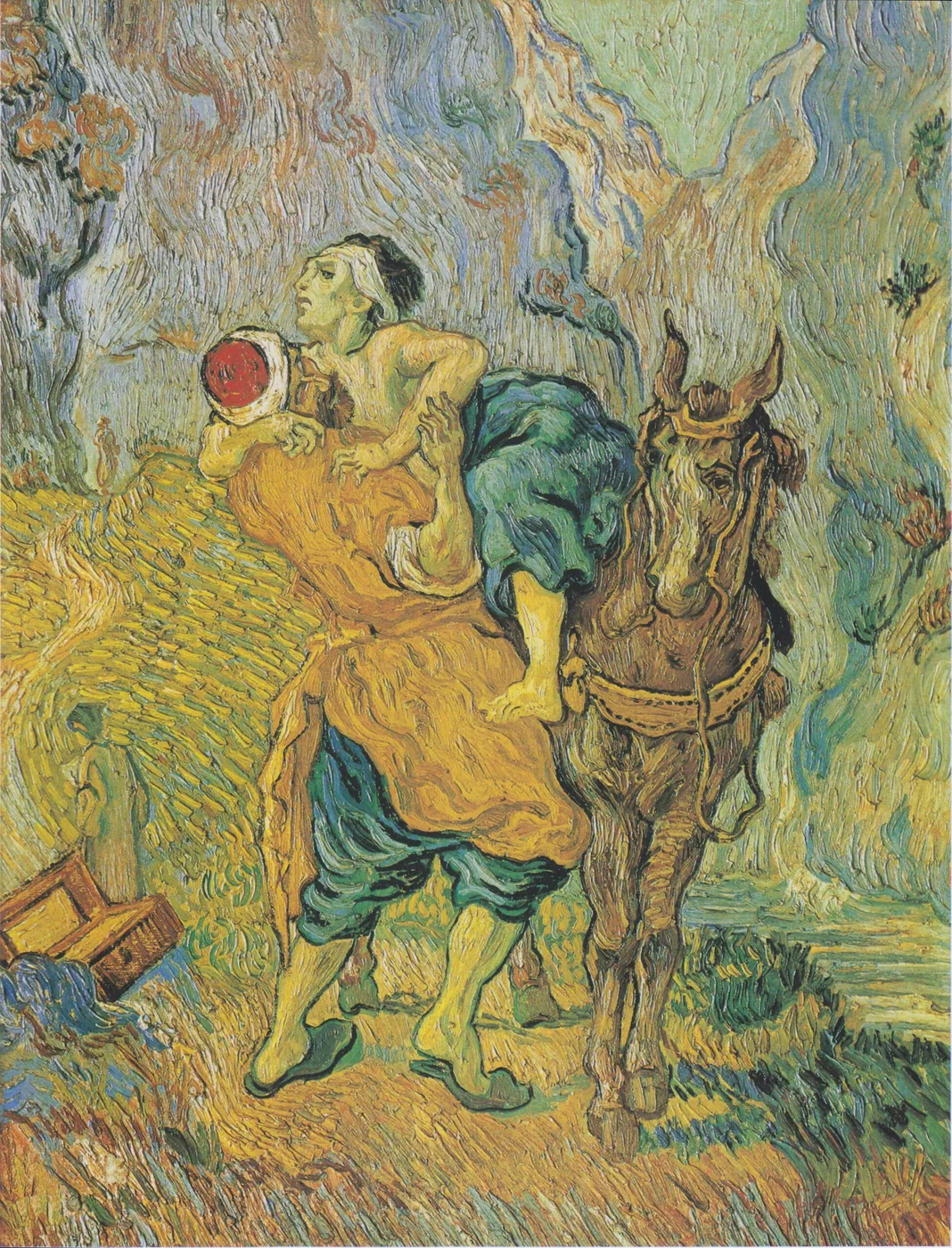
By the spring of 1890 Vincent van Gogh had spent almost a year inside the walls of the Saint-Paul-de-Mausole asylum at Saint-Rémy-de-Provence, painting between episodes of illness that left him unable to work at all. Cut off from models, short of fresh subjects and often confined to the asylum grounds, he turned to a practice he had used before: taking a black-and-white print after a painting he admired and remaking it in his own colour. The Good Samaritan, painted in 1890, is one of the results, a canvas built not from life but from another artist’s design, filtered entirely through Van Gogh’s own hand.
Working From Another Man’s Design
The print Van Gogh copied was after Eugène Delacroix, an artist he revered for his colour long before he ever saw an original Delacroix in the flesh. He had already reworked Delacroix’s Pietà the same year, and would return to Millet and Rembrandt with the same method, treating a borrowed composition as a starting point rather than a limit.
This was one of the few times in his career that Van Gogh chose a religious subject outright. He had trained as a lay preacher in his twenties and had once tried, and failed, to become an evangelist among the miners of the Borinage. The parable of a stranger who stops to help where others walk past clearly still meant something to him, even if he never wrote directly about why he chose it that year.
Working from a monochrome source meant every colour decision in the finished picture was his own. Nothing in the print told him the traveller’s robe should be that particular yellow, or that the rock behind the figures should turn green and violet. The invention is entirely in the paint.
The Scene on the Road
The picture shows the moment from Luke’s parable when the Samaritan lifts the robbed and beaten traveller onto his own animal. The wounded man hangs almost naked and boneless in his rescuer’s arms, his head wrapped in a stained red and white bandage, one arm dangling loose. The Samaritan, dressed in a heavy ochre coat over green breeches, braces his whole body backward to take the weight.
A sturdy brown horse stands at the centre of the canvas, its head turned to watch the two men, harness and bridle picked out in thick ropes of paint. In the middle distance, on the rise of the road, two small figures walk away without looking back: the priest and the Levite of the parable, who saw the injured man and passed by on the other side.
At the lower left an overturned wooden chest spills its blue cloth onto the ground, the leftover evidence of the robbery that opened the story. The setting is a steep, stony gorge rather than an open landscape, the road running diagonally uphill so the whole group seems to strain against the slope.
Nothing in the scene is decorative. Every object, the spilled chest, the loose bandage, the horse’s tensed neck, works to tell the single narrative moment of a man taking on another man’s weight.
Colour and the Movement of the Brush
Van Gogh’s palette here is built from three families of colour set hard against each other: the Samaritan’s golden ochre coat, the traveller’s blood-red headcloth, and a ground of blue-green and violet rock that fills most of the upper canvas. The wheat-coloured slope at the men’s feet is laid in with short diagonal strokes that all run the same direction, giving the impression of a field cut by wind.
The rock face behind the figures is where the brushwork becomes most agitated, built from long curling strokes of blue, white and ochre that twist upward like smoke or flame rather than describe any specific geological form. It is paint behaving as weather, not as stone.
Skin, cloth and harness leather are each given a different rhythm of mark: short stabbing touches for the traveller’s pale torso, longer sweeping strokes for the coat, tight coiled lines for the horse’s mane. The paint is never thin. It sits on the canvas in ridges a viewer can see catch the light from an angle.
The eye lands first on that one note of red at the wounded man’s head, the single sharp colour in a field of yellow, green and blue, before it travels down the diagonal of straining arms and legs to the horse’s braced hooves.
A Small Canvas With a Long Reach
At 60 by 73 centimetres, the original is a modest object, smaller than the drama within it might suggest. It now belongs to the Kröller-Müller Museum, part of a collection built specifically around Van Gogh’s work.
Scale like this rewards a wall where a viewer can stand close. From across a room the picture reads as a knot of ochre, green and red; only nearer does the individual strokes separate out, the layered colour resolving and dissolving again as the light in the room shifts through the day.
Morning light, raking low, will catch the ridges of paint on the rock face and the coat and throw a texture the flat colour alone does not have. Under a warmer evening lamp the ochre and red pull forward while the blues recede, and the whole gorge seems to darken around the two men, the picture changing without a single stroke being touched.
Sizes and materials for The Good Samaritan are listed on its product page.
More from this collection
Bring this painting home
Choose a hand-painted oil reproduction for real brushwork, or an archival canvas print for a crisp museum-image edition. Every size preserves the original proportions.
View this work & options
Further reading
Verify the original in the Kröller-Müller Museum collection record and continue through related works in the catalogue.