
Chestnut Trees in Blossom: Story, Meaning & Brushwork
A Furious Spring at Auvers-sur-Oise
Vincent van Gogh reached Auvers-sur-Oise in May 1890, having discharged himself from the asylum at Saint-Rémy-de-Provence after a year spent recovering from repeated breakdowns. He took a small room above the Café Ravoux and placed himself within reach of Dr Paul Gachet, a physician and amateur painter whom his brother Theo had found nearby. The village, north-west of Paris, offered thatched roofs, chalk cliffs and gardens just coming into leaf.
He painted at a pace that still unsettles biographers, producing roughly seventy canvases in the ten weeks before his death that July. Chestnut Trees in Blossom was painted in 1890, during that same concentrated stretch of work, when the village was still cool with spring rain and the trees along its streets were opening their first flowers of the season.
He had painted flowering branches before, almond blossom sent as a gift for his newborn nephew that winter. This canvas takes the same appetite for spring and turns it outward, away from a single cut branch and onto a full, mature tree standing in public view at the edge of a road.
A Village Street Beneath the Canopy
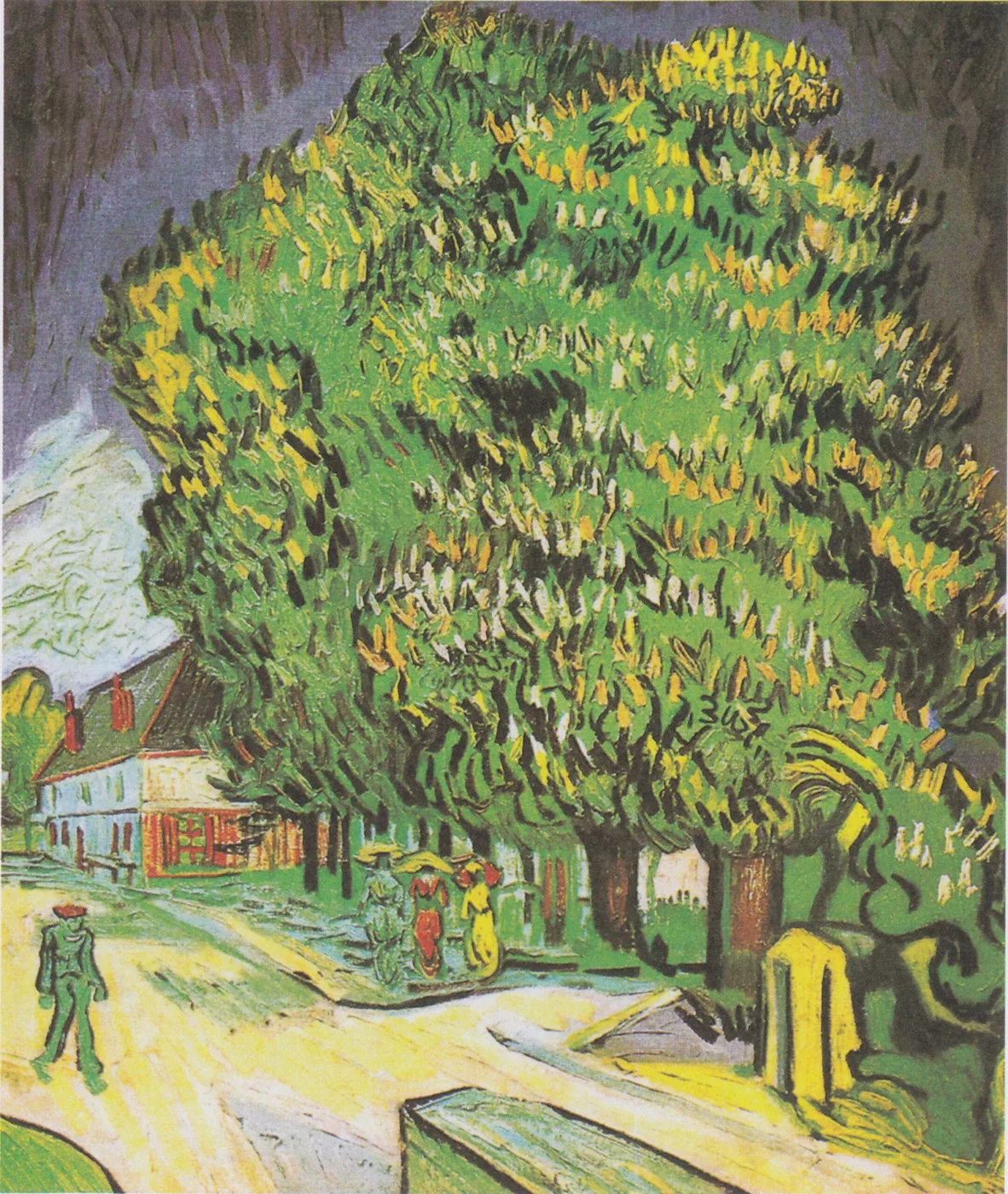
On a canvas just 58 by 70 centimetres, van Gogh built the composition around one enormous chestnut tree, its crown so wide and so tall that it crowds the sky into a narrow band of grey-violet at the top corners. Everything else in the scene, the houses, the road, the passers-by, is compressed beneath it, dwarfed by the sheer bulk of blossom overhead.
At the foot of the tree runs a pale ochre street, lined on the left by a low house with a red-tiled roof and shuttered windows. A man in a green coat and cap walks alone in the foreground, while further along the road a small group of women in red, yellow and dark cloth pause under wide summer hats, one carrying a parasol.
The trunk anchors the composition on the right, a dark, twisting column of black and umber strokes that reads almost as gnarled sculpture against the mass of green above it. Smaller trees and a low wall or bench, painted in the same loose green and yellow shorthand, close off the bottom right corner of the scene.
White, Pink and a Green Pushed to Its Limit
Van Gogh built the canopy from an unusually wide register of greens, from near-black shadow to sharp acid yellow-green catching the light at the crown. Scattered through that mass are the blossom candles themselves, dabbed in white, cream, pale pink and touches of orange, so that the tree seems lit from within by hundreds of small flames.
Against this the sky reads as a cold, stormy grey-blue, applied in the same short diagonal strokes as the foliage, so that even the empty passages of the picture feel charged with weather. The road below is warmer, a band of yellow ochre and pale green that catches whatever light escapes the canopy.
The effect is a canvas with almost no neutral ground. Colour is pushed hard everywhere at once, and it is the collision of that cool sky against the hot blossom, rather than any single passage, that gives the painting its charge.
Marks Laid Down at Speed
The blossom is not described so much as struck onto the canvas: short, curling dashes and flicked commas of paint, laid one beside another without blending. Up close the tree dissolves into pure mark-making, thousands of individual touches that only resolve into leaves and flowers at a distance.
This was Van Gogh’s late method at its most economical. Rather than modelling each cluster of flowers with care, he trusted a fast, repeated gesture, the same stroke used again and again with small shifts of colour and direction, to stand for the flicker of light through a moving crown of leaves.
The figures below are painted with the same shorthand, reduced to a handful of strokes each, just enough to fix a hat, a coat, a stride. Nothing in the picture is laboured. The whole surface carries the sense of a painter working against time, in the last spring he would see.
Living With the Painting
Hung in a room with changing daylight, the picture behaves less like a fixed image and more like weather. Morning light draws out the cool grey of the sky and the shadowed underside of the canopy; by evening, artificial light warms the yellows and pinks of the blossom until the tree seems to glow from the inside.
Because the canopy fills almost the whole frame, the painting reads at a distance as a single mass of green and white, and only on approach does it break into the village street, the walking figures, the individual flowers. That shift rewards a spot where it can be seen from across a room as well as up close.
It suits a green-toned or neutral wall, where its own greens can carry the room rather than compete with a busy palette around them. What stays with a viewer, long after the details of the street have been taken in, is the sheer scale of the blossom itself, a tree in full flower painted by a man who had very little spring left to see.
Sizes and materials for Chestnut Trees in Blossom are listed on its product page.
More from this collection
Bring this painting home
Choose a hand-painted oil reproduction for real brushwork, or an archival canvas print for a crisp museum-image edition. Every size preserves the original proportions.
View this work & options
Further reading
Verify the original in the collection record and continue through related works in the catalogue.