
Glass with Yellow Roses: Story, Meaning & Brushwork
Vincent van Gogh reached Paris in the early spring of 1886, arriving without warning at his brother Theo’s door and staying for two years that would remake how he painted. Theo ran a gallery that dealt in the new French painting, and through him Vincent had rooms to see Impressionist canvases at close range rather than hear about them second-hand from Antwerp or Nuenen. He did not adjust his palette overnight. Instead, through that first year in the city, he worked through a series of small canvases, still lifes mostly, using whatever sat on the table in front of him as a way of testing colour against colour.
Flowers were the obvious subject for this kind of exercise: cheap, replaceable, and available in a city where a market stall was never far away. A bunch of roses in a glass of water gave him a fixed arrangement of yellow, green and reflected light that he could return to over several sittings without the flowers themselves surviving that long. The pressure was not to compose a masterwork but to see what happened when thick, warm paint met a background he had not yet learned to lighten.
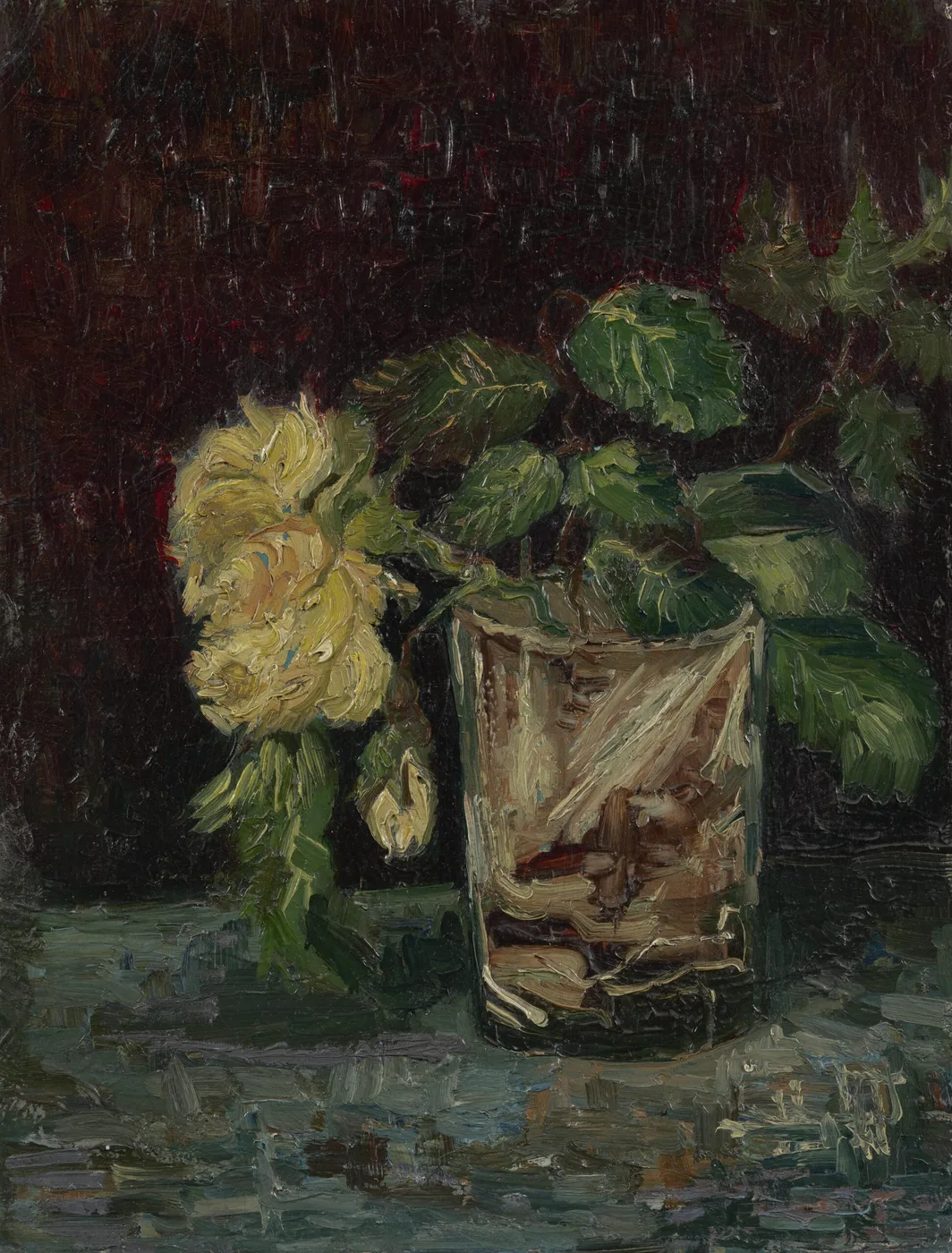
Glass with Yellow Roses, painted in 1886 and now held by the Van Gogh Museum, is one result of that testing. At 27 by 35 centimetres it is a small picture, worked at the scale of a tabletop rather than a wall, and it shows an artist mid-argument with himself: reaching for a freer touch in the flowers while the space around them still behaves like the interiors he had left behind in Brabant.
A Tumbler, Not a Vase
The flowers sit in an ordinary drinking glass rather than anything chosen for the purpose, the kind of vessel that suggests someone set a handful of cut roses down on a table without much ceremony. A loose cluster of pale yellow blooms, their petals running from near-white to a deeper ochre where the paint sits thickest, leans out toward the left edge of the canvas. One bud has already given up its weight, hanging low on a bent stem below the main cluster, caught at the exact point where the arrangement has started to go over.
Behind and above the roses, a dense mass of broad green leaves rises to fill the upper right of the canvas, so that foliage rather than flower claims most of the picture’s height. The glass itself stands roughly at the centre, straight-sided and cut with visible facets that catch the light in diagonal streaks of cream and pale pink, with the water inside rendered as little more than a scatter of loose, dark strokes.
Below the glass, a greenish tabletop carries a soft, broken reflection of it, painted with none of the definition given to the bouquet above. The whole arrangement sits low and slightly left of centre, leaving the top third of the canvas to leaves and the dark wall behind them.
Where the Brush Changes Its Mind
What catches the eye first is how differently Van Gogh has handled the roses and the leaves that surround them. The petals are built from short, thick, almost sculptural strokes of white, cream and yellow, laid on heavily enough that individual petals stand slightly proud of the canvas surface when seen up close.
The leaves, by contrast, are painted more loosely, in overlapping strokes of green, olive and a sharper yellow-green where light catches their upper faces. The effect is a kind of restless, unfinished energy that has little in common with the careful, tighter brushwork of the still lifes he had painted in the Netherlands only a year or two earlier.
The glass is the picture’s quietest piece of technical daring. A small number of pale, dry strokes in white and green describe its facets and the liquid inside, doing the work of transparency with very little paint and letting the dark ground behind it stand in for shadow. It is not a showy passage, but it is the one place in the canvas where Van Gogh trusts a few marks to do a great deal of work.
The Wall That Still Belongs to Nuenen
Behind the bouquet, a deep maroon-brown wall fills most of the upper canvas, worked over in short, repeated, near-vertical strokes that never quite settle into a flat colour. It reads less like the airy backgrounds of the Impressionist canvases Van Gogh was seeing in Paris that year and more like the hatched, sombre interiors of his paintings of Brabant peasants.
That contrast is the real subject of the picture, more than the roses themselves. A painter who had spent years mixing browns and umbers for cottage interiors was, in this canvas, trying out a brighter, more broken handling for the flowers while the habits of his old palette still governed everything around them. The result sits between two ways of painting rather than fully inside either one.
A Small Canvas That Needs Good Light
Hung on a wall, this is not a picture that announces itself from across a room. In dim or indirect light the maroon background reads as close to black, and the roses can blur into a pale smudge until the eye has time to adjust and separate petal from glass, and glass from the leaves behind it.
Direct or raking light changes that considerably. The built-up strokes on the flowers begin to catch light and throw small shadows of their own, and the picture takes on a texture that no reproduction quite conveys. It is a canvas that rewards being noticed in passing, the way an actual glass of cut flowers left on a table might be noticed, rather than one built to be read instantly from the far side of a room.
That quiet, uneven presence, giving up its colour only under the right light and staying half in shadow otherwise, has more to do with what Van Gogh was actually working through in 1886 than with the brighter palette people now associate with his name. It is an early picture, made by an artist still deciding what kind of painter he was going to become.
Sizes and materials for Glass with Yellow Roses are listed on its product page.
More from this collection
Bring this painting home
Choose a hand-painted oil reproduction for real brushwork, or an archival canvas print for a crisp museum-image edition. Every size preserves the original proportions.
View this work & options
Further reading
Verify the original in the Van Gogh Museum collection record and continue through related works in the catalogue.