
Portrait of Madame Trabuc: Story, Meaning & Brushwork
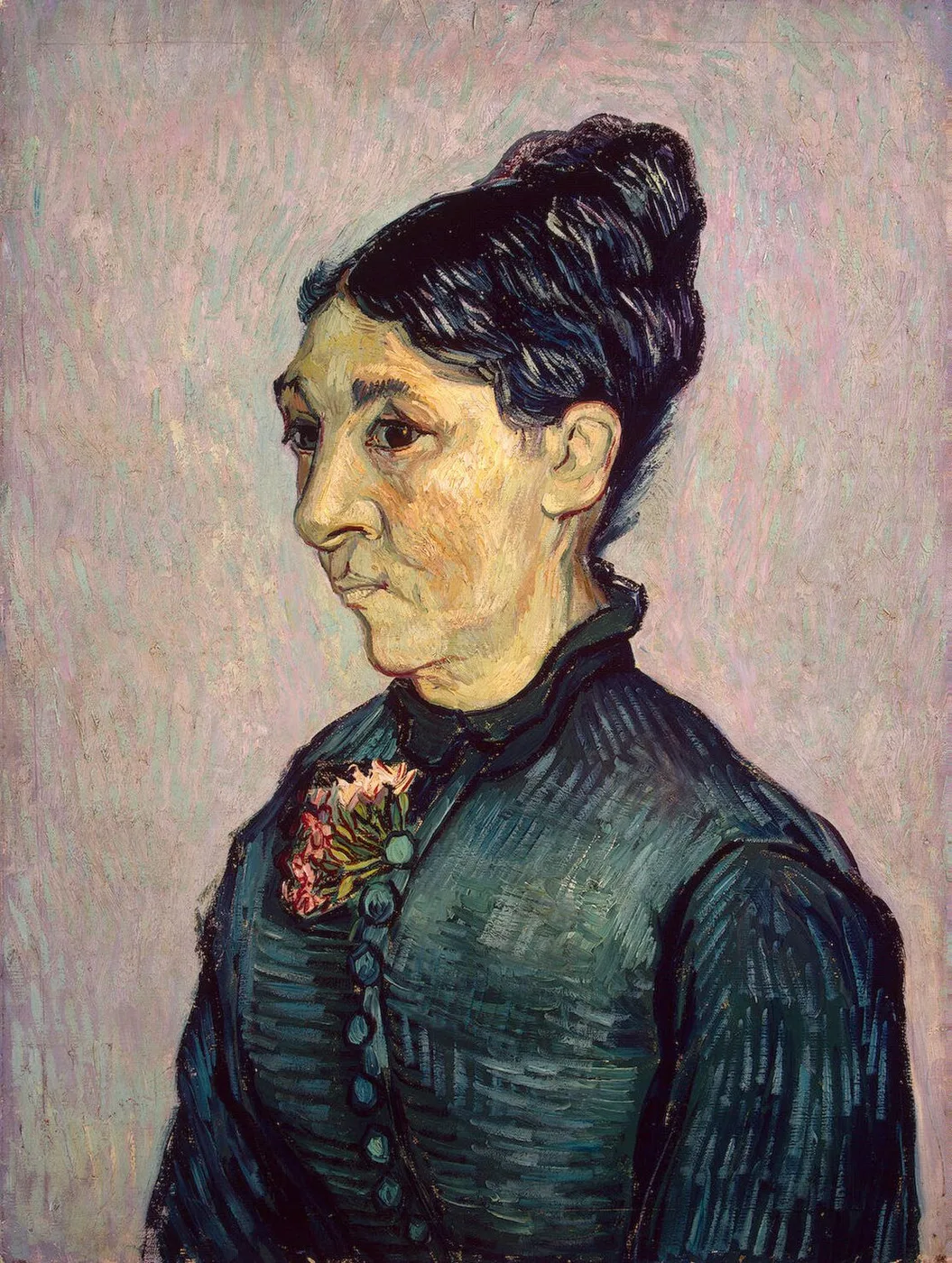
By the spring of 1889 Vincent van Gogh had committed himself to the asylum of Saint-Paul-de-Mausole, just outside Saint-Remy-de-Provence. He had asked to go there after the crisis in Arles, and he stayed for just over a year, painting in bursts between episodes that left him unable to work at all. Models were almost impossible to come by inside those walls, so when a willing sitter appeared, he seized the chance.
That sitter was the wife of Charles-Elzeard Trabuc, the head attendant who supervised the ward and had grown, by van Gogh’s own account, into something like a trusted acquaintance. Van Gogh painted the husband first, in a portrait of similar directness, and then turned to Madame Trabuc. She gave him what Saint-Remy rarely offered: a face he could study for as long as he needed, sitting still in a room he already knew.
A household portrait made under lock and key
There is nothing incidental about this picture. Van Gogh was a painter who thrived on daily contact with people and places, and the asylum cut him off from both. Letters from that year describe his hunger for subjects beyond the walled garden and the view from his cell window.
Madame Trabuc answered that hunger directly. She was not a professional model and there is no sign in the finished canvas that she was asked to perform anything for the artist. She sits as a woman of the household staff might sit for a portrait she had agreed to as a favour, composed and a little wary, giving van Gogh her attention without giving him a performance.
The painting is dated 1889, placed by scholars among the small cluster of portraits he managed in that difficult year, when illness repeatedly interrupted his output and sitters of any kind became precious.
The face she turned toward him
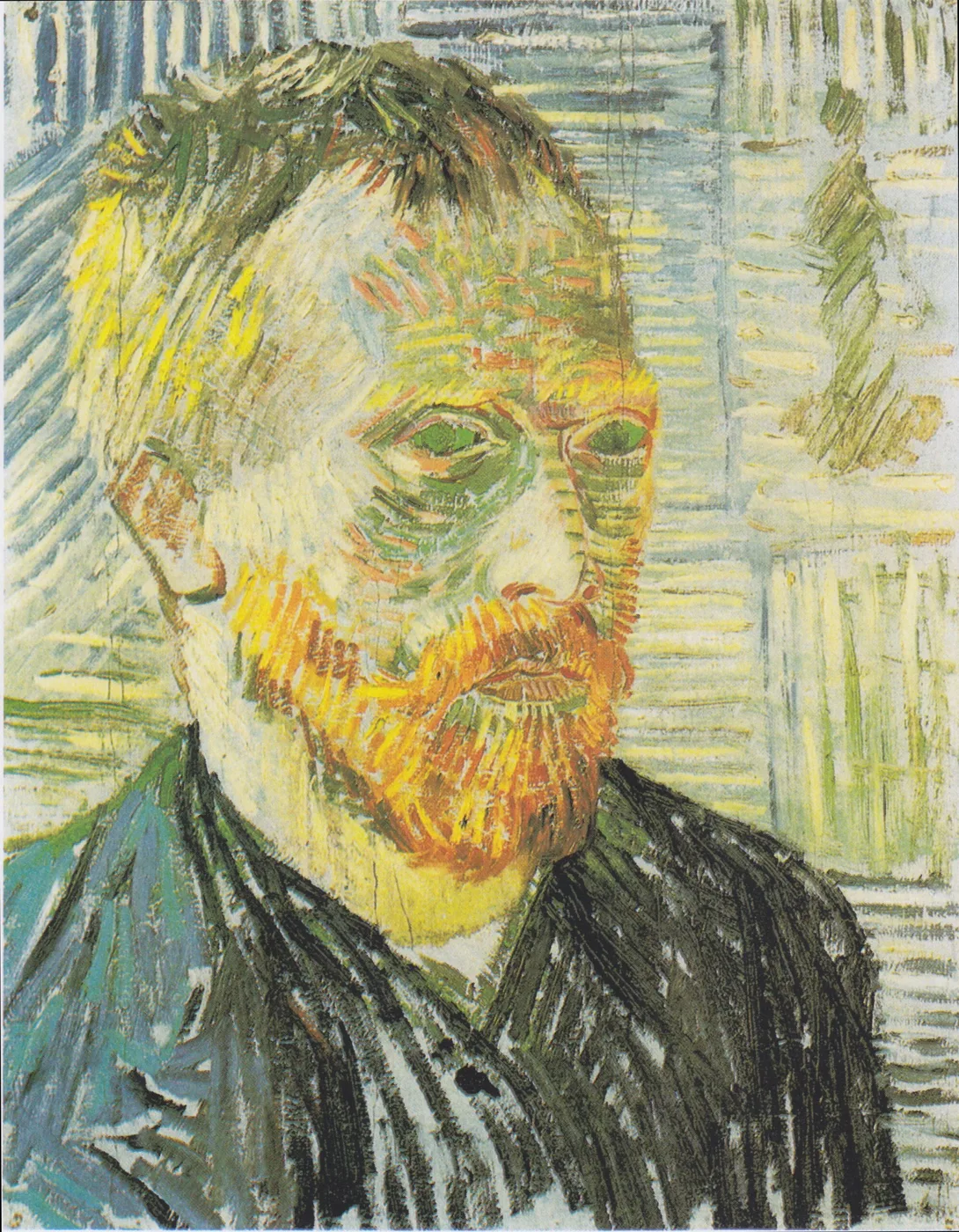
Madame Trabuc is shown from the chest up, her body turned three-quarters and her head in near profile, so that the eye first meets the sharp line of her nose and the set of her mouth before it reaches her eyes. She looks past van Gogh rather than at him, her gaze fixed somewhere beyond the edge of the canvas.
Her hair is drawn back and piled high in a dark, glossy knot, painted in long curving strokes that catch a little cool light along the crown. Her skin is rendered in warm ochre and gold, built up with the same visible, directional touches he used everywhere else in the picture, so that the face reads as constructed rather than smoothed into place.
She is not young in this portrait, and van Gogh does not soften that. The lines around her mouth and the set of her jaw are stated plainly, giving her the gravity of someone used to responsibility rather than the idealised calm of a formal sitter.
A dark green dress against a pink ground
She wears a high-collared dress in deep, ridged blue-green, buttoned to the throat, with a small posy of pink and white flowers pinned at the chest, the one bright accent against all that dark cloth. The buttons run in a straight line down the front, each one a small, distinct dab of paint that anchors the composition as it descends.
Behind her, the wall is a soft, warm pink, worked in short diagonal strokes that give the surface a woven, almost textile quality rather than a flat wash. The pairing of that green dress against the pink ground is the picture’s real subject as much as the sitter herself, two complementary tones set beside each other so that each intensifies the other.
Van Gogh had used this kind of deliberate colour pairing before, choosing hues that sit opposite one another on the wheel to make a portrait carry weight without resorting to heavy shadow. Here the effect is quieter than in some of his Arles work, but it is doing the same job, holding the whole picture together through contrast rather than description.
How the paint itself was laid down
Look closely and the dress becomes a field of short, ribbed strokes running mostly on the diagonal, echoing the texture of the woven fabric without ever trying to copy it literally. The same economy of gesture shapes the collar and the sleeve, each plane picked out with strokes that change direction just enough to describe where the body turns.
The flowers at her chest are the loosest passage in the whole canvas, a few quick touches of pink, white and green laid down almost as shorthand. Against the more careful modelling of the face, that looseness reads as spontaneity, as if van Gogh allowed himself one moment of freedom once the harder work of the likeness was settled.
The canvas itself is modest in scale, measuring 48 by 63.7 centimetres, close enough to life size in the face that the portrait holds a genuine sense of presence without ever feeling monumental.
What it does hanging in a room
A portrait built on this pairing of deep green and warm pink behaves differently depending on the light around it. Under daylight the pink ground reads soft and airy, and the green dress sits forward, dense and grounded, so the whole picture has a kind of quiet weight.
Under lamplight in the evening the warmer tones pull forward and the green recedes further into shadow, and Madame Trabuc’s face, already turned away from the viewer, seems to withdraw a little more into her own thoughts. That shift is part of what keeps a picture like this worth living with, since it does not settle into a single fixed mood.
The original is recorded in the Otto Krebs collection, and its details are catalogued under the Wikidata record for the work. It remains one of the clearest surviving traces of the handful of people van Gogh was able to paint from life during his year at Saint-Remy.
Sizes and materials for Portrait de Madame Trabuc are listed on its product page.
More from this collection
Bring this painting home
Choose a hand-painted oil reproduction for real brushwork, or an archival canvas print for a crisp museum-image edition. Every size preserves the original proportions.
View this work & options
Further reading
Verify the original in the Otto Krebs collection collection record and continue through related works in the catalogue.