
Still Life, Plate with Bread: Story, Meaning & Brushwork
Paris, 1887, and a Change of Diet
Vincent van Gogh arrived in Paris in early 1886 to live with his brother Theo, an art dealer whose flat and gallery contacts put him in daily contact with Impressionist and Neo-Impressionist painting for the first time. By 1887 he had spent a year absorbing lessons he could not have reached in the Netherlands.
Chief among them was the discovery that colour itself, not brown shadow, could carry a picture. He was watching Pissarro, Signac and others break their paint into separate, visible strokes, and he wanted to try the same thing for himself, on whatever he could find.
Money was tight and willing sitters were scarcer still, so Van Gogh turned to what was already in the apartment: fruit bought cheaply, cut flowers, and bread. Still life, plate with bread, painted in 1887, belongs to this run of pictures, made not because bread carried some grand symbolism but because it was there, patient, and free to paint as often as he liked.
A loaf does not tire, complain or charge by the hour. It let him work fast, testing how far he could push a narrow set of colours against one another without the added pressure of a likeness to get right.
Bread on a White Plate
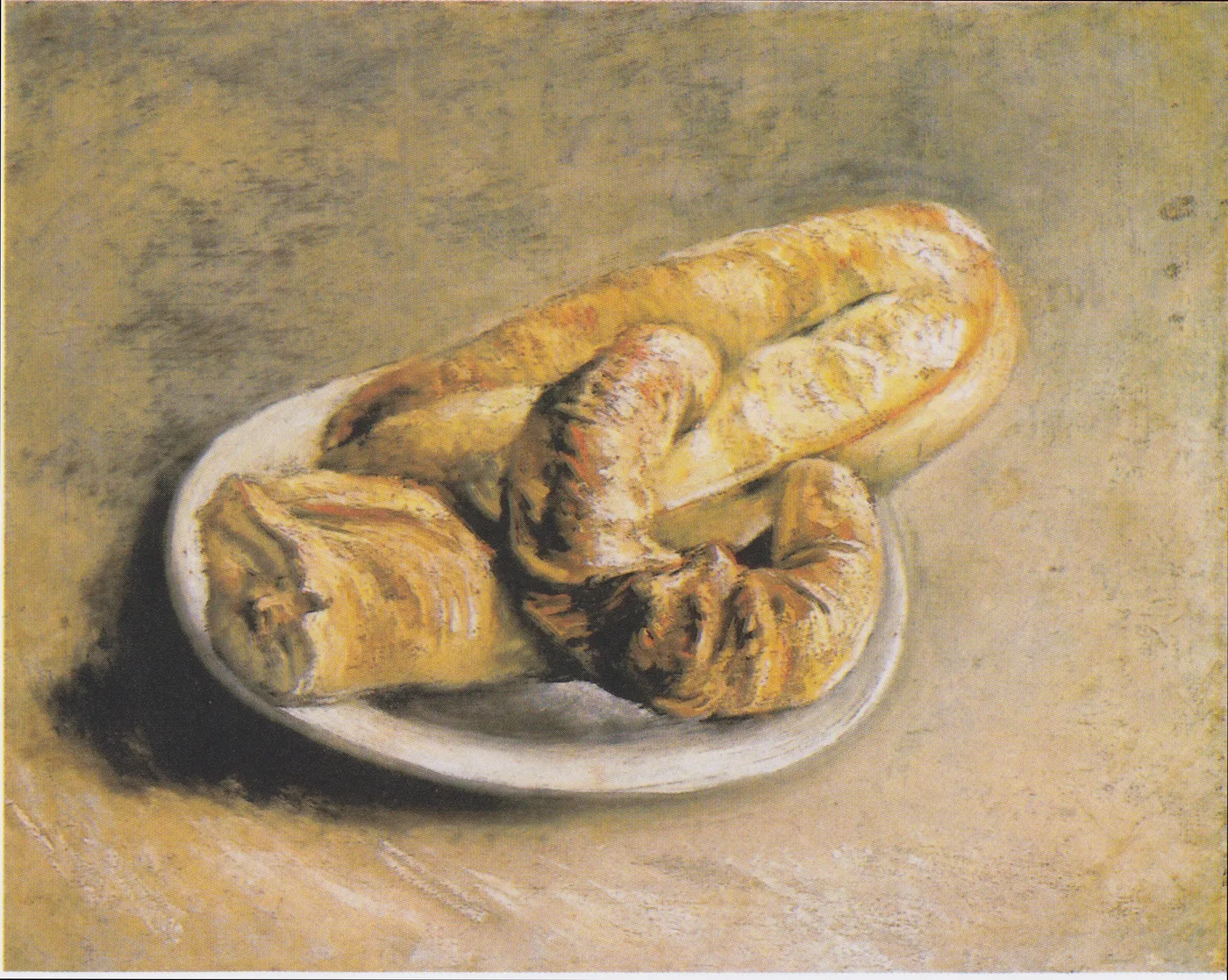
The painting, recorded in the museum’s own catalogue simply as Still life, plate with bread, is small, 40 by 31.5 centimetres, and its subject fits easily within that frame. A plate carries two pieces of bread: one long and curved, tapering to a browned end, the other cut short so its pale, torn interior faces the viewer.
The plate is white and oval, tipped slightly so its far rim rises into view, and it rests on a bare table painted in warm ochre with a scatter of pale, scratch-like strokes at the lower left, as though a cloth or a dry brush had been dragged across the wet paint. Behind it, the wall is a mottled grey-green, brushed unevenly so that darker patches gather like shadow without describing anything specific.
There is no laid cloth, no knife, no scattered crumbs added for the sake of a story. It is plate and bread alone, isolated so the picture reads as a study of a small, related family of tones rather than as an account of a meal.
The Grain of the Brush
Looked at closely, the bread’s crust turns out to be built from short, dragged strokes of ochre, burnt orange and chalky white, laid one over another so that the ridges of the loaf’s folds catch light exactly where a real crust would crack and lift.
Van Gogh does not blend these strokes into a smooth surface. He leaves them separate, almost hatched, so the crust reads as broken light rather than as a described object. Where the longer loaf curls back on itself, deep umber and grey-violet shadow gathers into the fold.
The white plate is handled no differently. It is not flat white but a mix of cool grey, blue-tinged shadow and warm ochre reflected up from the table, so the porcelain never goes dead or chalky.
This close, warm palette is what he was testing that year: a narrow family of ochres and neutral whites set against cooler greys, worked hard to see how much life could be drawn from a handful of pigments without reaching for a single loud colour.
A Small Canvas That Holds Its Own
Hung today, the painting stays close to the wall in scale. At 40 by 31.5 centimetres, it asks to be read from a few paces off, the distance at which the separate strokes resolve into the sheen of a crust and the soft give of a cut loaf.
In direct light, the ochres and warm whites of the bread lift forward and the grey-green wall recedes behind them. In duller light, the picture flattens toward a single warm haze and the individual strokes become harder to pick apart, closer perhaps to how Van Gogh saw it himself by lamplight in Theo’s rooms.
It rewards the kind of looking a kitchen or dining room invites naturally: a glance before sitting down, a longer look once the room has emptied. Nothing about it demands attention from across a space: everything about it holds attention once you are close.
The original remains at the Van Gogh Museum, a small, unglamorous witness to a year in which a largely self-taught painter used the food already on the table to teach himself how colour actually behaves.
Sizes and materials for Still Life, Plate with Bread are listed on its product page.
More from this collection
Bring this painting home
Choose a hand-painted oil reproduction for real brushwork, or an archival canvas print for a crisp museum-image edition. Every size preserves the original proportions.
View this work & options
Further reading
Verify the original in the Van Gogh Museum collection record and continue through related works in the catalogue.