
Encampment of Gypsies with Caravans: Story
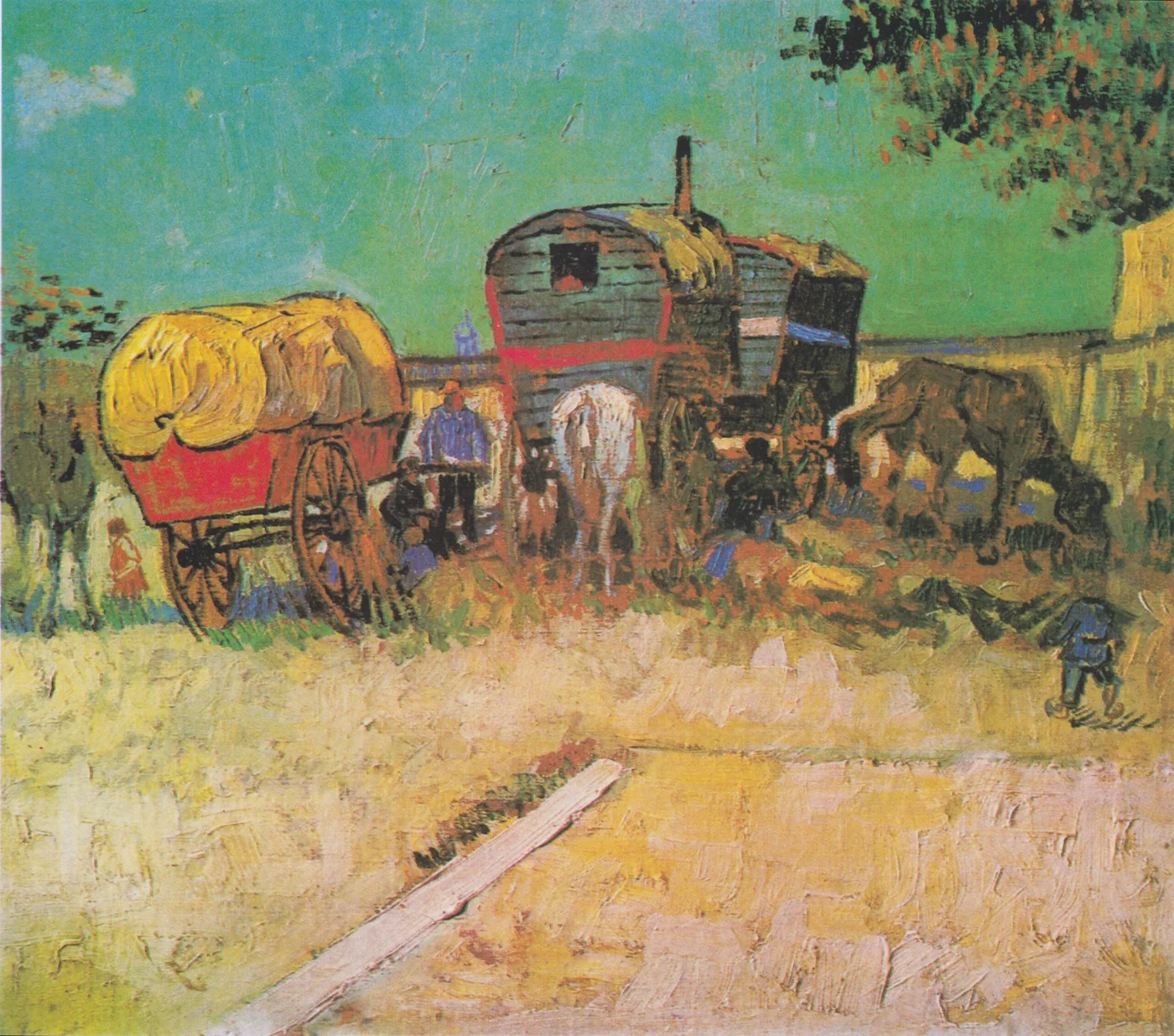
A Halt on the Road Out of Arles
In the summer of 1888 Vincent van Gogh was working at a pace that alarmed even his own brother, sending finished canvases north from Arles faster than Theo could hang them. Between the wheat fields and the orchards he kept turning to the roads themselves, and to the people who did not stop on them the way everyone else did.
Gypsy families travelling through Provence in covered wagons were a familiar sight along the routes near Arles, camping for a night or two before moving on. Van Gogh painted this halt as he found it, without staging or sentiment, a working camp rather than a picturesque vignette.
He had spent the earlier months of the year absorbed in orchards in blossom and would soon turn to the wheat harvest and the night sky over the Rhône. This canvas sits between those better-known campaigns, a quieter subject caught on an ordinary afternoon.
Two Wagons and a Green Sky
The composition is built around two very different vehicles standing side by side. On the left a farm cart with a bright ochre-yellow hood and a red-painted body rests on tall wheels, its shafts propped against the ground. Beside it stands a heavier caravan, dark green with a red trim band running along its side and a thin stovepipe chimney rising from the roof.
A white horse stands harnessed between the two, its pale coat the brightest passage of paint in the lower half of the canvas. Further right a second horse, dark brown and unharnessed, bends its head to graze at the ground, its bulk set against the pale wall behind it.
Small figures move around the wagons: a man in a blue jacket stands near the caravan steps, others sit or crouch in its shade, and a lone figure in blue walks away down the track towards the lower right corner, already small with distance. None of them meet the viewer’s eye, and the scene reads as glimpsed rather than posed.
Above it all the sky is not blue but a deep, almost turquoise green, broken only by a scrap of white cloud at the upper left. A dark tree with heavy, near-black foliage crowds in from the top right corner, its branches cropped by the edge of the canvas, giving the whole scene a sense of having been caught mid-glance rather than composed.
A Track Painted Almost Bare
The lower third of the canvas is given over to the dirt road itself, laid down in broad strokes of ochre, cream and rose pink. A single pale plank of wood lies across it on the diagonal, the one deliberate incident in an otherwise empty foreground.
This expanse of open ground does real work in the picture. It pushes the camp back into the middle distance and gives the eye a long, plain surface to cross before it reaches the wagons, horses and figures clustered beyond.
Colour Laid on Fast
Van Gogh worked this canvas in short, loaded strokes, the paint often thick enough to hold the mark of the brush or knife that placed it. The yellow hood of the cart and the red of its body are set down in almost unmixed colour, one against the other, with barely any transitional tone between them.
The green of the sky and the ochre of the road are handled the same way, as flat fields of strong colour rather than graded light. Outlines are dark and quick, more drawn than painted, holding the wagons and animals together against grounds that might otherwise swallow them.
Nothing here is smoothed or blended for polish. The picture keeps the evidence of having been painted quickly, in front of the subject, before the camp moved on.
Forty Years On, Still on a Wall
Encampment of Gypsies with Caravans measures 51 by 45 centimetres, a modest size that Van Gogh often worked to that year when painting directly from a scene rather than building a larger studio composition. The original hangs in the Musée d’Orsay in Paris.
At that scale the picture behaves differently depending on the light around it. In direct daylight the green sky and yellow hood carry the room, and toward evening the darker greens of the caravan and the black tree come forward, with the white horse becoming the point the eye returns to.
It rewards a short distance and a long look, the kind of picture that changes character across a day the way the road it depicts would have changed with a moving camp, gone and elsewhere by morning.
Sizes and materials for Encampment of Gypsies with Caravans are listed on its product page.
More from this collection
Bring this painting home
Choose a hand-painted oil reproduction for real brushwork, or an archival canvas print for a crisp museum-image edition. Every size preserves the original proportions.
View this work & options
Further reading
Verify the original in the Musée d'Orsay collection record and continue through related works in the catalogue.