
Still Life with Cabbage and Clogs: Story
A Self-Taught Painter’s Early Exercise
In 1881 Vincent van Gogh was not yet the painter of sunflowers and starry skies. He was twenty-eight, living with his parents in the Brabant village of Etten, and only beginning to teach himself to draw and paint with any consistency, having decided the previous year to give his life over to art.
He had no formal training worth the name, and little money for models or costly subjects. What he had was the parsonage kitchen, the vegetable garden, and the plain wooden footwear worn by the labourers around him, so these became his exercises: objects that would sit still, cost nothing, and teach him how form gathers weight under light.
Still Life with Cabbage and Clogs belongs to this period of disciplined practice. It is one of the works in which Van Gogh, still finding his hand, worked through the problem of rendering solid things convincingly before he ever attempted the human figure or the open landscape with any confidence.
What Lies on the Table
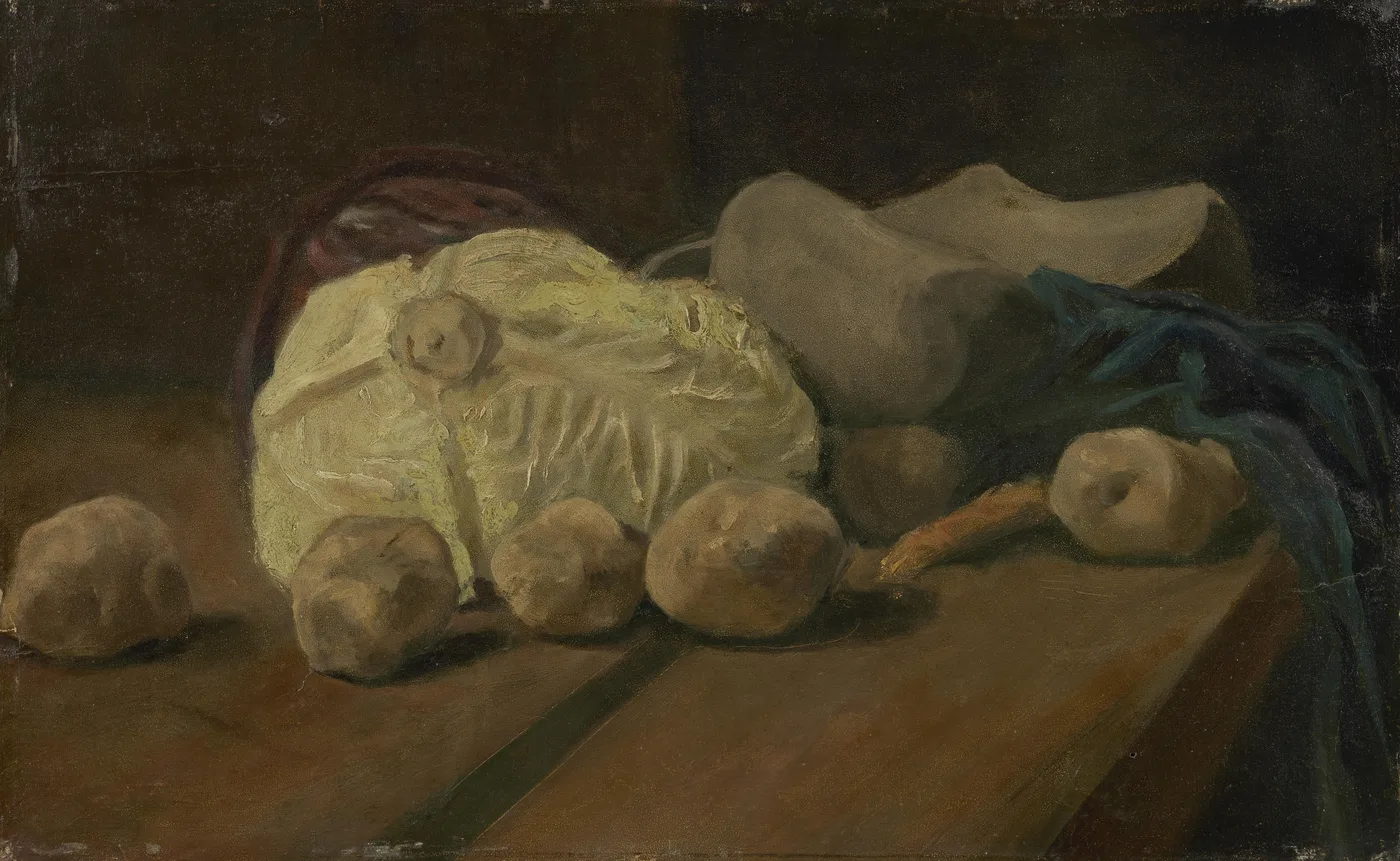
The painting gathers a handful of kitchen vegetables and a pair of wooden clogs on a bare wooden tabletop, pushed close to the picture plane so that nothing recedes far into depth. A pale cabbage sits at the centre, its outer leaves loosely furled and catching the light unevenly across its curved surface.
Potatoes, five or six of them, are strewn along the table edge in front of the cabbage, their skins painted in warm ochres and browns that make them read as heavy, tactile things rather than props. A single carrot lies among them, its orange muted almost to the same earth tone as everything around it.
Behind and to the right, the pale wooden clogs catch what little light reaches the back of the table, their curved uppers rendered in the same chalky cream as the cabbage leaves, so that the two forms almost merge before the eye separates them. A dark cloth or bundle of greens spills down at the right edge, and the indistinct shape of a basket can just be made out in the gloom behind.
The table itself runs on a strong diagonal from lower right toward the upper left, its worn boards giving the only firm structure in an otherwise loosely brushed composition. The eye meets the cabbage first, drawn there by its pale bulk against the dark ground, before travelling along the line of potatoes and out to the clogs.
Earth, Shadow and a Heavy Hand
Van Gogh worked the whole canvas, which measures 55 by 34 centimetres, in a narrow band of browns, ochres and muted greens, with the cabbage and clogs standing out only because they are lighter in tone, not because any colour truly contrasts with another. This is a painter still testing how far he can push value rather than hue.
The background offers almost nothing: a deep, unresolved brown that swallows the upper half of the canvas and gives no sense of a room, a wall, or a window. Whatever light falls across the table seems to come from close by and low, the kind of light a single lamp or a low winter window might have thrown across a kitchen table.
The paint is laid on thickly and without much finesse, the brushwork visible in short, searching strokes that build the cabbage leaves out of overlapping curves rather than describing each one precisely. This is not the confident, rhythmic brushwork of his later Provence years but something more effortful, a young painter working out how paint behaves on canvas.
What the picture lacks in polish it makes up in honesty. Van Gogh was drawn throughout his career to the plain implements of rural labour, and here, at the very start, the cabbage and the clogs already carry the weight and dignity he would later find in a pair of worn boots or a peasant’s hands.
On a Wall, in Changing Light
Hung in a room, this is not a painting that announces itself from across the space. Its palette is close and its contrasts are quiet, so it asks to be approached rather than glanced at, and it rewards a viewer willing to stand near enough to see how the cabbage leaves are actually built from paint.
Morning light will pick out the pale cream of the clogs and the cabbage against the surrounding dark, giving the picture a brief warmth before the shadows reassert themselves later in the day. Under lamplight in the evening it draws inward again, closer to the low, close illumination Van Gogh painted into it in the first place.
The original hangs today in the Van Gogh Museum in Amsterdam, catalogued among the earliest surviving evidence of a painter who had, in 1881, barely begun. Seen in that light, a cabbage and a pair of clogs on a kitchen table become something more than a beginner’s exercise: the first, tentative proof of a hand learning to see.
Sizes and materials for Still Life with Cabbage and Clogs are listed on its product page.
More from this collection
Bring this painting home
Choose a hand-painted oil reproduction for real brushwork, or an archival canvas print for a crisp museum-image edition. Every size preserves the original proportions.
View this work & options
Further reading
Verify the original in the Van Gogh Museum collection record and continue through related works in the catalogue.