
Blossoming Almond Branch in a Glass: Story & Meaning
Vincent van Gogh reached Arles in February 1888 in the middle of an unusually hard frost, snow still lying on the fields he had come south to paint in colour and light. He waited through weeks of cold before the almond trees, always the first to stir in Provence, broke into flower. Blossoming Almond Branch in a Glass records that first sign that the year had turned, a single cut branch set up on a table and studied at close range rather than a tree seen whole in an orchard.
A Cutting Brought Indoors
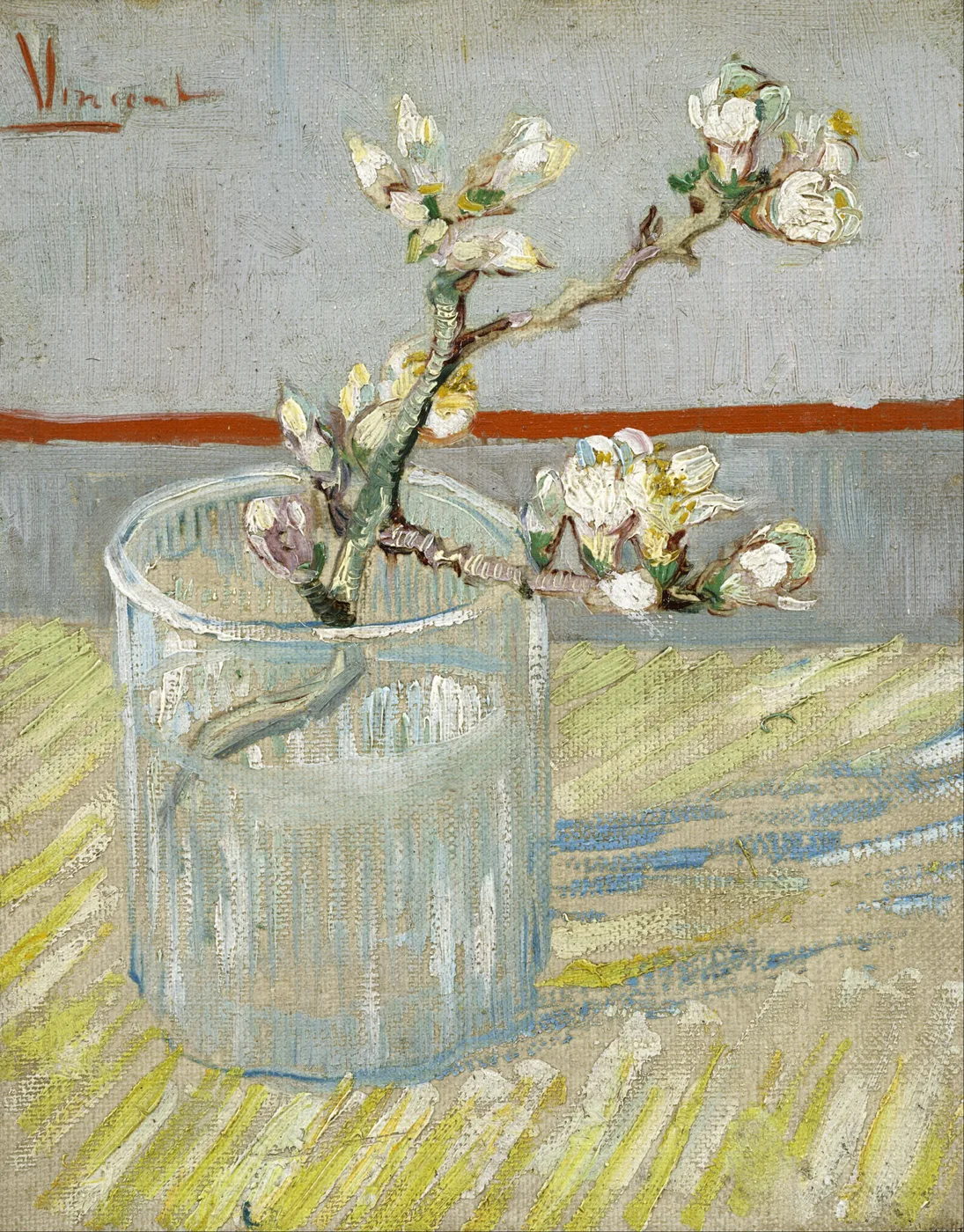
Rather than wait for warmer weather to paint outdoors, Van Gogh brought the spring in to himself. He cut a flowering almond twig, stood it in an ordinary tumbler of water on a table, and painted it as a small, quick study measuring just 19 by 24 centimetres.
The scale matters. This is not a grand orchard piece but something closer to a private note, made at the size of an object you might actually hold, and it has the directness of something painted in a single sitting.
It sits early in a sequence of blossom subjects that would occupy him on and off for two more years, reaching its best-known form in the large Almond Blossom he painted in 1890 for his newborn nephew. Here, in 1888, the idea is still small and exploratory.
What Stands on the Table
A single branch, forked partway up, rises out of a plain glass tumbler of water and leans across the upper half of the canvas. Clusters of white blossom open along its length, some flowers fully spread with soft green and gold centres, others still closed as pale pink buds tight against the twig.
The glass itself is painted almost transparent, its ribbed sides catching pale blue and grey light, the stem of the branch visible where it bends beneath the waterline. Van Gogh signed the work simply “Vincent” in red at the top left, in the loose, upright script he used across his Arles canvases.
Behind the branch, the wall is divided in two: a cool grey blue above, a darker greenish grey below, separated by a single band of burnt orange running the width of the canvas. That thin warm line is the only strong colour note behind the flowers, and it pulls the eye back toward the blossom rather than competing with it.
Below, the tabletop is laid in loose diagonal strokes of yellow green, streaked here and there with pale blue, so that the surface reads as sunlit wood without ever being described in detail. Nothing in the background is finished in the sense of a conventional interior. It exists only to hold the branch up to the light.
A Line Learned from Japanese Prints
Van Gogh had collected Japanese woodblock prints for years before he left Paris, and their influence sits close to the surface here. A single flowering branch cropped against a plain ground, drawn with a firm, unbroken contour, is a compositional habit lifted almost directly from prints of plum and cherry blossom that he owned and admired.
The blossoms themselves are built from small, loaded touches of white, cream and pale pink, laid on quickly enough that individual petals barely separate from one another. Up close the flowers dissolve into paint; from a normal viewing distance they snap back into focus as blossom caught in the act of opening.
The branch itself is drawn more deliberately, with the same dark, springy outline he used for tree trunks and roof beams that year, giving a wiry, almost calligraphic structure for the softer paint of the flowers to hang from.
The Painting in a Room
Hung at eye level in a bedroom or a quiet hallway, this small canvas asks to be looked at closely rather than taken in at a glance. Morning light picks out the ribbed glass and the thin orange band behind it; in the evening the same passages sink into the grey of the background and the blossom is what remains lit.
It rewards the kind of looking a larger, busier painting does not, the same attentiveness Van Gogh gave to a single branch on a February table while he waited for an entire southern spring to arrive.
The original is held by the Van Gogh Museum in Amsterdam, painted there in Arles in 1888, a small, exact record of the first flower of the year set down before it could fade.
Sizes and materials for Blossoming Almond Branch in a Glass are listed on its product page.
More from this collection
Bring this painting home
Choose a hand-painted oil reproduction for real brushwork, or an archival canvas print for a crisp museum-image edition. Every size preserves the original proportions.
View this work & options
Further reading
Verify the original in the Van Gogh Museum collection record and continue through related works in the catalogue.