
Small Pear Tree in Blossom: Story, Meaning & Brushwork
A Garden Season After a Hard Winter
Vincent van Gogh had come south to Arles in February 1888, hoping for stronger light and colour than Paris had given him. Instead he found snow, and a cold that kept him indoors longer than he wanted. When the thaw finally broke and the orchards around the town came into flower, he went out to paint almost every day the weather allowed.
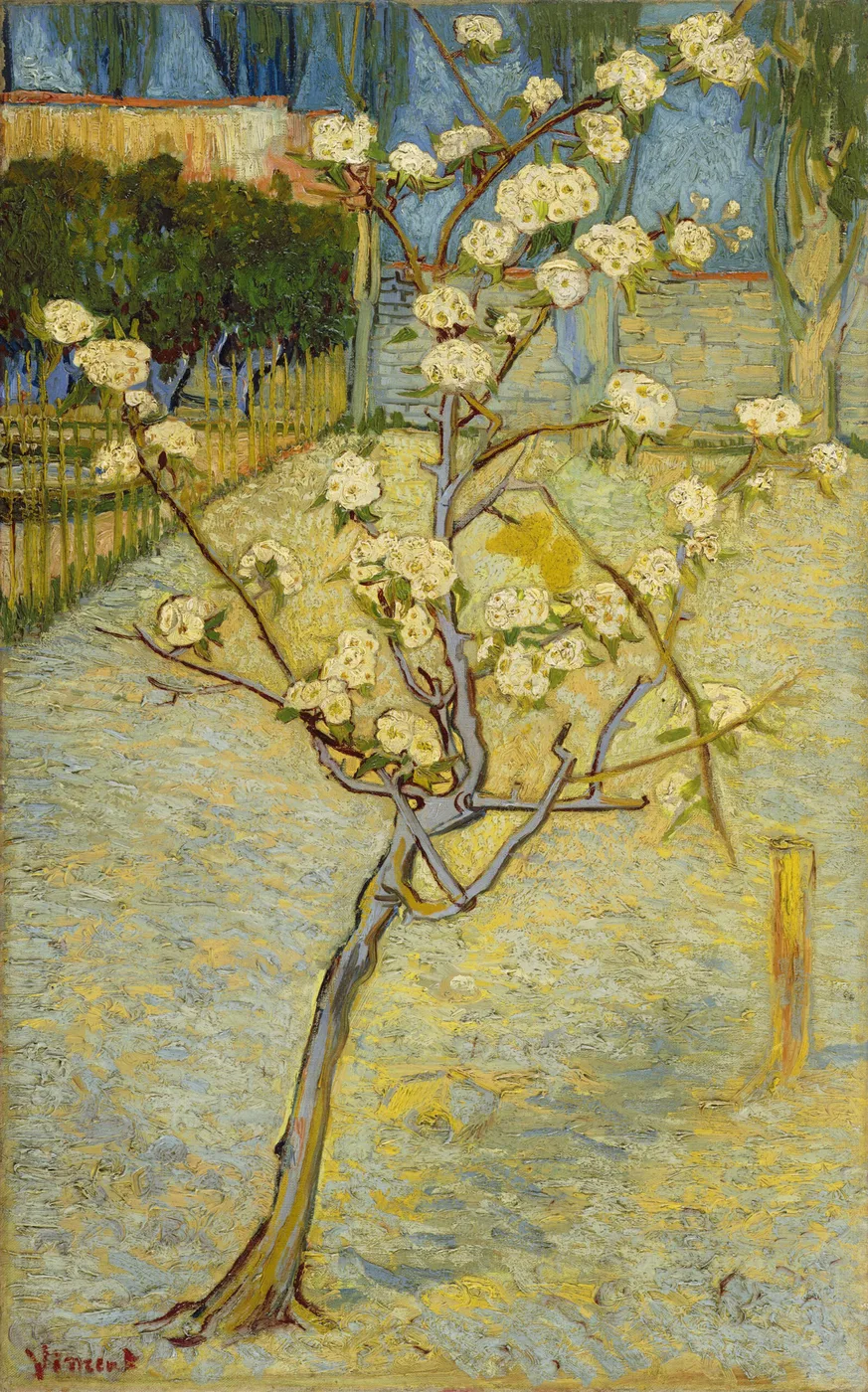
That spring produced a run of orchard pictures, wide views of blossoming rows seen from a distance and closer studies of single trees. Small pear tree in blossom, painted in 1888, belongs to the second group. Rather than a field of trees, it gives its whole canvas, 46 by 73 centimetres, to one young tree standing more or less alone.
The upright format matters here. A wider orchard view invites the eye to travel sideways along a row of blossom. This canvas is built to be read from the ground up, following one trunk as it rises and branches into flower.
A Young Tree, Closely Watched
The pear tree stands just left of centre, its trunk a narrow, twisting column of grey and lilac that leans before it forks. It is a young planting, not yet the thick, gnarled tree of an established orchard, and Van Gogh does not disguise that. Long stretches of branch carry no blossom at all.
The flowers cluster mostly at the crown and along the upper branches, dense rosettes of white touched here and there with pale yellow and the faintest blue in their shaded folds. A scatter of small green leaves breaks through between the blossom clusters, enough to root the tree in early spring rather than full bloom.
A bare wooden stake stands to the right of the trunk, close to its own height, the kind of support given to a tree still finding its footing. It is a small, practical detail, easy to miss, that quietly confirms how young this particular tree is meant to look.
A Garden Behind the Blossom
Van Gogh sets the tree inside a garden rather than open farmland. A low wattle fence, its posts drawn in quick strokes of ochre and brown, runs along a path towards a cluster of buildings with warm, tiled roofs in the upper left. Tall, narrow strokes of blue green rise on the right of the canvas, read more readily as trees or a clipped hedge than as orchard rows stretching to a horizon.
That choice of setting gives the picture an enclosed, domestic feeling rather than the openness of the wide blossom fields Van Gogh painted elsewhere that spring. The ground itself is not grass in any conventional sense. It is built from interwoven strokes of pale yellow, cream and light blue, suggesting sunlit, uneven soil rather than a lawn.
He signs the work simply “Vincent,” in red, at the lower left corner, in the manner he used throughout his mature career.
White Against Blue, Yellow Against Grey
The blossom is built from short, loaded touches of paint rather than blended colour. Each cluster reads, at close range, as a scatter of separate dabs, white at the centre, cooling to blue grey in shadow, warming to a pale gold where the light catches it directly. Seen from a normal viewing distance those touches resolve into full, soft heads of flower.
The sky above is not a flat blue but a field of short, roughly vertical strokes in blue and grey, giving it a quiet restlessness that echoes the upright lines of the trunk and branches. Against that sky the white blossom sits with real weight, the brightest passage on the canvas and the place the eye meets first.
From there the eye is pulled down the leaning trunk, past the bare stretches of branch, to the pale, sunstruck ground. Little of the picture is left unworked. Even the soil carries the same broken, directional brushwork as the sky and the blossom, so the whole surface feels animated rather than settled.
On a Wall, Through the Day
Its upright shape suits a narrow wall, a stair landing, a spot beside a window, anywhere a picture is met at close range rather than viewed across a room. At that scale the blossom keeps its handmade, dabbed quality rather than dissolving into a uniform white mass.
Morning light tends to sharpen the contrast between the white flowers and the blue grey sky behind them. Later in the day, with softer light, the yellows in the ground and the warmer touches within the blossom itself come forward, and the picture reads less crisply, more gently, than it did an hour before.
The original is held by the Van Gogh Museum in Amsterdam, painted in the same spring that gave Arles its brief, crowded season of blossom, before summer heat and later illness would change what Van Gogh painted next.
Sizes and materials for Small pear tree in blossom are listed on its product page.
More from this collection
Bring this painting home
Choose a hand-painted oil reproduction for real brushwork, or an archival canvas print for a crisp museum-image edition. Every size preserves the original proportions.
View this work & options
Further reading
Verify the original in the Van Gogh Museum collection record and continue through related works in the catalogue.