
The Pink Orchard: Story, Meaning & Brushwork
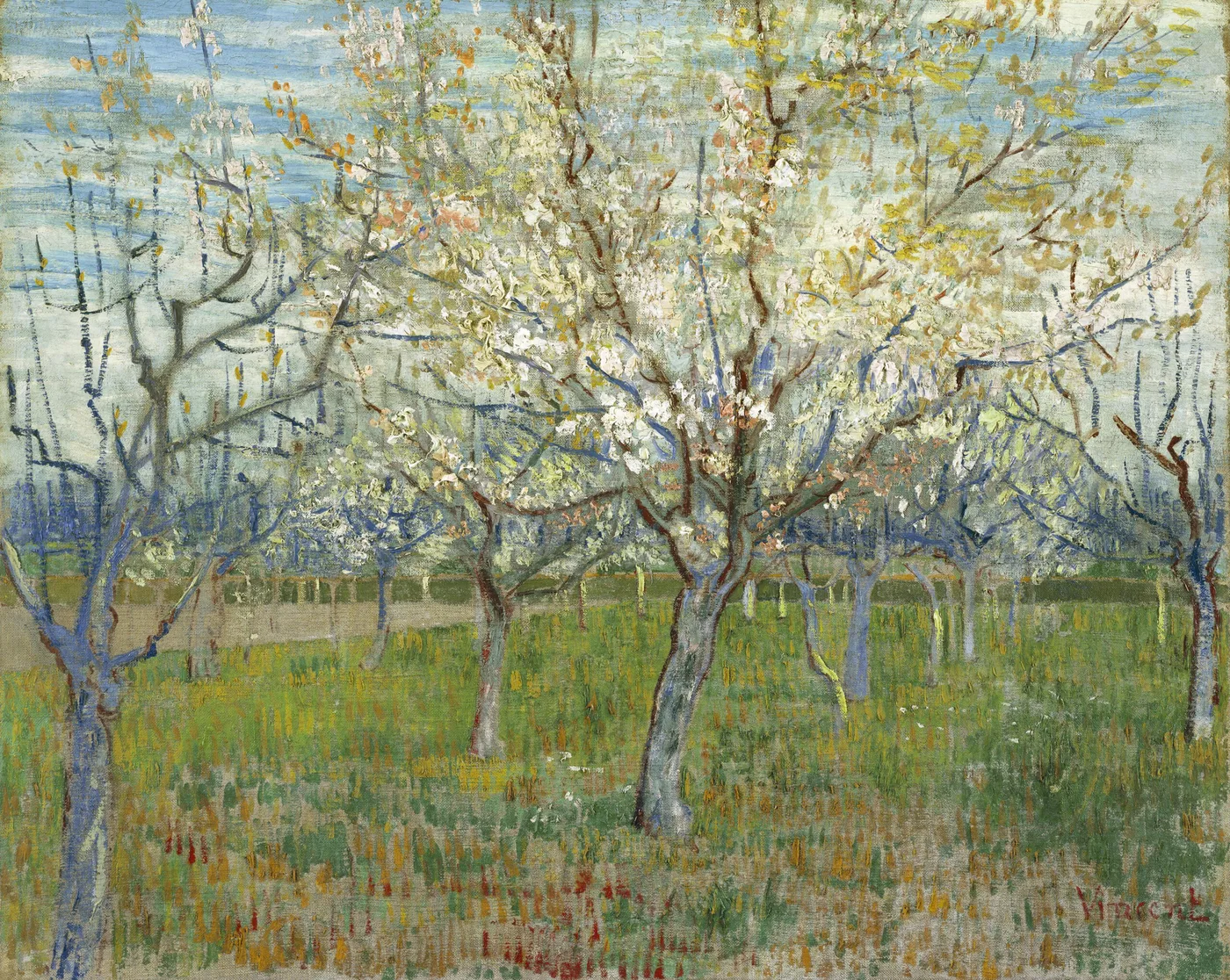
In February 1888, Vincent van Gogh left Paris for Arles, chasing a light he had only imagined through Japanese prints and the paintings of artists he admired. He rented a room, then the Yellow House, and set up to work in a town he barely knew, in a landscape he had not yet learned to read. Within weeks the fruit trees around him began to flower, and he had his first subject.
The orchards did not wait for him to settle in. Blossom opens and falls within days in the Provençal spring, so Van Gogh worked at speed, moving from tree to tree and canvas to canvas before the flowers dropped. The pink orchard, painted in 1888 and now held by the Van Gogh Museum, belongs to that short, urgent campaign.
A Newcomer’s First Weeks in the South
Arles was meant to be a fresh start. Van Gogh had left the crowded, competitive art world of Paris hoping for cheaper living, sharper colour and a landscape closer to the Japanese prints he collected. What he found that first spring was an unfamiliar country of orchards, canals and flat fields under a sky he kept trying to get right.
He wrote often to his brother Theo about the trees coming into flower, describing them as subjects almost too fleeting to catch. The orchard paintings from these weeks are not a single studied series planned in advance. They read instead as a diary kept in paint, one canvas following another as fast as the season allowed.
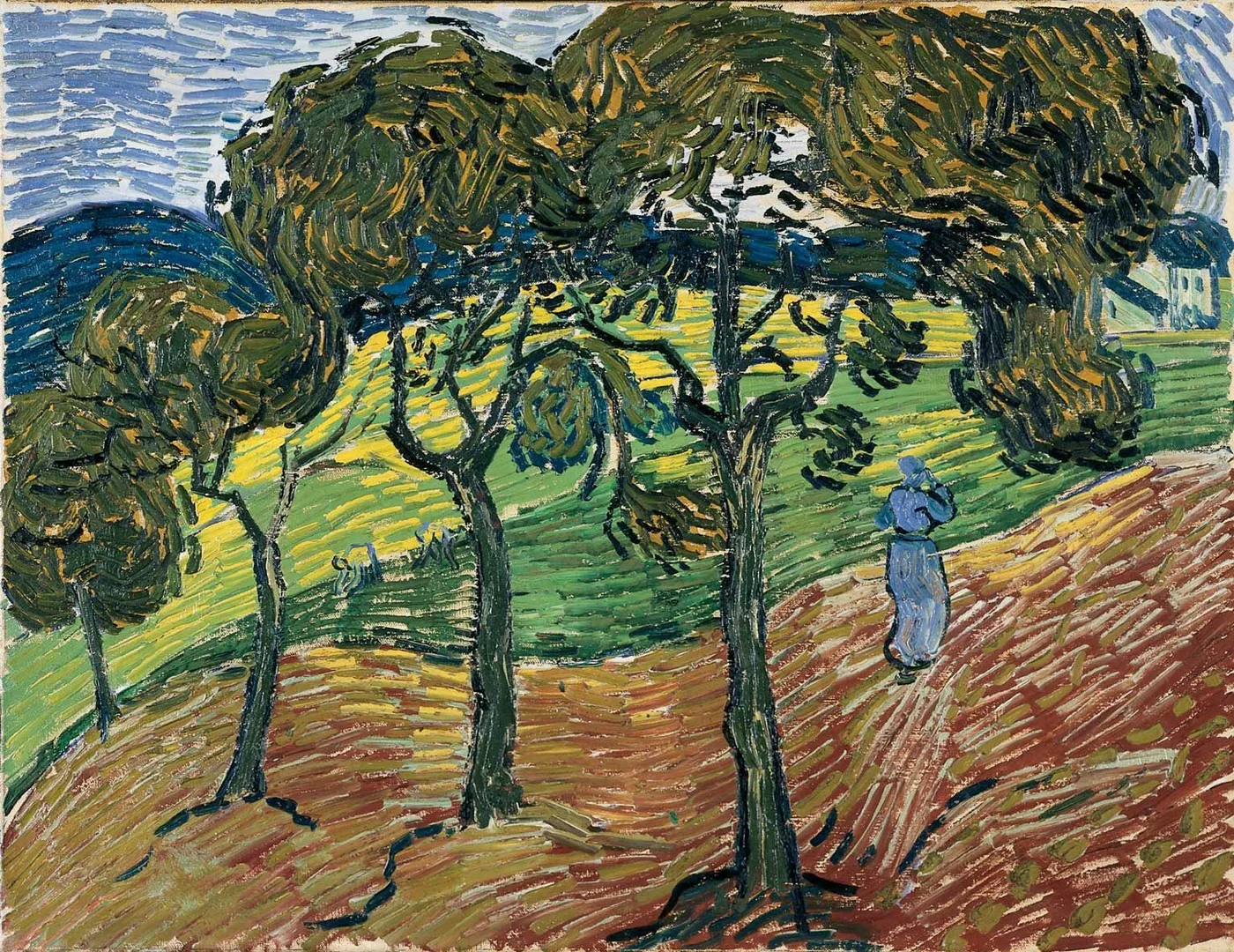
This particular orchard is a plainer, more ordinary plot than the picturesque views tourists might seek out. Rows of young fruit trees stand in grass, their trunks bare of leaves, their branches just breaking into flower. It is a working orchard, not a garden.
Blue Trunks and a Sky Full of Small Fires
The trunks and branches are painted not in brown or grey but in blue and violet, laid down in long, dry strokes that read as bark from a distance and as pure colour up close. Against them the blossom sits in loose clusters of white touched with pale pink and warm cream, thickest through the centre of the canvas where the nearest tree spreads its full crown.
Behind the trees a pale blue sky is streaked with long, combed clouds, calmer and more evenly brushed than the branches in front of it. The horizon is a thin band of ochre and green, just enough to place the orchard in open country rather than an enclosed garden. Further trees repeat in smaller, softer versions towards the back of the picture, giving the orchard real depth without any fussy detail.
Underfoot the grass is built from short, choppy strokes of green, yellow and a scatter of red and orange that could be fallen petals, wild poppies or simply the broken light of early spring. Nothing in the grass is described in detail. It exists as texture and colour, a floor for the trees to stand on.
The eye lands first on the tallest, most fully flowered tree just right of centre, where the blossom is densest and the trunk darkest against it. From there it moves out along the thinner, still-bare branches at either edge, and down into the tangle of colour at ground level. Van Gogh signed the canvas in red in the lower right corner, a small, deliberate mark of ownership on a picture made in a hurry.
Painted at the Speed of the Blossom
The paint itself is thin in places and heavier in others, applied wet into wet rather than built up in layers over time. Van Gogh had little choice but to work fast. A tree in full flower might be bare again within the week, so each canvas had to be settled in a single sustained sitting or not at all.
That urgency shows in the brushwork. The blossom is not rendered petal by petal but suggested in short dabs and dashes, some almost dry, that read as flowers only when the eye steps back. Up close the canvas dissolves into pure mark-making, small strokes of white, pink and pale yellow set directly against the blue of the branches.
The picture takes its title from the blush of pink running through the white blossom rather than from any single dominant colour, and that pink sits lightly across the canvas, in the tips of the flower clusters and the warmer passages of the trunks. It is a quieter pink than the title might suggest on its own, closer to a flush than a solid colour, which is part of what makes the picture worth looking at slowly.
Van Gogh painted roughly a dozen orchard scenes that spring, working through fruit trees of different kinds as they came into flower in turn. Seen against that group, this canvas is neither the most crowded nor the most sparse. It sits in the middle of the campaign, a working painter’s record of one more morning spent racing the light.
What the Orchard Gives a Room
Hung where morning light reaches it, the picture picks up warmth in the blossom and lets the blue trunks read almost black against it. Later in the day, under a cooler or artificial light, the same trunks lift back into colour and the whole canvas turns quieter, more blue than pink.
It rewards a wall where someone will actually stand close to it now and then, since the brushwork only makes full sense at short range. From across a room it is a spring orchard in flower. Nearer, it becomes a record of how quickly one painter had to work, and how much he still managed to see, in the first weeks of a season that would not wait for him.
Sizes and materials for The pink orchard are listed on its product page.
More from this collection
Bring this painting home
Choose a hand-painted oil reproduction for real brushwork, or an archival canvas print for a crisp museum-image edition. Every size preserves the original proportions.
View this work & options
Further reading
Verify the original in the Van Gogh Museum collection record and continue through related works in the catalogue.