
Wheatfield with Crows: Story, Meaning & Brushwork
In May 1890 Vincent van Gogh left the asylum at Saint-Remy-de-Provence and settled in Auvers-sur-Oise, a village on the Oise river north of Paris, placing himself under the informal watch of Dr Paul Gachet. He took a room above the Ravoux inn and worked at a pace that still startles historians who study his output from these weeks.
In a little over two months he produced roughly seventy paintings: wheat fields, farmhouses, the doctor’s garden, the church at Auvers, portraits of people from the village. Wheatfield with Crows belongs to that final, furious burst of work, painted in July 1890.
The wheat fields around Auvers stretch out flat and open above the village, and Van Gogh returned to them repeatedly that summer, drawn to their scale and to how their colour shifted as the crop ripened toward harvest.
A field with no clear way through
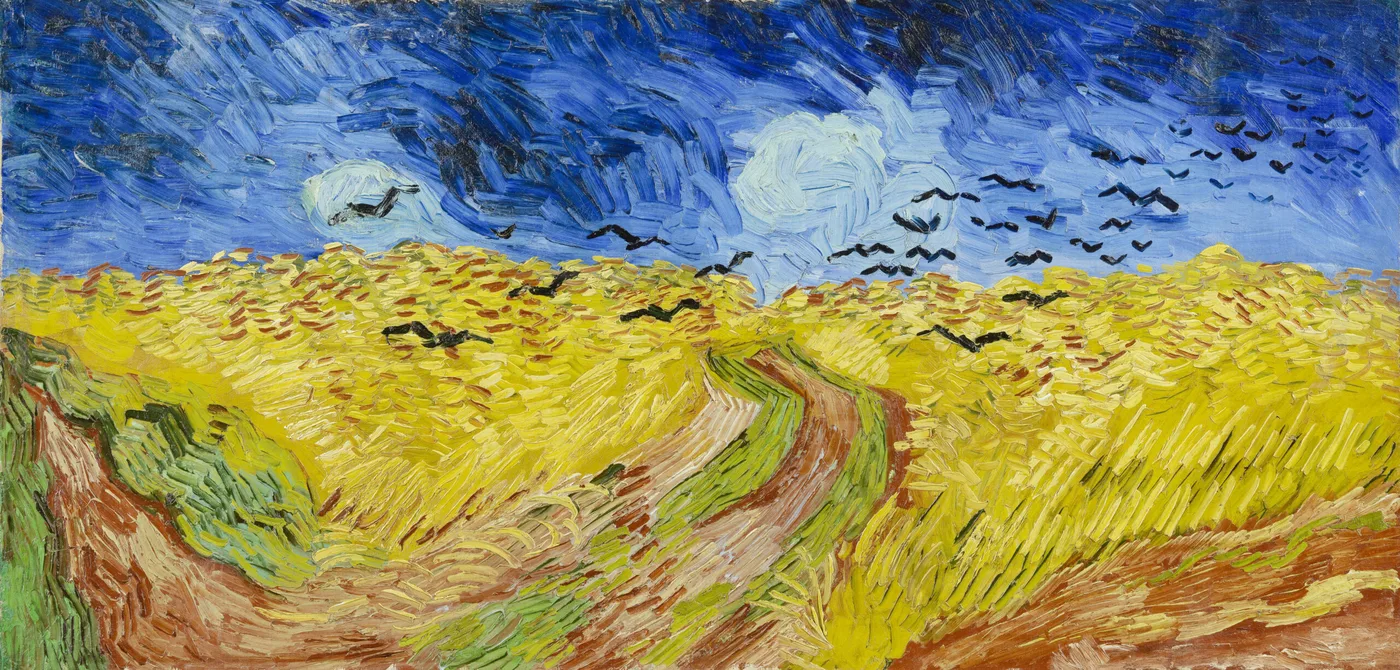
The canvas is long and low, 103 by 50.2 centimetres, a format Van Gogh had taken up that summer specifically for these wheat field subjects. It lets the eye travel sideways across the land rather than into it, the way a real field is met when you stand at its edge.
Ripe wheat fills nearly the whole lower two thirds of the picture, worked in short strokes of chrome yellow, ochre, and touches of orange and green that never settle into one flat colour. Close up the field reads as pure mark-making; from a step back it becomes grain moving under wind.
Three paths cut into the wheat from the bottom edge: a green track breaking left, a reddish path curving through the centre, a third splitting off to the right. None runs to a building, a horizon, or any point of arrival. Each simply disappears into the crop.
There is no figure anywhere in the picture. The paths imply a walker without showing one, which is part of why this canvas has so often been read as a picture about a place rather than about a person passing through it.
Storm blue and a scatter of crows
Above the wheat, the sky takes up roughly the top third of the canvas, built from thick, dragged strokes of ultramarine and near-black, broken by two paler patches of cloud where a lighter blue shows through.
A flock of crows crosses the field on the diagonal, painted as quick, angular black marks, wings raised, moving from the middle distance toward the viewer’s left. They are the only sharp, dark shapes against all that soft, broken colour, and the eye tends to find them before it settles on anything else.
Van Gogh wrote to his brother Theo that summer that he wanted these wheat field paintings to carry sadness and extreme loneliness, and, in the same letters, the health and restorative forces that I see in the country. The picture holds both at once rather than choosing between them.
Because Van Gogh died on 29 July 1890, weeks after this canvas was painted, it has long been treated as a farewell, a reading encouraged by biography and by film. That says as much about how his death has shaped the painting’s reputation as it does about anything fixed in the paint.
Paint laid on like weather
Van Gogh was working straight from the tube by this point in his life, and the canvas shows it plainly. The wheat is built from loaded, slashing strokes applied wet into wet, and the ridges of paint are still visible in raking light more than a century on.
The sky is handled the same way but at a larger scale: long diagonal drags of blue that keep the brushmark visible rather than blending it away. Nothing here is smoothed. Every passage records the movement of the hand that made it.
That physical, built-up surface is exactly what a hand-painted reproduction in oils can carry across in a way a flat print cannot: the true height of the ridges, the direction of each stroke, the small shifts in how thickly the paint sits from one patch of wheat to the next.
On a wall, through the day
Hung where daylight reaches it, the painting changes hour to hour. Morning light catches the raised ridges of yellow paint and the wheat seems to flare; by evening the same ridges throw shadow and the blue-black sky reads heavier and closer.
At this long, low format, it suits a wall where the eye can travel its full width: a stretch of wheat and open sky rather than a framed view built around one fixed centre. The horizontal pull of the paths and the diagonal sweep of the crows keep drawing the eye back and forth rather than letting it rest in one spot.
The original hangs in the Van Gogh Museum in Amsterdam, painted in July 1890 at Auvers-sur-Oise. It remains one of the clearest records of how Van Gogh was seeing, and painting, in the last weeks of his life.
Sizes and materials for Wheatfield with Crows are listed on its product page.
More from this collection
Bring this painting home
Choose a hand-painted oil reproduction for real brushwork, or an archival canvas print for a crisp museum-image edition. Every size preserves the original proportions.
View this work & options
Further reading
Verify the original in the Van Gogh Museum collection record and continue through related works in the catalogue.