
The Yellow House: Story, Meaning & Brushwork
In the spring of 1888 Vincent van Gogh arrived in Arles chasing a light he had admired for years in Japanese prints, and by May he had rented four rooms in a squat house on the Place Lamartine, at the edge of town where the road met the railway line to Tarascon. He was thirty-five, largely self-taught, and living on the money his brother Theo sent from Paris each month.
By September the rooms were furnished enough to paint, and van Gogh set up his easel across the square to record the building before the light changed. He had decided this house would be more than lodgings. It was to be the base for a community of artists he had been imagining for months, a place where painters could live cheaply and work side by side, and the picture he made of it was an announcement of that plan as much as a view of a street.
A House on the Place Lamartine
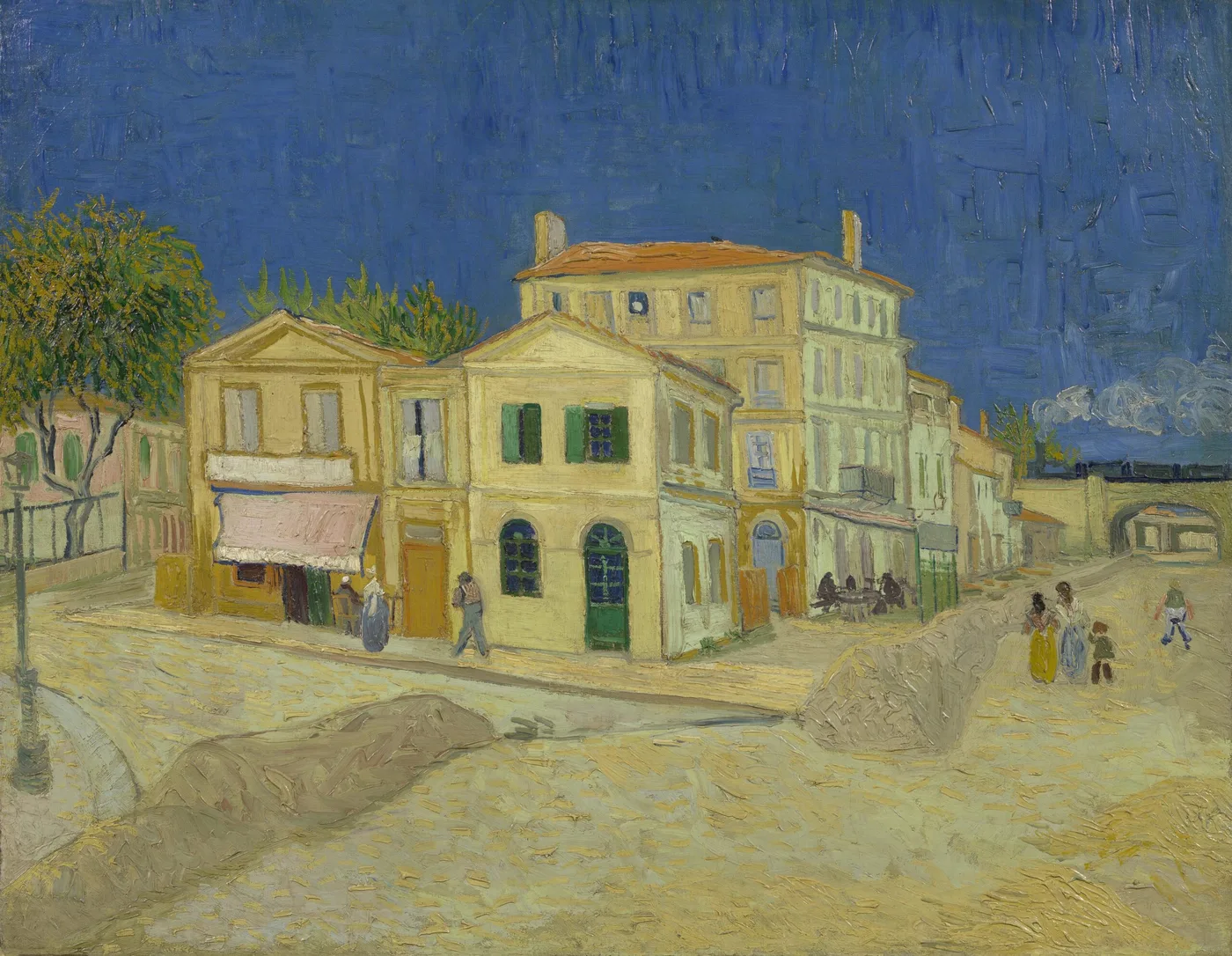
The yellow house stands at the corner where two streets meet, its ochre walls catching the day’s sun against a sky that has already deepened to cobalt blue. Van Gogh rented the right-hand section, two rooms on the ground floor and two behind the green shutters upstairs, and used them as his studio and bedroom.
The building beside it, painted the same warm yellow, held a grocer’s shop. A pink and white awning shades its window, and a figure in blue stands near the doorway. To the right the taller, paler house with a restaurant terrace belongs to a different owner, and small figures sit at tables under its awning.
A man in a hat crosses the pavement in front of the yellow house, and further along the road a small group walks toward a railway bridge in the distance, where a steam train trails smoke across the arch. Van Gogh placed each figure with only a few strokes, enough to give the street its ordinary daily traffic without pulling attention from the building itself. The foreground is bare, sun-baked earth in the same ochres and pinks as the house, broken by a single gas lamp and a low iron railing.
The Studio of the South
Van Gogh had convinced himself that Arles could become a colony for painters working in the modern manner, sharing costs, sharing subjects, arguing out ideas over dinner. He called the plan his Studio of the South and pinned much of his hope for it on a single guest, Paul Gauguin, whom he had met in Paris and had been inviting south for months. Theo helped broker the arrangement, offering Gauguin a monthly allowance in exchange for paintings sent back to Paris.
Ahead of the visit van Gogh decorated the house with paintings of sunflowers, the flower he associated with gratitude and welcome, so that Gauguin’s room would already feel furnished with work. Gauguin arrived in October 1888, and for a few weeks the two painted side by side, sometimes taking the same subjects from different angles.
The arrangement collapsed in December, in the crisis that led to van Gogh’s hospitalisation, and Gauguin left for Paris soon after. The Studio of the South never became the school van Gogh had pictured, but the house he painted in September remains the clearest record of how seriously he took the idea before it went wrong.
Yellow Against Blue
Van Gogh built the picture on a single contrast, the yellow of the house against the blue of the sky, colours that sit opposite each other on the colour wheel and intensify one another the closer they are pushed together. He kept the yellow warm and slightly broken, mixing in ochre and touches of green so the wall reads as sun-warmed plaster rather than flat paint.
Against it the sky is worked in short, upright strokes of cobalt and ultramarine, laid on thickly enough to catch light across the canvas surface. The architecture itself is drawn with a firm, almost graphic line, roofs, window frames and shutters kept legible even where the paint sits at its thickest.
Figures and foliage are looser, dabbed rather than drawn, which keeps the eye moving from the solid geometry of the house out to the softer business of the street. Van Gogh painted The Yellow House in oil on a canvas measuring 91.5 by 72 centimetres in 1888, a size large enough to let the house dominate without shrinking the street life gathered around it. It hangs today at the Van Gogh Museum, among the clearest surviving statements of what he wanted Arles, and his own address there, to mean.
On a Wall, in Changing Light
A reproduction of this size holds a room the way the original holds a gallery wall, the yellow pulling forward while the blue sky recedes behind it. In daylight the ochres read warm and sunlit; under lamplight in the evening the blue deepens and the house seems to glow against it, much as van Gogh intended the two colours to behave when he set them side by side.
Hung where morning light reaches it, the painting shifts through the day almost as the real house would have, the yellow catching brighter as the light strengthens and settling back as it fades. What stays with a viewer is not the street traffic but the house itself, waiting at its corner for a future that, in the end, never arrived.
Sizes and materials for The Yellow House are listed on its product page.
More from this collection
Bring this painting home
Choose a hand-painted oil reproduction for real brushwork, or an archival canvas print for a crisp museum-image edition. Every size preserves the original proportions.
View this work & options
Further reading
Verify the original in the Van Gogh Museum collection record and continue through related works in the catalogue.