
The Red Vineyard: Story, Meaning & Brushwork
By the autumn of 1888, Vincent van Gogh had been in Arles for the better part of a year, working at a pace that alarmed even his most devoted supporters. He had rented the Yellow House, filled it with canvases, and was waiting, not entirely patiently, for Paul Gauguin to arrive and share the studio he imagined as a colony of painters working the light of Provence. The harvest was in, the vines were turning, and Van Gogh had grapes and stubble fields on his mind.
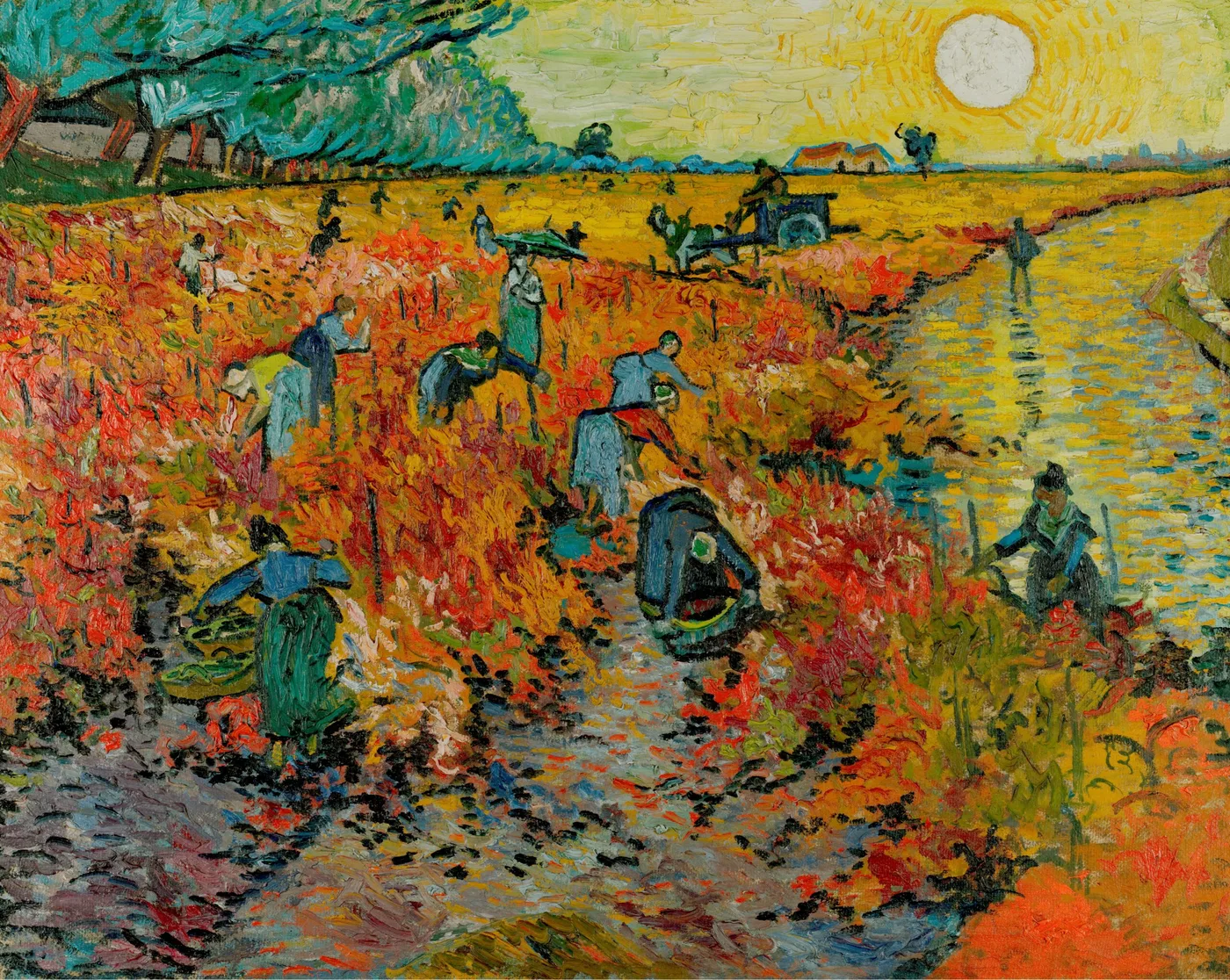
The Red Vineyard belongs to that charged autumn. It is a picture built less from what stood in front of the easel than from what stayed in his memory after a walk through the countryside near Arles, when he saw a vineyard catch the low sun and turn, in his own description, the colour of red wine. He carried that impression back to the studio and painted it whole.
A Vineyard Recalled, Not Observed
Working from memory rather than from the motif was unusual for Van Gogh, who normally set up his easel in the fields themselves. That he painted this scene indoors, from a mental image, may explain why the picture feels less like a transcription of a place and more like a distilled sensation: heat, colour and the particular ache of a season ending.
The result is not a literal vineyard so much as the feeling of one. Rows of vines become ribbons of red, orange and violet; the figures bent among them are quick, economical marks rather than portraits. Van Gogh kept only what the memory had kept, and discarded the rest.
Fire in the Furrows
The eye lands first on the sun, a disc of raw white and yellow set low in a sky of pale green and gold, its light thrown out in short radiating strokes. Beneath it, the vineyard runs the length of the canvas in a blaze of vermilion, orange and dashes of near-black, as though the ground itself were smouldering after the day’s heat.
Small figures move through the rows, some bent double at the vines, one shielding herself with a pale umbrella, another pair working close to a cart and horse on the path behind. To the right, a canal cuts through the composition, its water streaked yellow and blue, catching the same low sun that scorches the field beside it.
A line of dark trees, blue-green and cool, closes the upper left corner and holds the composition together against so much red and gold. It is one of the few passages in the picture where the temperature drops, and the eye is glad of the rest.
How the Paint Sits on the Canvas
Van Gogh laid the vineyard in with thick, directional strokes, the paint often applied wet into wet so that red bleeds into orange and orange into violet without a clean edge between them. Across the foreground path, dabs of black and deep green sit on top of the warmer ground, giving the impression of trampled earth and fallen leaves without describing either in detail.
The sun is handled differently again: built up in a near-relief of white paint, with the surrounding sky scored in short combed lines that pull outward from it like heat itself has a texture. This is paint used as much for its physical presence on the canvas as for the colour it carries, a method Van Gogh had been sharpening all through his time in Arles.
The Only Sale He Knew
Van Gogh painted The Red Vineyard in 1888, and its dimensions, 93 by 75 centimetres, place it among the more substantial canvases of that Arles period. It carries a particular weight in his story: it is widely held to be the one painting he sold during his lifetime, bought in 1890 by the Belgian painter Anna Boch at an exhibition in Brussels for 400 francs.
That single transaction sits oddly against everything that followed. A man who would become one of the most reproduced painters in the world parted with this canvas for a modest sum, to a fellow artist who recognised something in it that the wider market did not yet see.
Living With the Painting
The original now belongs to the Pushkin Museum of Fine Arts, and its intensity has not dimmed for having travelled from a provincial French exhibition to a major national collection. Reproduced at scale, on a wall that gets real daylight, the picture behaves less like a fixed image and more like a source of warmth in the room.
Morning light picks out the impasto sun and the ridges of red across the vines; by evening, with lamps on, the same canvas settles into something darker and more ember-like, the black dashes in the foreground reading as shadow rather than accent. Few paintings shift so visibly with the hour, which is part of why this one keeps drawing the eye back.
Sizes and materials for The Red Vineyard are listed on its product page.
More from this collection
Bring this painting home
Choose a hand-painted oil reproduction for real brushwork, or an archival canvas print for a crisp museum-image edition. Every size preserves the original proportions.
View this work & options
Further reading
Verify the original in the Pushkin Museum of Fine Arts collection record and continue through related works in the catalogue.