
The Potato Eaters: Story, Meaning & Brushwork
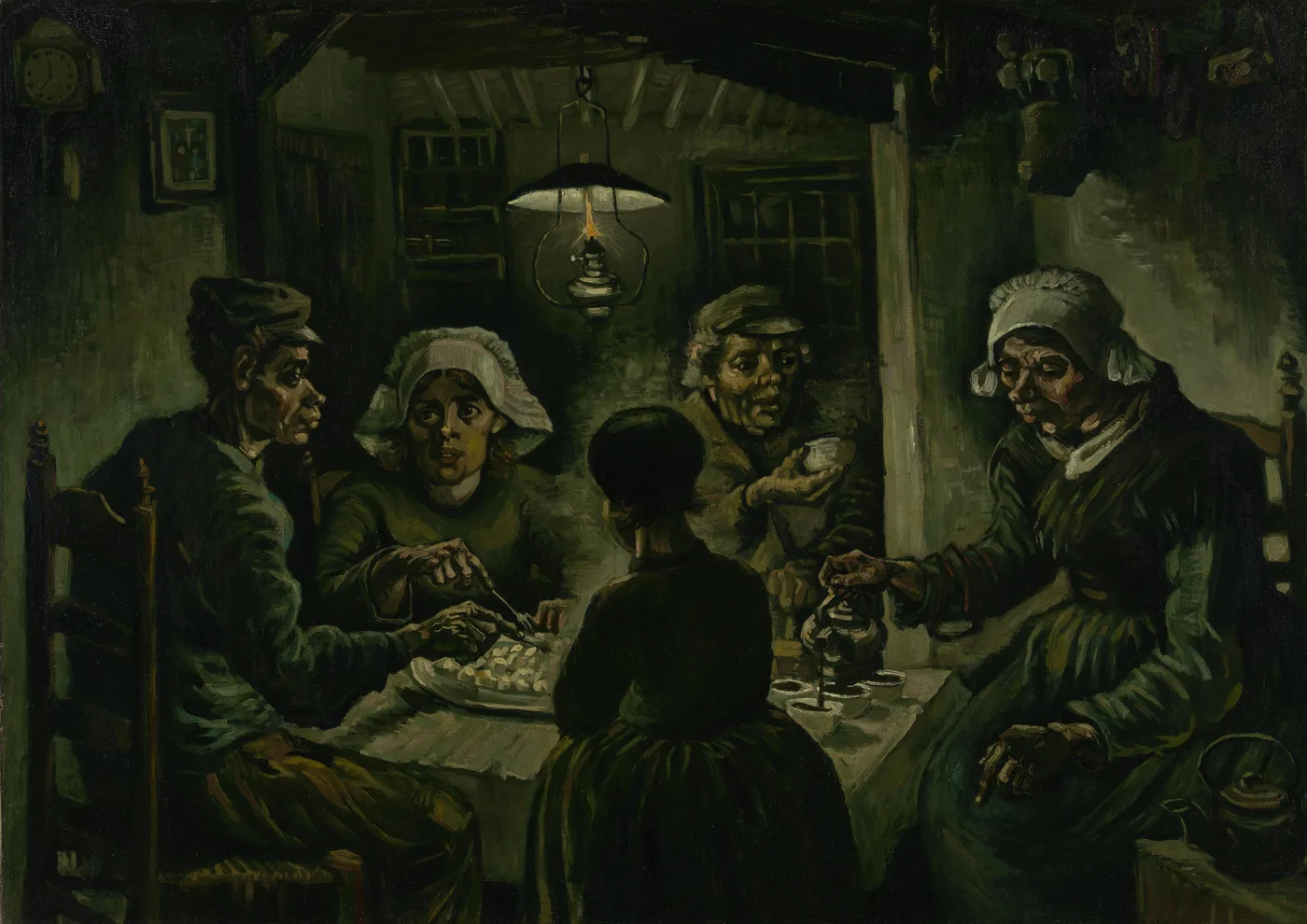
In the spring of 1885, Vincent van Gogh was still living at his parents’ parsonage in Nuenen, a small village in the Dutch province of North Brabant. His father, the local pastor, had died that March, and Van Gogh was working with an intensity that bordered on obsession, drawing and painting the weavers and peasant families of the district almost daily. He wanted, at last, to prove to himself and to his brother Theo that he could carry a real figure composition, not just a study.
For months beforehand he had filled sketchbooks and canvases with studies of individual heads and hands, returning again and again to the same cottagers until their features felt as familiar to him as his own. Those studies were preparation for a single ambitious painting: a peasant family at their evening meal, gathered in the one room of their cottage that mattered most.
That painting is The Potato Eaters, completed in Nuenen in 1885 and now the picture Van Gogh himself called the most important figure painting he had yet attempted. It measures 114 by 82 centimetres and belongs to the Van Gogh Museum in Amsterdam, where it remains one of the defining works of his Dutch period.
Five figures beneath a lamp
The scene is a cramped cottage interior at night. Five people sit or stand around a rough wooden table, and above them a single oil lamp hangs from the low ceiling, its flame the brightest point in the entire canvas.
At the left, a man in a peaked cap leans toward the woman beside him, who wears a white bonnet and is caught in the act of forking food from a shared dish of potatoes. Facing the viewer from the far side of the table, an older woman in another white bonnet pours from a small pot into cups, while a man opposite her holds his cup up to receive it. In the foreground, seen entirely from behind, a fifth figure sits with head bowed, a dark silhouette that anchors the composition and pulls the eye past her toward the lit table beyond.
Behind the group, the room dissolves into near darkness: the faint outline of a clock on the wall, a small framed picture, a plate rack, and a window and door barely legible in the gloom. Nothing in that background competes with the lamp and the hands beneath it.
Earth-coloured paint
Van Gogh built the picture almost entirely from browns, dull greens and near-blacks, a palette he described as the colour of a dusty, unpeeled potato. There is barely a passage of clean colour anywhere on the canvas outside the small warm halo cast by the lamp.
The paint itself is handled thickly and without any polish. Faces are modelled in short, knotted strokes that leave the coarseness of the skin and bone visible, and the hands, gripping forks, cups and the plate itself, are built up with the same rough insistence, so that they read as worked hands before they read as anatomy.
That deliberate roughness was the point. Van Gogh was not interested in refining these people into something prettier or more sentimental than the life they actually led.
A deliberate manifesto
In a letter to Theo, Van Gogh explained exactly what he wanted the painting to say: that these people, eating their potatoes in the lamplight, had dug the earth with the very hands they put into the dish, and had honestly earned their food. The painting was conceived as an argument as much as an image, a statement that peasant life deserved to be painted in its own coarse truth rather than smoothed into something more agreeable to a gallery-going public.
It was not received warmly at the time. Critics and fellow painters found it clumsy and its figures ugly, and even some of Van Gogh’s own circle questioned the drawing. He held to it regardless, convinced that it was the strongest thing he had made.
By the end of that same year he had left Nuenen for Antwerp, and within months he was in Paris, where his palette would open into the colour for which he later became known. The Potato Eaters stands at the hinge of that change, the last and largest statement of the dark, socially engaged painting he had been pursuing throughout his Dutch years.
On a wall
Hung in a room, this is not a painting that announces itself from across the space. Its darkness asks the eye to come closer, and only then does the lamp, the plate of potatoes and the individual faces separate themselves from the shadow around them.
Under low or warm evening light, the picture draws inward on itself, the browns and greens merging almost to black except for that one lit circle above the table. In brighter daylight, the texture of the paint becomes legible again, the ridges and knots of pigment that make up each hand and face. The painting changes character with the light in the room in something like the way its own lamp governs the room it depicts.
Sizes and materials for The Potato Eaters are listed on its product page.
More from this collection
Bring this painting home
Choose a hand-painted oil reproduction for real brushwork, or an archival canvas print for a crisp museum-image edition. Every size preserves the original proportions.
View this work & options
Further reading
Verify the original in the Van Gogh Museum collection record and continue through related works in the catalogue.