
Self-Portrait (1887): Story, Meaning & Brushwork
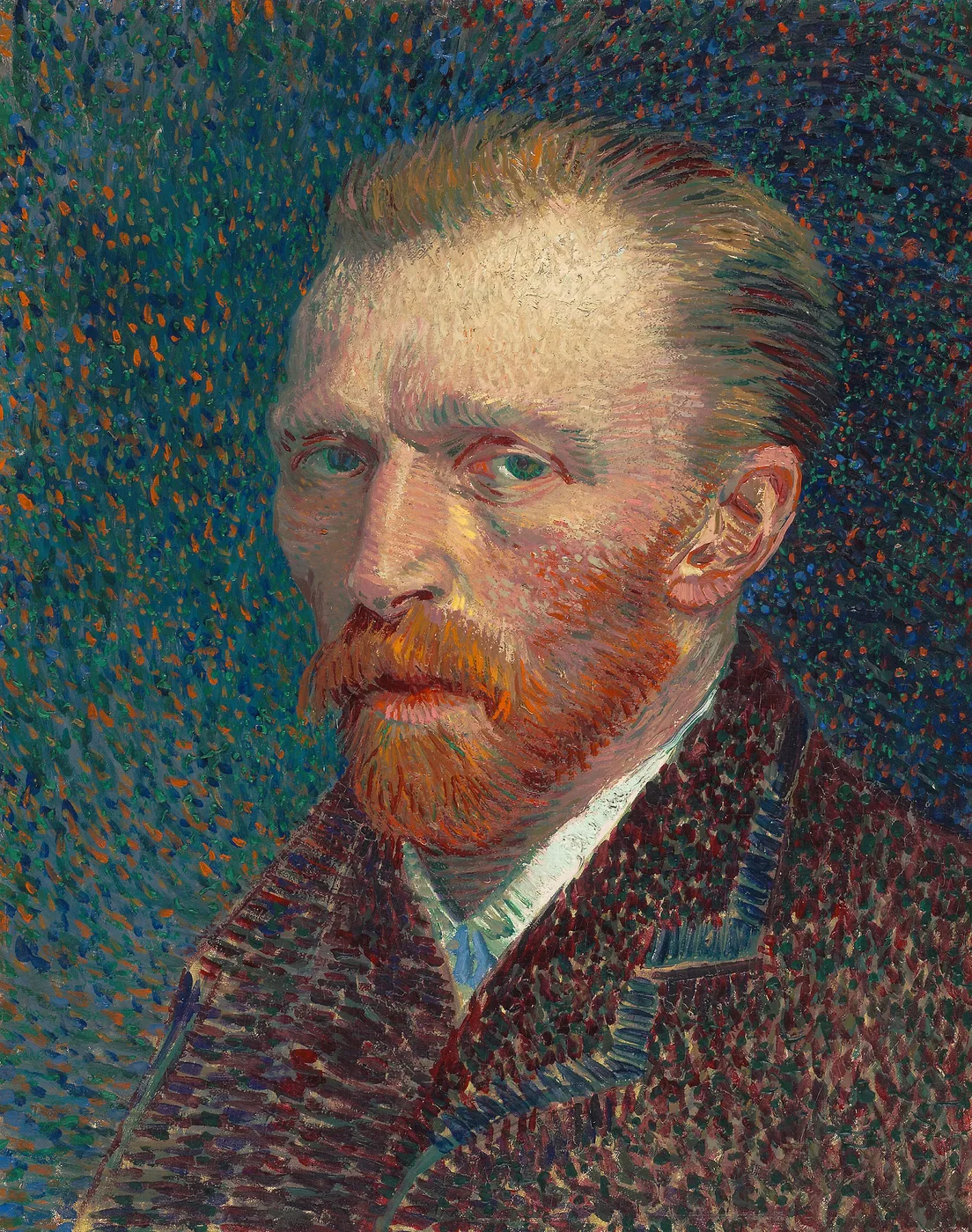
By the spring of 1887, Vincent van Gogh had been in Paris for the best part of a year, living with his brother Theo above a paint-supply shop and print gallery on the Rue Lepic. He had arrived from Antwerp painting in the dark, earthy palette of the Dutch tradition, all bitumen browns and heavy shadow. Within months he was standing in front of canvases by Seurat, Signac and Pissarro, watching colour get broken apart into small independent touches instead of being mixed on the palette.
He could not easily afford to hire models, so he turned the problem into a method. Through 1887 he set up his easel in front of a mirror again and again, using his own face to test what he had just seen in other painters’ studios. This Self-Portrait, painted that year and now held by the Art Institute of Chicago, is one result of that private, repeated experiment.
A Face Held Still Against a Restless Ground
Van Gogh presents himself turned slightly to one side, chin low, eyes tracking straight back at the viewer. The gaze is level and unflinching, more watchful than warm, the look of a man studying his own features with the same detachment he would bring to a bowl of fruit or a pair of boots.
His hair and beard are a warm ginger-blond, catching light across the crown of the head where the paint turns almost cream. The jaw and moustache carry the same rust-orange, set against skin painted in strokes of pink, ochre and pale green that never quite settle into a single flesh tone.
Behind him the background has no fixed shape at all. It is a field of short dashes in teal, deep blue and green, flecked through with orange and red, denser and darker toward the edges of the canvas and lighter where it meets the halo of hair. There is no wall, window or studio detail, nothing to locate him in a room beyond the painted surface itself.
Colour Laid Stroke by Stroke
The paint across the whole picture, at 32.5 by 41 centimetres a small and close-worked panel, is built from short, directional touches rather than blended passages. Nothing here is smoothed. Every patch of the face, the jacket and the background keeps the mark of a single loaded brush pressed down and lifted away.
Van Gogh sets warm against cool the way the Neo-Impressionists he had been studying did, orange beard against blue-green ground, pink cheek against teal shadow. Placed side by side rather than mixed, these opposing colours keep vibrating against each other instead of resolving into calm, even skin.
The dark jacket is handled with the same discipline. Its maroon wool is cut through with threads of blue and green, laid in short diagonal strokes that follow the fall of the collar, so that even the plainest area of the painting keeps a low, steady flicker of colour rather than sitting flat.
A Cheap Model Who Never Refused a Sitting
Van Gogh painted himself close to two dozen times during his two years in Paris, more often than he painted almost anyone else. Money was part of the reason. A professional model cost more than he and Theo could regularly spare, while his own reflection cost nothing and never grew tired of holding a pose.
But the self-portraits also did work that a hired sitter could not. Each one let him rehearse a different idea about paint, sometimes closer to Impressionist broken colour, sometimes closer to the disciplined dots of Pointillism, without needing anyone’s patience but his own.
Seen in sequence, these paintings from 1886 to 1888 track a fast, visible change: a painter arriving from Antwerp in muddy browns and leaving two years later for Arles with a palette built entirely out of contrasting colour. This canvas sits inside that short, compressed education.
Living With It, as the Light Moves
Hung where daylight reaches it through the day, this kind of broken, directional brushwork keeps shifting. Strong side light catches the ridges of paint on the beard and jacket and throws small shadows between the strokes, so the surface has a texture that a smooth photograph of the same image does not carry.
Under softer evening light, the same canvas settles. The dashes in the background stop reading as individual marks and merge into a low hum of blue and green behind the head, and the gaze becomes the thing the eye keeps returning to, steady and a little guarded, exactly as Van Gogh painted it in 1887.
Sizes and materials for Self-Portrait are listed on its product page.
More from this collection
Bring this painting home
Choose a hand-painted oil reproduction for real brushwork, or an archival canvas print for a crisp museum-image edition. Every size preserves the original proportions.
View this work & options
Further reading
Verify the original in the Art Institute of Chicago collection record and continue through related works in the catalogue.