
Orchard in Blossom, Bordered by Cypresses: Story
Arles in the Spring of 1888
Vincent van Gogh reached Arles in February 1888, leaving Paris and its greyer light behind him. Within weeks the fruit trees of Provence began to flower, and he found himself racing to catch them before the blossom fell. He wrote to his brother Theo that he was in a fury of work, wanting to paint a Provence orchard of tremendous gaiety.
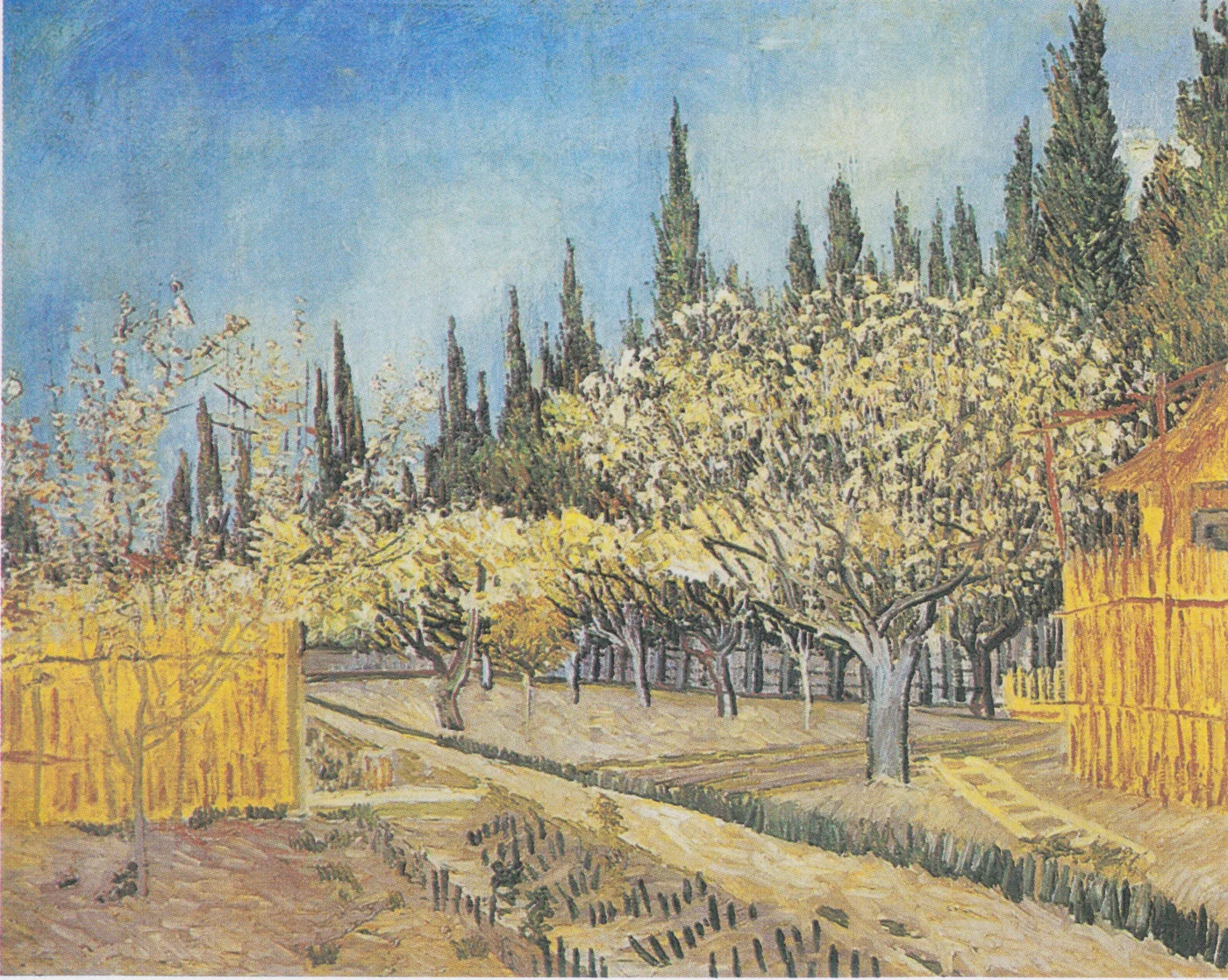
That urgency shaped an entire body of work. Between March and May 1888 he painted around fourteen orchards in bloom, moving from one plot of blossoming almond, pear, plum and apricot trees to the next as each came into flower and then dropped its petals. Orchard in Blossom, Bordered by Cypresses belongs to that campaign, painted in 1888 and now measuring 81 by 65 centimetres.
He was not simply recording a pretty season. The orchards let him test how far colour and quick, directional brushwork could carry a picture, ahead of the sunflowers and starry skies that would follow later that year and into 1889. This canvas shows that testing already well underway.
A Reed Fence, a Path, and a Wall of Blossom
The foreground is given over to a mustard-ochre fence of woven reed and timber, running in from both lower corners and framing the view like a gate left open. A bare path cuts between rows of young shoots planted in the turned earth, drawing the eye straight back into the orchard beyond.
Above the fence, the trees carry their flowers in loose, pale masses of cream and white, touched here and there with a warmer yellow where the light catches them. Their trunks are thin and slightly bent, painted in grey and pale ochre, standing bare below the canopy so that the blossom seems to float free of any solid support.
Behind the orchard runs an unbroken line of cypresses, dark green against the sky, rising in tapering points of varying height like a rough-cut hedge. They close the composition at the back and stop the eye from travelling off into open country, holding the whole scene inside a narrow, enclosed strip of ground.
Above it all is a high, pale blue sky, brushed thin and almost bare of cloud near the horizon, deepening slightly toward the top of the canvas. To the right, part of a building appears at the edge of the picture, its timber walls the same warm ochre-brown as the fence, anchoring the orchard to the working land around it rather than presenting it as untouched nature.
Racing the Blossom
Van Gogh knew he had only days before each orchard turned from flower to green leaf, and he painted with that clock running. He would often begin and finish a canvas in a single sitting, working directly in front of the motif rather than composing from memory back in the studio.
The choice to fence in the view, rather than open it out to distant hills, is typical of the series. Repeatedly he chose orchards that were bounded by a wall, a hedge, or in this case cypresses and reed fencing, so that the blossom reads as a contained, almost domestic event rather than a sweeping landscape.
That containment also served a practical purpose. Working fast and close to his subject, a narrow, screened plot gave him a manageable field of colour and structure to resolve before the light changed or the petals began to drop.
Paint Laid Down at Speed
The blossom is built from short, loaded touches of white and pale yellow, dabbed rather than blended, so that each flower cluster keeps its own separate mark. Seen up close the canopy dissolves into individual strokes; stepped back, it reassembles into drifts of flower.
The cypresses are handled differently, in longer, more upright strokes of dark green that follow the shape of each tree from base to tip. That contrast in touch, quick and scattered for blossom, firmer and more continuous for the evergreens, gives the two elements distinct textures even though they share the same canvas.
The earth and fence are laid in with broader, flatter strokes of ochre and brown, giving the foreground a settled weight against the more agitated brushwork above it. Across the whole surface the paint sits thickly enough to catch real light, so the picture changes slightly as a viewer moves in front of it.
On a Wall, Depending on the Light
The painting is held today by the Kröller-Müller Museum, which keeps one of the largest groups of Van Gogh’s work anywhere. Seen there or reproduced elsewhere, it remains a picture built for close looking, its blossom resolving only at a certain distance.
Hung where daylight reaches it, the canvas shifts through the day much as the orchard itself once did: the ochre fence and cypresses read darker and more solid in low light, while the blossom lifts and brightens as direct sun crosses the surface. It is a spring afternoon fixed in paint, still answering to the light in the room around it.
Sizes and materials for Orchard in Blossom, Bordered by Cypresses are listed on its product page.
More from this collection
Bring this painting home
Choose a hand-painted oil reproduction for real brushwork, or an archival canvas print for a crisp museum-image edition. Every size preserves the original proportions.
View this work & options
Further reading
Verify the original in the Kröller-Müller Museum collection record and continue through related works in the catalogue.