
The Langlois Bridge at Arles: Story & Meaning
A Dutch Bridge Under a Provençal Sky
Vincent van Gogh arrived in Arles in February 1888, worn out by two years in Paris and hoping the south would sharpen both his eyes and his health. The town was still cold when he got there, snow on the ground in places, but within weeks the light turned clear and hard in a way he had never painted before. He wrote to his brother Theo that he had come looking for something like the clarity of Japanese prints, and Provence, he thought, might give it to him.
It did not take him long to find a subject that mattered to him personally. On the canal running south of town towards Bouc stood a small wooden drawbridge, worked by chains and a counterweight, the kind of lifting bridge more often associated with the flat waterways of his native Netherlands than with the dry hills of Provence. It caught him off guard, a piece of Dutch engineering set down in southern light.
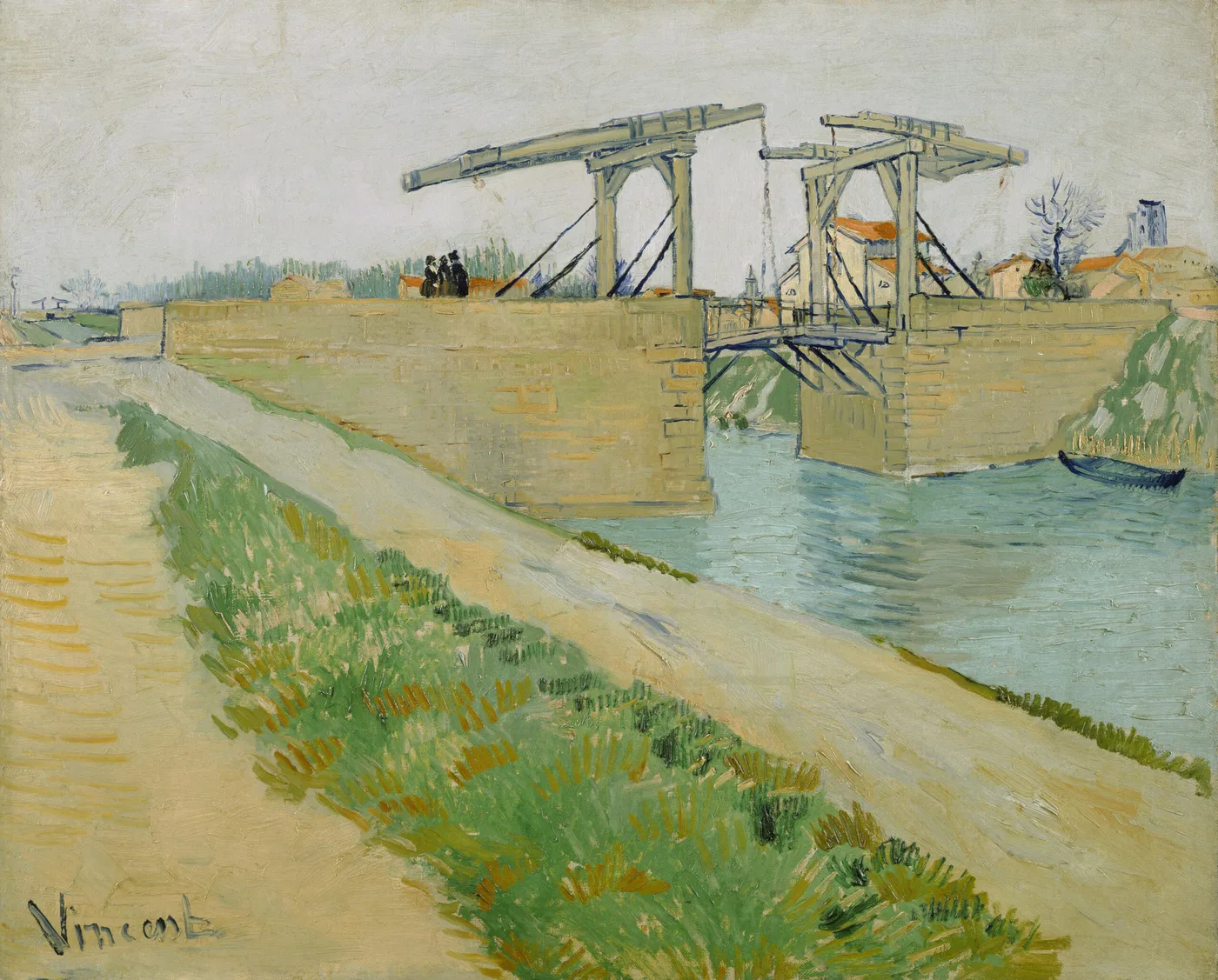
He returned to the crossing repeatedly through that first spring, setting up his easel on the bank and reworking the same stretch of water and towpath from slightly different positions. This canvas, dated to 1888 and now held by the Van Gogh Museum, is one of the results of that sustained attention, painted while the subject was still new to him and the southern light still a surprise.
Looking Along the Towpath
The view is taken from low on the bank, looking along a dirt path that runs on a diagonal from the lower left corner into the middle distance. A strip of rough grass and low scrub runs beside it, painted in short dabs of green and ochre that catch the eye before anything else in the lower half of the canvas.
The bridge itself sits back from the viewer, its stone abutments squaring off the canal on either side while the timber lifting arms cross overhead in black, angular strokes. Chains and struts are indicated rather than drawn in detail, enough to read the mechanism at a glance without slowing the eye down.
A handful of tiny figures stand near the bridge deck, no more than a few marks of dark paint, and beyond them the roofs of Arles show in patches of orange and cream against a stand of trees. On the water to the right, a small rowing boat sits close to the bank, its dark hull one of the few sharp accents against the pale green of the canal.
Van Gogh has signed the work simply, “Vincent,” in the bottom left corner, in the loose script he used throughout the Arles years.
A Palette Kept Narrow and Clean
The colour is deliberately restrained. The sky is almost white, a pale grey-blue that gives no drama and asks for none, letting every other colour in the scene sit against a neutral ground. Against it, the black timber of the bridge reads as the strongest value in the whole composition.
Water and grass share a family of cool greens, the canal slightly bluer, the bank slightly warmer, so the eye slides between them without a hard break. The ochre path cuts through this coolness on the diagonal, the one warm passage of any size in the lower half of the picture, and it is what pulls the eye from the foreground back towards the bridge.
This is not the dark, tonal palette of Van Gogh’s Dutch years. It is closer to the flat, unshadowed colour fields of the Japanese woodblock prints he collected and admired, applied here to a subject that happened to remind him of home.
The Hand Behind the Paint
The grass and scrub are built from short, repeated strokes laid close together, quick marks that suggest texture without describing any single blade or stem. It is fast, economical paint handling, the kind that comes from working directly in front of a motif rather than composing it in the studio.
The bridge, by contrast, is drawn with a firmer, more continuous line, since its geometry needed to hold together for the structure to read correctly. Van Gogh balances the two approaches within a single canvas of modest size, 73.6 by 59.6 centimetres, a scale close enough to intimate that the brushwork rewards standing near it.
On a Wall, Through the Course of a Day
Hung where daylight reaches it, this painting shifts more than its quiet subject might suggest. In flatter light the pale sky recedes and the greens of the bank come forward; in warmer evening light the ochre path picks up colour and the black bridge stands out harder against it.
It is a picture built on a single receding line, the towpath, and that kind of composition tends to hold a room’s attention without demanding it, drawing the eye back along the same path each time. A quiet, working corner of Arles, seen once by an artist newly arrived and testing what southern light could do with a memory from home.
Sizes and materials for The Langlois bridge are listed on its product page.
More from this collection
Bring this painting home
Choose a hand-painted oil reproduction for real brushwork, or an archival canvas print for a crisp museum-image edition. Every size preserves the original proportions.
View this work & options
Further reading
Verify the original in the Van Gogh Museum collection record and continue through related works in the catalogue.