
Study for The Potato Eaters: Story & Meaning
Nuenen, Winter, and an Unproven Painter
In the winter of 1885, Vincent van Gogh was living in the presbytery garden house at Nuenen, a village in the Dutch province of North Brabant where his father had served as pastor. He was thirty-two years old and had been painting seriously for only a few years, without a single canvas he considered finished enough to define him.
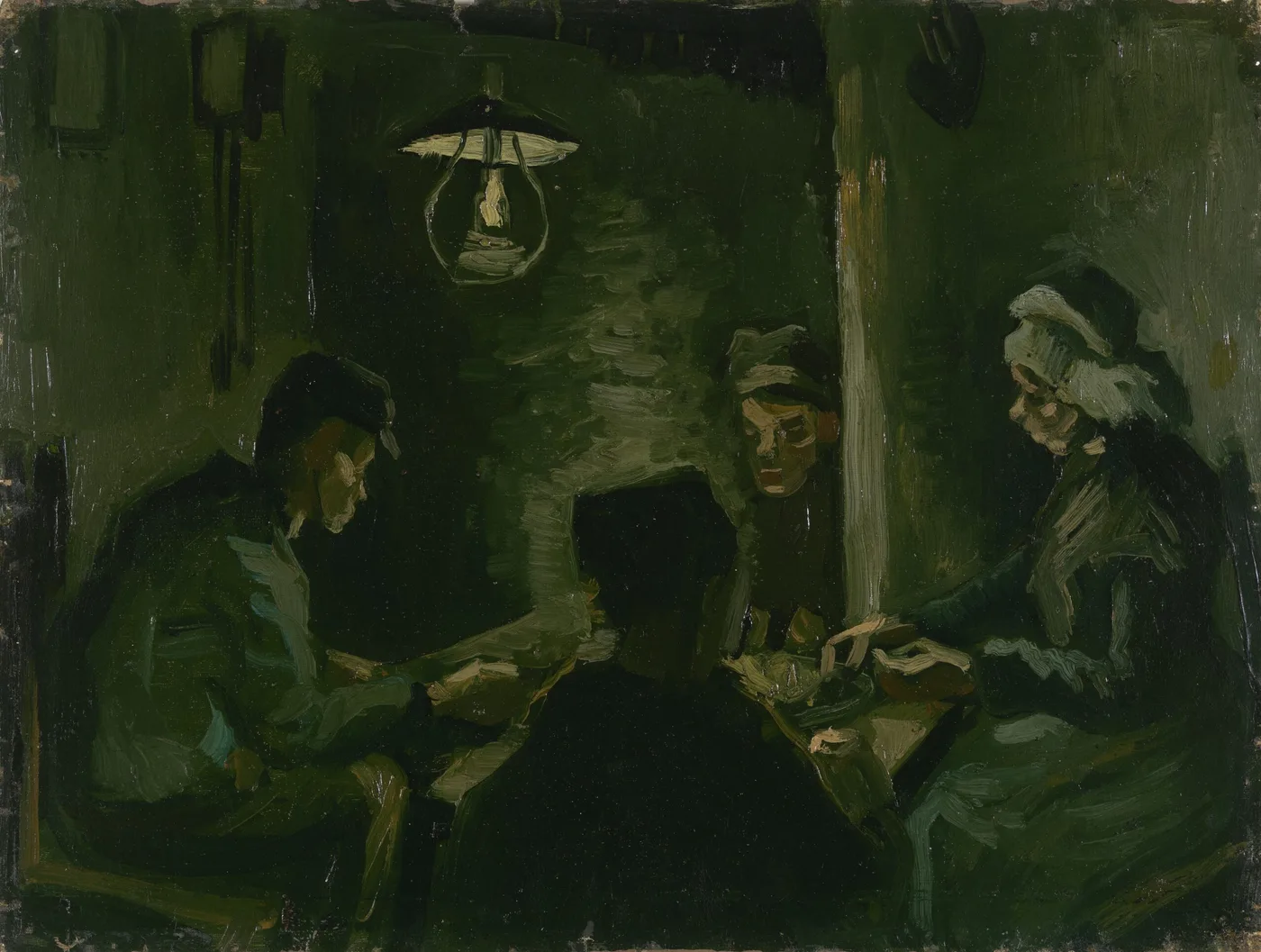
He had spent the previous two years drawing the local weavers and peasants, filling notebooks with studies of hands, heads, and bent backs. What he wanted now was to bring all of that observation into one ambitious composition: a peasant family eating a meal of potatoes by lamplight, in their own kitchen, at the end of a day’s labour in the fields.
This small oil study, painted on panel and measuring 44.4 by 33.5 centimetres, belongs to that period of intense preparation. It is one of the trials Van Gogh made as he worked out how to arrange five figures around a table without the scene collapsing into a stiff group portrait.
Five Figures Under One Lamp
The scene is a low-ceilinged room, so dark that the walls read as a single wash of green-black shadow. A single oil lamp hangs from a cord at the centre of the composition, its glass globe the brightest passage in the whole panel and the one point the eye keeps returning to.
Around the table sit four figures with faces caught by the lamp’s small circle of light, their skin painted in warm ochre against the cold gloom behind them. A fifth figure, seen only from behind as a dark, faceless silhouette, anchors the foreground and pulls the viewer into the huddle rather than leaving them outside it.
Hands reach toward the table’s centre, sketched in quick, loaded strokes rather than drawn in outline. Van Gogh is not interested in individual likeness here; he wants the shape a family makes when it closes ranks around food and light.
Working in the Dark
The palette is built almost entirely from the colours of a Brabant kitchen after nightfall: bottle green, umber, near-black, and the single warm note of the lamp flame. There is barely any pure colour anywhere in the panel, and what little there is has been pushed toward grey.
Van Gogh once wrote that he wanted his peasant picture to smell of bacon, smoke, and potato steam, and this study already carries that ambition in its handling. The paint is laid on thickly and fast, ridged where the brush has dragged, so that the surface itself feels worked and unglamorous.
Nothing here is smoothed for effect. The rough, almost muddy paint surface is the point: a picture of hard rural life could not, in Van Gogh’s view, be painted with a polished hand.
A Study on the Way to a Painting
Van Gogh made dozens of studies like this one in the months before he finished the large canvas now known as The Potato Eaters. Each study let him test one piece of the puzzle, sometimes a single head, sometimes the whole grouping, before he trusted himself to commit it to the final composition.
What survives here is one of those trial arrangements, painted quickly and kept as a working record rather than a finished exhibition piece. Its small size and its unresolved passages, especially the dark, unfinished mass of the foreground figure, mark it clearly as a step in a process rather than an end point.
The study is held today by the Van Gogh Museum, which keeps much of the material Van Gogh made during this same Nuenen period, including the letters in which he set out exactly what he was trying to achieve.
On a Wall, After Dark
Hung in a room with ordinary daylight, this study reads mostly as shape and shadow, a huddle of dark forms with one small warm point at its centre. It rewards a second, closer look far more than a glance from across a room.
In lamplight or low evening light, the effect sharpens. The single painted lamp finds an echo in whatever real light falls across the canvas, and the ring of faces seems to draw closer together, much as they must have done in the kitchen Van Gogh was actually watching.
It is a picture that asks to be looked at when the room around it has gone quiet, which is, in the end, exactly the hour it depicts.
Sizes and materials for Study for ‘The Potato Eaters’ are listed on its product page.
More from this collection
Bring this painting home
Choose a hand-painted oil reproduction for real brushwork, or an archival canvas print for a crisp museum-image edition. Every size preserves the original proportions.
View this work & options
Further reading
Verify the original in the Van Gogh Museum collection record and continue through related works in the catalogue.