
Field with Poppies: Story, Meaning & Brushwork
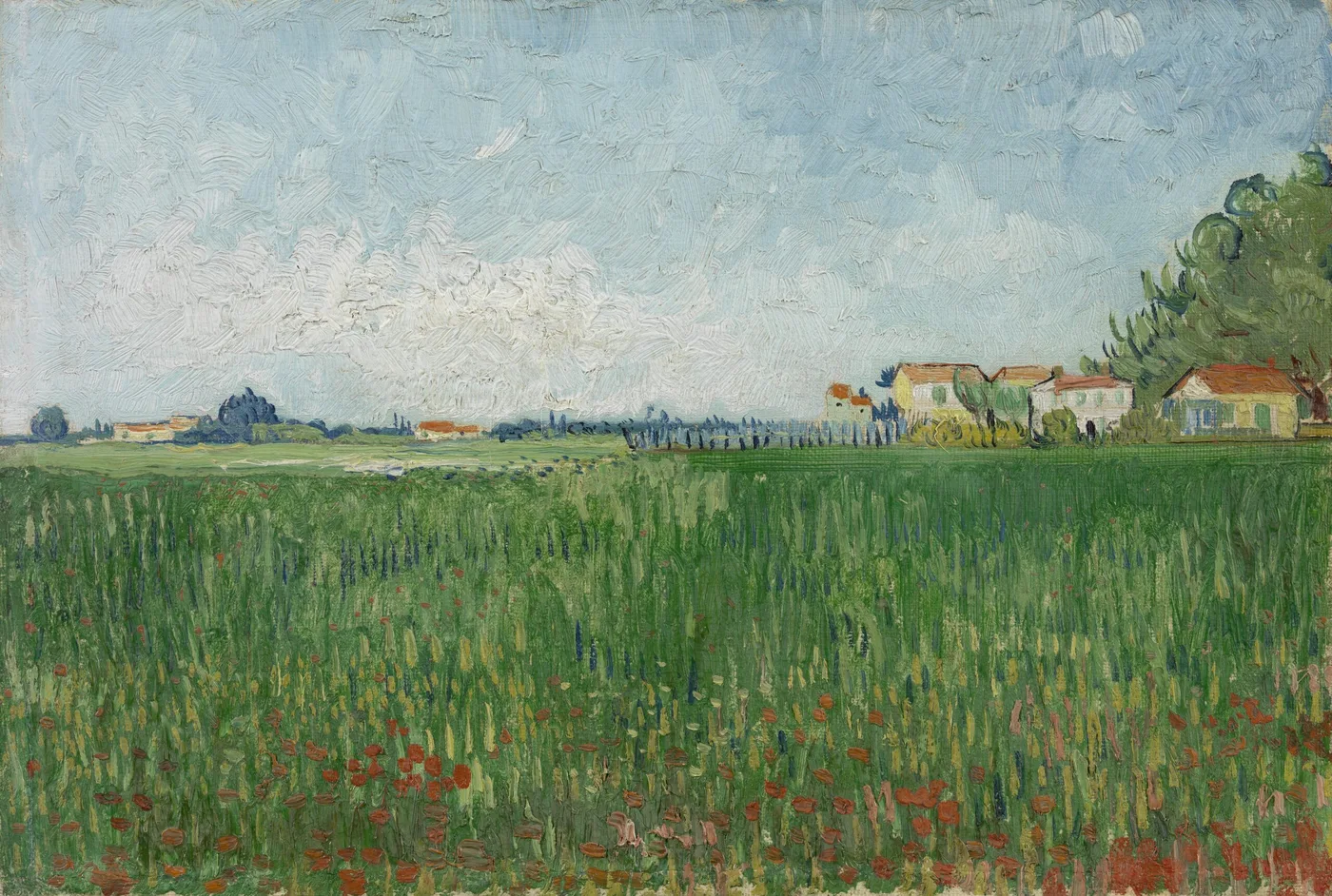
In the early summer of 1888, Vincent van Gogh was working at a pace that alarmed even his own brother. He had arrived in Arles that February, chasing a harder, clearer light after two grey years in Paris, and by June he was painting outdoors nearly every day, often finishing a small canvas before the afternoon heat became unbearable. Field with Poppies belongs to this rush of activity, a modest panel made somewhere on the plain outside the town, where wheat and grass grew waist high and wild poppies came up red among them for a few weeks each year.
A farmhouse at the field’s edge
Van Gogh set his easel low, so the horizon sits well below the middle of the canvas and the sky takes up roughly half the picture. On the right, a cluster of farm buildings catches the eye first: a pale house with green shutters, a run of orange-tiled roofs, and a stand of tall trees behind them, all painted with more detail and darker colour than anything else in the scene.
Further along the horizon, to the left, the buildings thin into a hazier row of rooftops and cypresses, painted with looser, paler strokes to suggest distance. A line of trees runs along the field boundary between the two clusters, marking where the cultivated ground gives way to the next property.
Red among the green
The lower half of the canvas is given over entirely to the field itself, painted in a range of greens from cool blue-green to a warmer yellow-green, laid down in short upright strokes that follow the direction of the grass. Van Gogh worked fast, and it shows: the brush rarely pauses long enough to blend one stroke into the next.
Into this green he set the poppies, not as a uniform band of colour but as loose, irregular clusters, thicker along the bottom edge of the canvas and in the right foreground, thinning toward the middle distance. Each flower is a single dab or a short flick of red, sometimes verging on orange, applied wet enough that some strokes have dragged slightly into the green beside them.
There is no single cluster of poppies that the picture asks you to settle on. The eye moves across the lower third of the canvas picking up one patch of red after another, much as it would moving across an actual field, and that scattering is what the picture is really about.
Sky, cloud and the flat light of Provence
Above the buildings and the tree line, the sky is built from broad, mostly horizontal strokes of pale blue, broken by a large mass of white and grey cloud drifting across the left half of the canvas. The cloud is painted almost as thickly as the field below it, with visible ridges of paint where the brush dragged.
The light is even and slightly overcast rather than the harsh midday sun of his more famous Arles landscapes, which gives the greens and reds in the field a softer, more even value than they might have had under stronger sun. Nothing in the sky is dramatic; it simply sits above the field, doing the ordinary work of a summer sky over flat farmland.
A small panel, worked quickly
Field with Poppies is a small picture, just 35 by 24.5 centimetres, closer to the size of a large book than a wall-filling landscape. Its scale matches how Van Gogh painted it: quickly and directly, evidently without much reworking, the sort of study he might have carried out to a field and finished in a single sitting.
That directness is part of what survives in the paint today. You can still see the order in which some strokes were laid, wet green under wet red, cloud stroke over sky stroke, in a way that a more laboured, studio-finished picture would not show.
The painting is now held by the Van Gogh Museum, which keeps one of the largest groups of his Arles-period work and lets this small field study be read alongside the wheat fields, orchards and farmhouses he painted in the same few months of 1888.
On the wall
Reproduced at a larger size and hung in a room, the picture behaves differently depending on the light falling on it. In soft, indirect daylight, the greens read as calm and continuous, and the poppies sit quietly within them.
Under warmer evening light, or lamplight with any yellow in it, the reds intensify and start to separate from the green rather than blending into it, so the same canvas can look restful in the morning and more alive in the evening.
Because the horizon is low and the sky occupies so much of the composition, the picture also reads well from across a room. The pale sky and its white cloud give it enough quiet space that it does not need close examination to register as a field under a summer sky.
Sizes and materials for Field with Poppies are listed on its product page.
More from this collection
Bring this painting home
Choose a hand-painted oil reproduction for real brushwork, or an archival canvas print for a crisp museum-image edition. Every size preserves the original proportions.
View this work & options
Further reading
Verify the original in the Van Gogh Museum collection record and continue through related works in the catalogue.