
Still Life with Meadow Flowers and Roses: Story
In the early months of 1886 Vincent van Gogh left Antwerp for Paris and moved into his brother Theo’s apartment. He was thirty-three, largely self-taught, and still painting in the dark, earthy palette he had used for the peasant scenes of Nuenen. Paris changed that within weeks.
He had no money for models and little patience for asking strangers to sit still, so he turned to what was cheap, patient and always available: cut flowers from the market. Through 1886 he painted dozens of flower still lifes, using them the way a musician uses scales, to retrain his eye and hand in colour he had barely touched before.
A bouquet too large for its vase
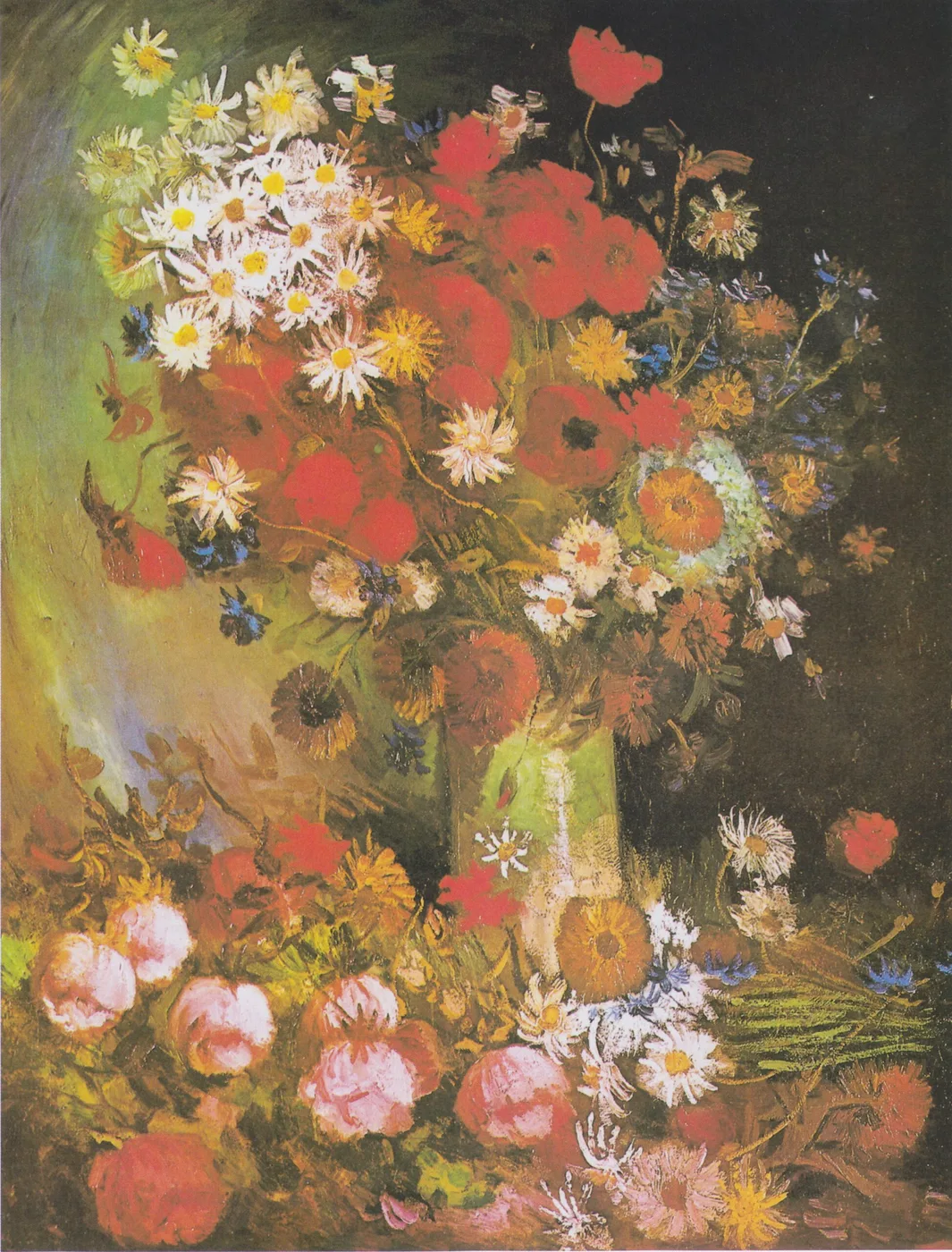
Still Life with Meadow Flowers and Roses, painted in 1886, is one of the largest and most crowded of that year’s flower studies, measuring 79 by 99 centimetres. The canvas is nearly filled edge to edge by a single dense mass of blooms, so that the vase holding them looks almost incidental.
A plain, pale green cylindrical vase sits just right of centre, barely visible beneath the weight of what it carries. Van Gogh was not interested in the container. He wanted the flowers themselves, piled and overlapping, to occupy nearly the whole surface of the picture.
What is packed into the picture
Red poppies, their petals loose and papery, cluster through the upper half alongside white oxeye daisies with bright yellow centres and smaller orange and yellow marigold-like flowers. Threads of small blue cornflowers run through the mass, breaking up the warmer colours with cool, sharp accents.
Near the foot of the vase the bouquet seems to overflow. Pink roses, heavy and rounded, spill forward with more daisies and scattered red blooms, as though the arrangement had grown too full to stay contained and had spread out across the surface below.
The stems and leaves are barely described. Van Gogh gives just enough dashes of green and brown to hold the flowers together, keeping the eye on colour and mass rather than on botanical detail.
A canvas split by light
The background is divided in two. On the left, pale greens and yellows swirl and lighten, almost like a halo drawn around the bouquet. On the right, the ground turns dark, close to black, so the reds and whites of the flowers seem to burn against it.
This is not a neutral backdrop. The dark half pushes the flowers forward and gives the reds extra weight, while the light half lets the white daisies and pale petals dissolve slightly into the ground behind them. The same bouquet reads two different ways depending on which side the eye settles on first.
It is an early instance of the colour thinking Van Gogh would carry further within a year, once he left Paris for the south: warm against cool, colour set against its opposite to make both more intense.
Paint laid on thick and fast
The flowers are built from loaded, visible strokes, not smoothed or blended. A single dab of white with a touch of yellow becomes a daisy; a twist of red laid over dark green becomes a poppy catching the light. The paint sits on the canvas with real thickness, especially in the pale petals and the pink roses at the base.
Working this way at speed suited Van Gogh’s temperament and his subject. Cut flowers wilt within days, so a bouquet had to be painted quickly, and the urgency shows in the directness of every stroke.
On a wall, in changing light
Hung in a room that gets daylight, the picture leans toward its pale left side: the greens and yellows lift, the white daisies stay crisp, and the bouquet reads as fresh and open. Under lamplight in the evening, the dark right side of the canvas deepens and the reds and pinks glow more like embers than petals.
Seen close, the surface breaks into loose, almost abstract patches of colour. Step back and those same patches resolve into a recognisable, overflowing bunch of meadow flowers and roses, the way the eye actually assembles a bouquet from across a room.
The original hangs today at the Kröller-Müller Museum, set among the woods and heath of the Hoge Veluwe in the Netherlands, a fitting home for a painting built entirely from what grows in a field and what fills a market stall.
Sizes and materials for Still Life with Meadow Flowers and Roses are listed on its product page.
More from this collection
Bring this painting home
Choose a hand-painted oil reproduction for real brushwork, or an archival canvas print for a crisp museum-image edition. Every size preserves the original proportions.
View this work & options
Further reading
Verify the original in the Kröller-Müller Museum collection record and continue through related works in the catalogue.