
Bank of the Oise at Auvers: Story, Meaning & Brushwork
In May 1890, Vincent van Gogh left the asylum at Saint-Remy and travelled north to Auvers-sur-Oise, a village on the river an hour from Paris, to be near Dr Paul Gachet. He had perhaps ten weeks left. In that short stretch he worked at a pace that still startles cataloguers, sometimes finishing a canvas in a single sitting, and the river itself became one of his repeated subjects that final summer.
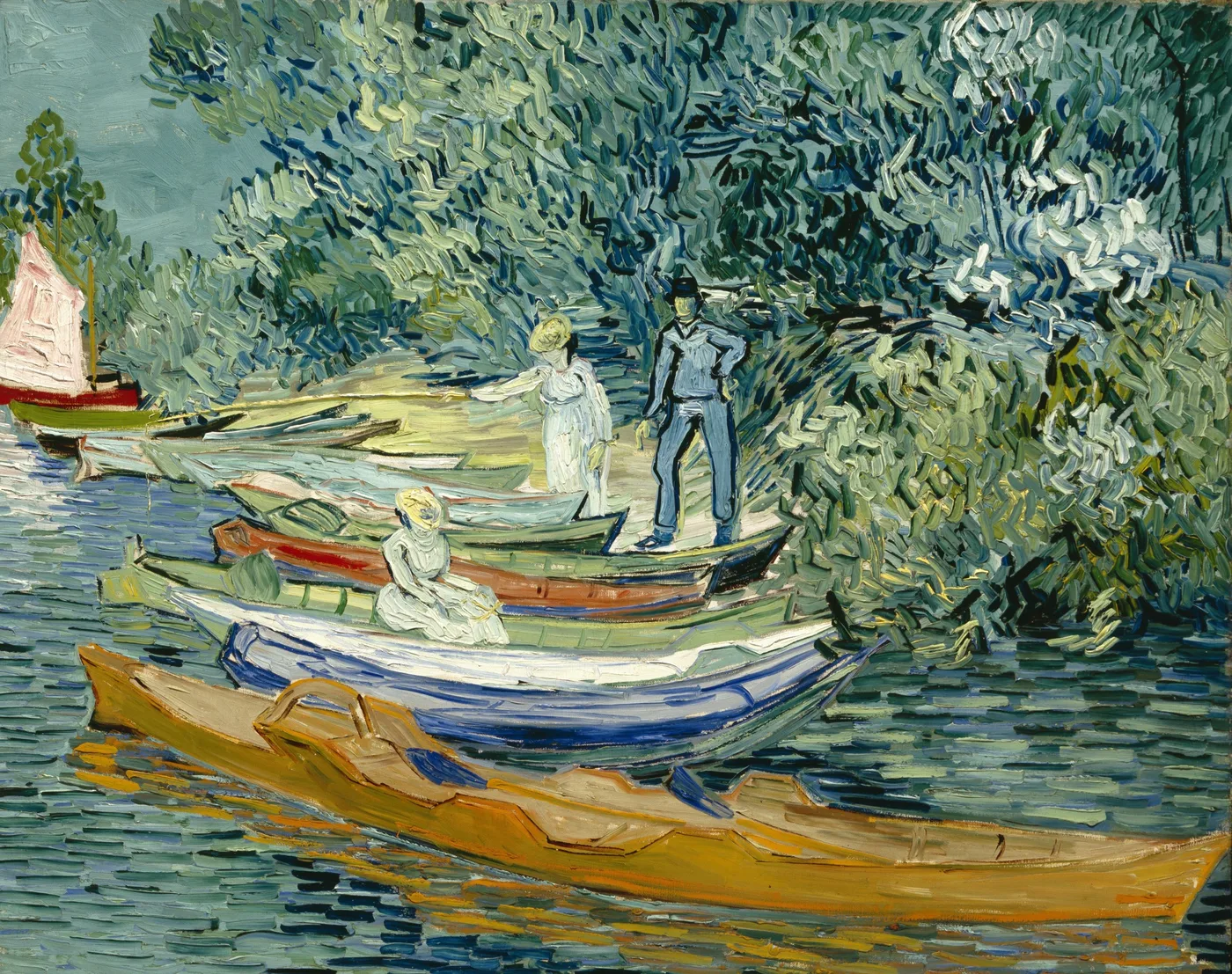
Bank of the Oise at Auvers belongs to that burst of work. Painted in 1890, it is not a farewell gesture or a symbolic last testament; it reads instead as a working painter’s record of a particular stretch of water and the boats tied up along it, seen on an ordinary day.
Three Figures Among the Moored Boats
The lower half of the canvas is almost entirely boat. A broad ochre hull, empty and turned toward the viewer, fills the foreground, its planks caught in loose parallel strokes of yellow, tan and white. Behind it a blue and white boat, a green one and a red-brown one lie tied together at odd angles, their hulls overlapping like a raft.
Two women in pale dresses and straw hats stand and sit among the boats, and a man in blue trousers and a dark hat stands beside them, hands loose at his sides. None of them is doing anything in particular. They give the scene scale and company rather than narrative, three people pausing by the water on a warm day.
Further back, almost lost against the far bank, a small boat with a pale pink sail sits at anchor. It is the one note of open water and open sky in the whole composition, a gap left near the top left corner where the rest of the canvas presses close.
A Wall of Green Rather Than Sky
What is unusual here, next to Van Gogh’s other river scenes, is how little sky survives. The far bank of the Oise rises directly behind the boats as a solid mass of foliage, built from teal, olive, cobalt and near-black greens with white and pale yellow struck through it for sunlit leaves.
That bank reads less like landscape depth and more like a woven screen, dense enough to flatten the space behind the figures. The eye has almost nowhere to go but sideways along the water and the boats, which is exactly where the incident of the painting sits.
The original canvas measures 93.7 by 73.3 centimetres, a size that lets this wall of green carry real physical weight rather than sitting as a small backdrop detail.
Paint Laid Stroke by Stroke
Van Gogh built the water in short horizontal dashes of blue, green and grey, laid close together so the surface seems to shift as the eye moves across it. There is no smooth passage anywhere in the river; even the calmest patches are made of visible, separate marks.
The foliage is handled with the same directness but a different rhythm, flicked rather than dragged, so the bank behind the boats has a nervous, almost electric texture next to the flatter planes of the hulls. Black outlines reappear here and there, holding a branch or a boat’s edge in place against all that movement.
Against this restless surface the figures are painted more simply, in broader strokes of cream, pale yellow and blue, which is part of why they read clearly even from across a room. The contrast of quiet figures against agitated water and foliage is one of the painting’s small but real achievements.
On a Wall, Through Changing Light
Hung in a room that gets daylight, this painting shifts more than most across a day. Morning light draws out the cooler blues and teals in the water and the far bank; a lamp in the evening warms the ochre boat and the cream dresses, pulling them forward.
Because the composition is built almost entirely from close-toned greens and blues, with the warm hulls as the only real counterweight, it rewards a spot where it can be looked at for more than a passing second, rather than glanced at from across a hallway.
The original hangs at the Detroit Institute of Arts, one of the riverside canvases from Van Gogh’s final weeks at Auvers-sur-Oise, a village he had come to for quiet and where, instead, he kept working until almost the last day.
Sizes and materials for Bank of the Oise at Auvers are listed on its product page.
More from this collection
Bring this painting home
Choose a hand-painted oil reproduction for real brushwork, or an archival canvas print for a crisp museum-image edition. Every size preserves the original proportions.
View this work & options
Further reading
Verify the original in the Detroit Institute of Arts collection record and continue through related works in the catalogue.