
Flowering Meadow with Trees and Dandelions: Story
Vincent van Gogh reached Auvers-sur-Oise in May 1890, having discharged himself from the asylum at Saint-Rémy. He took a room above a café, placed himself under the watch of Dr Paul Gachet, and began painting at a pace that startled even people used to his habits, sometimes a canvas a day. Wheatfields, the village church, thatched roofs and orchards in blossom all went down on canvas that spring and early summer.
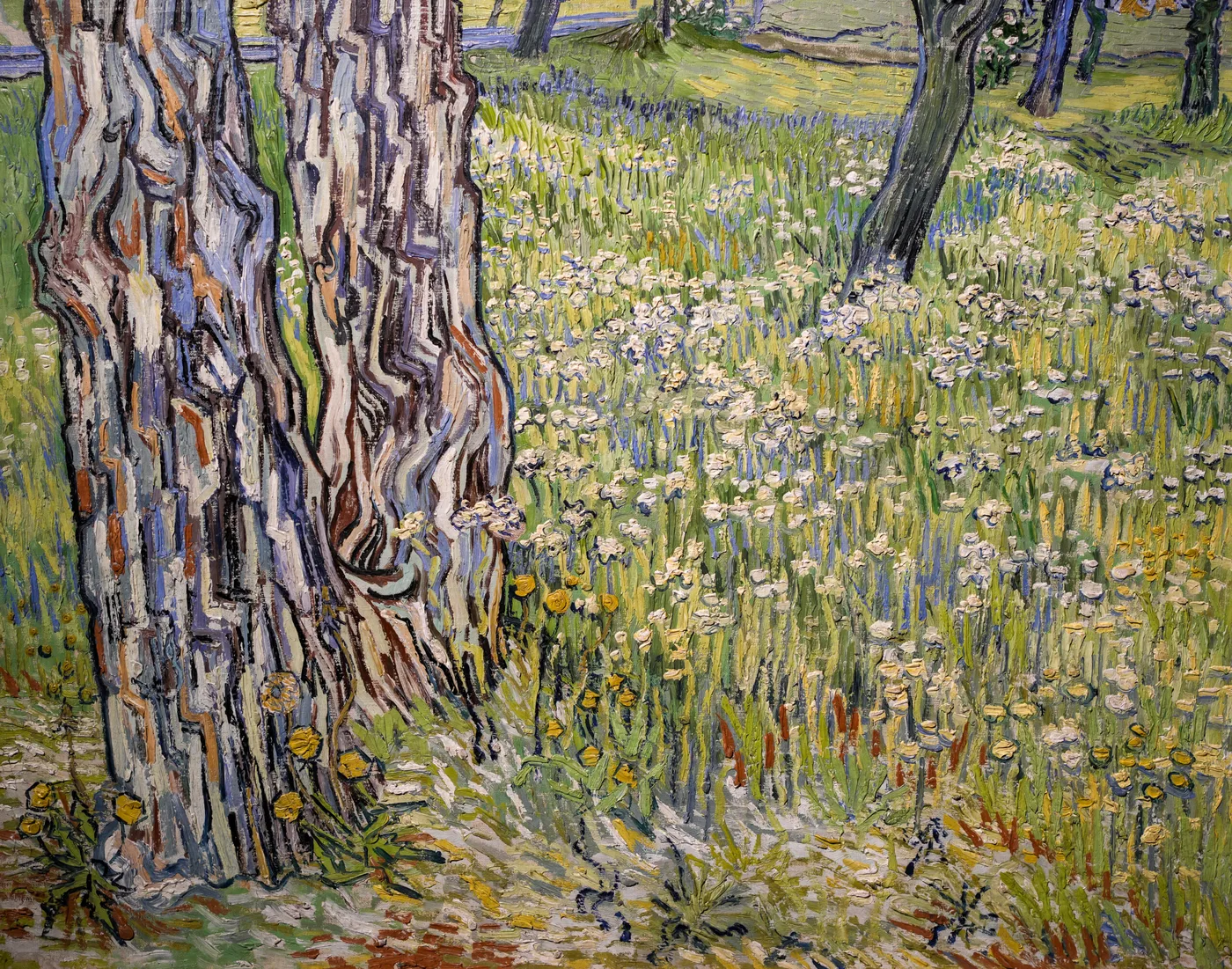
Flowering meadow with trees and dandelions belongs to that final burst of work in 1890. It is not a view of Auvers so much as a patch of ground within it, a stretch of grass and tree trunks he could have stood beside for an afternoon. The picture measures 90 by 72 cm, tall enough that the meadow feels like it rises to meet the viewer rather than recedes from them.
A Patch of Ground, Not a View
Two tree trunks fill the left third of the canvas, cropped at top and bottom so they read as columns rather than whole trees. There is no sky in this picture and barely a horizon: a thin band of pale blue-grey along the very top, perhaps a path or a low wall, is the only hint of anything beyond the meadow itself.
To the right, grass carries dozens of small white flowers, ox-eye daisies most likely, scattered thickly near the trunks and thinning as the ground runs back. Yellow dandelions punctuate the white, low to the ground near the base of the trees and again in scattered clusters further into the field.
Further back, a few more slender trunks stand among the grass, dark and narrow, suggesting the meadow continues into an orchard or the edge of a park. Van Gogh gives almost nothing away about scale or distance; the whole canvas is filled with ground, and the eye is pulled down and along rather than out toward a vanishing point.
Bark Painted Like Woodgrain
The two trunks are the most worked passages in the painting. Van Gogh built them from interlocking bands of white, ochre, rust-brown and violet-blue, each stroke following the vertical grain of the bark and edged in dark outline.
The effect is closer to woodgrain or marbling than to bark rendered from observation. Colour does the describing here, not shading: light and shadow on the trunk are given as adjacent bands of cool and warm paint rather than blended tone.
The paint on the trunks sits thick on the canvas, laid on wet and worked while still workable, so the ridges of individual strokes catch the light. It is some of the densest paint handling in any of his Auvers canvases.
Grass Built from Short Strokes
The meadow itself is made from short, close-set vertical dashes: green, yellow-green and a cooler blue-green laid one against another rather than blended. Van Gogh used the same vertical logic across the whole field, so grass, stems and flower stalks all share one rhythm of mark-making.
The daisies are dabs rather than drawn flowers, small flicks of white with a touch of yellow at the centre, repeated until they read as a field rather than as individual blooms. The dandelions are heavier, rounder strokes of orange-yellow, fewer in number and concentrated mostly near the trunks.
Colour in the picture stays close to a narrow range: greens and yellows carry the meadow, white carries the daisies, and violet-blue is reserved almost entirely for the trunks and the shadowed ground beneath them. A few dashes of rust-red at the base of the trees are the only note that breaks from this palette, and they anchor the whole composition where the trunks meet the grass.
What Hangs on the Wall
This is a picture that rewards being seen up close, the way Van Gogh painted it. From across a room the meadow reads as a mass of green and white; nearer, it resolves into hundreds of individual strokes and flowers, and the trunks reveal their built-up ridges of paint.
Light changes it considerably. In a dim room the greens around the trunks sink toward black and the white daisies hold most of the light on the canvas. Under a stronger, more direct light the yellow dandelions and the ochre bands in the bark come forward, and the whole field feels warmer.
The original hangs today in the Kröller-Müller Museum, part of a collection built around exactly this kind of close, unguarded look at the natural world Van Gogh had around him in his last months.
Sizes and materials for Flowering meadow with trees and dandelions are listed on its product page.
More from this collection
Bring this painting home
Choose a hand-painted oil reproduction for real brushwork, or an archival canvas print for a crisp museum-image edition. Every size preserves the original proportions.
View this work & options
Further reading
Verify the original in the Kröller-Müller Museum collection record and continue through related works in the catalogue.