
Fritillaries: Story, Meaning & Brushwork
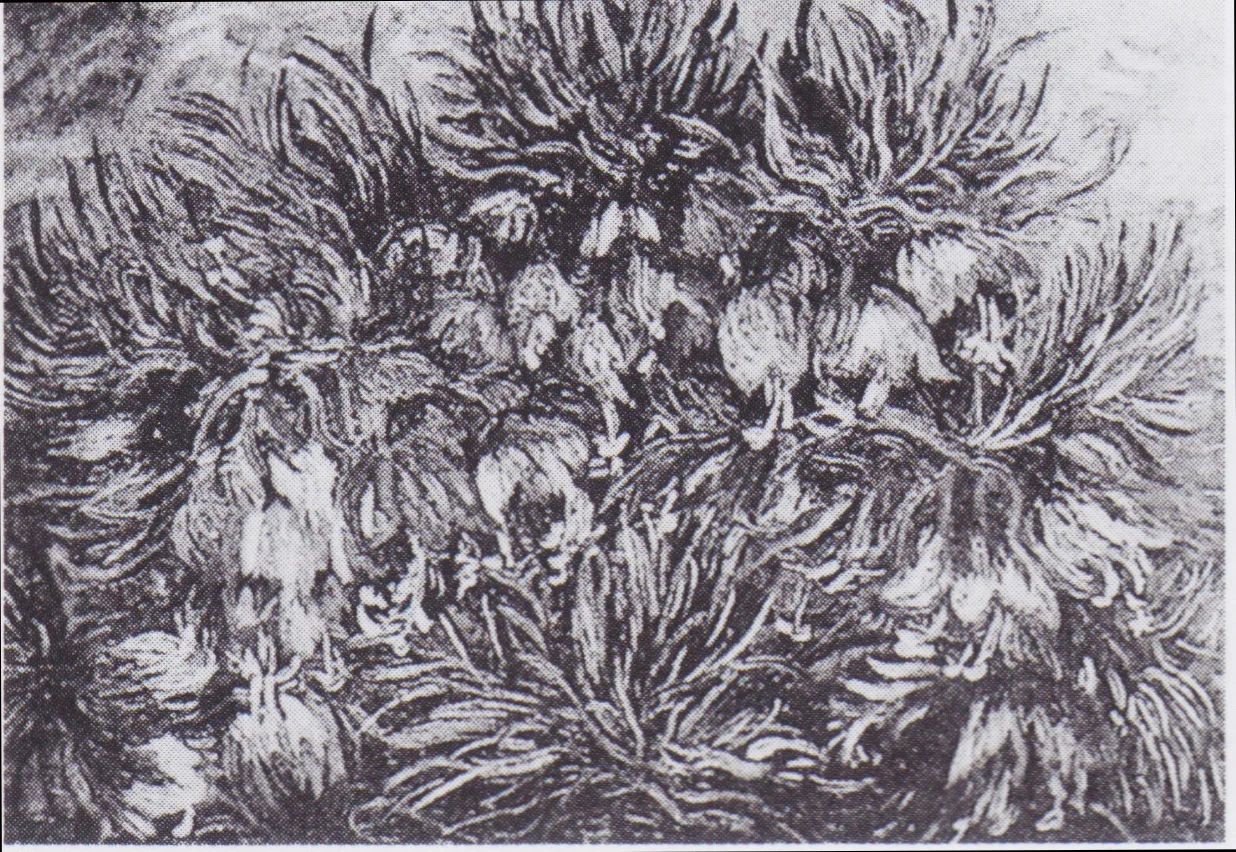
Paris, 1886
Vincent van Gogh arrived in Paris in the early spring of 1886 and moved in with his brother Theo, an art dealer whose gallery kept him close to the pictures reshaping French painting. He had spent the previous years in the Netherlands working in browns, greys and umbers, and Paris confronted him with something else entirely: canvases built from broken colour, laid side by side rather than blended on the palette.
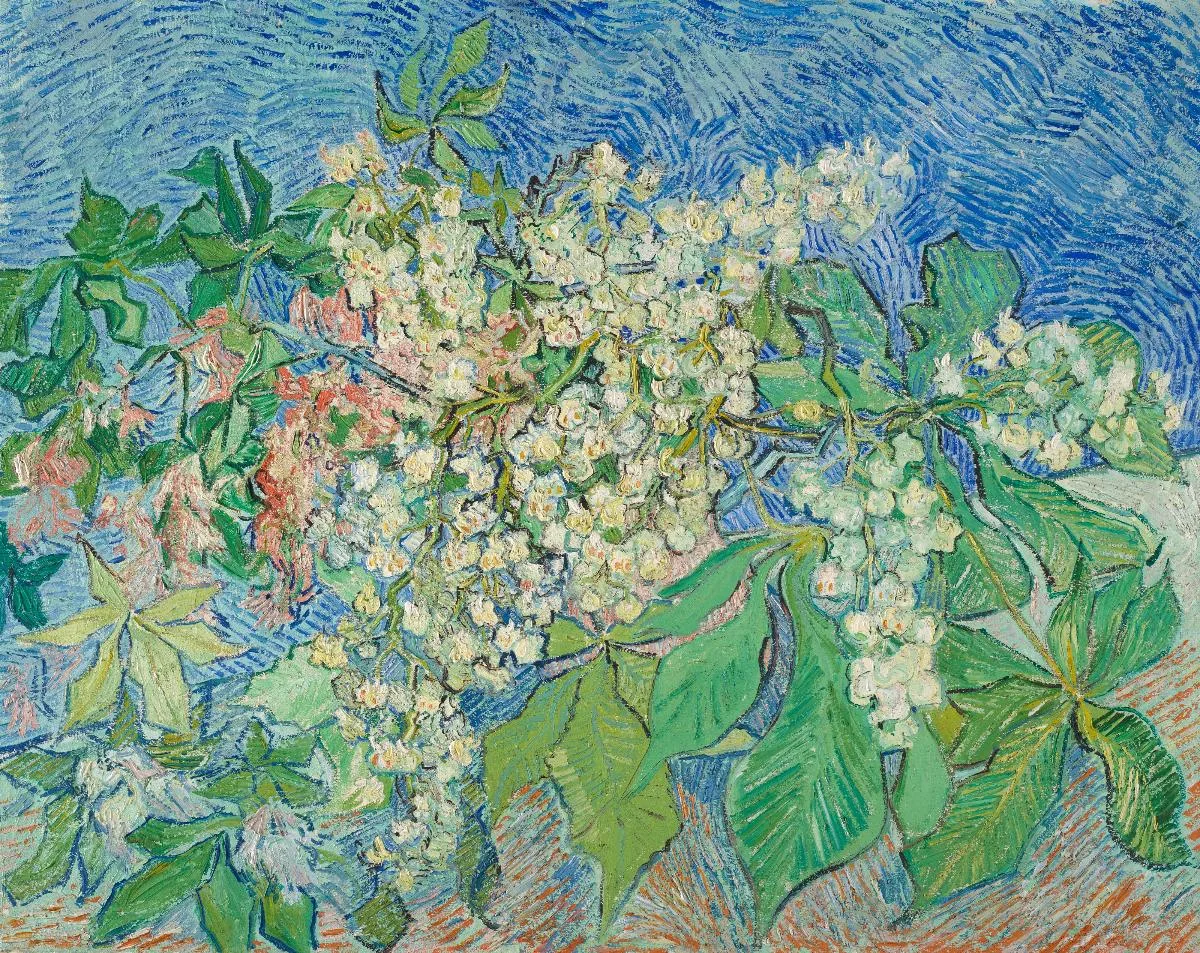
He answered the shock the way he usually did, by working. Cut flowers were cheap, patient and endlessly available, so through 1886 he painted them in quick succession, one arrangement after another, using each canvas to test how far a colour could be pushed before it lost the object underneath it. Fritillaries, painted that year at 55 by 38 centimetres, belongs to that run of studies.
It was demanding, unglamorous practice, the kind an artist sets for himself rather than the kind a patron commissions, and it shows in how many flower pieces survive from these months. Few of them are as densely packed as this one.
A Crowd of Nodding Heads
The picture is given over almost entirely to the flowers themselves. Crown fritillaries hang in tight clusters, their bell shaped heads drooping on curved stems, each one crowned by a tuft of narrow, upright leaves that spike outward like a ruff. Van Gogh has massed them so densely that stem and leaf and petal interlock, leaving barely a gap for the eye to rest.
There is no single bloom set apart for admiration here. The subject is the crowd, not any one flower within it, and the composition reads more like a thicket than a bouquet arranged for display.
That density is a deliberate choice. By filling the frame edge to edge with overlapping heads, Van Gogh turns a modest still life into something closer to a study of pattern and pressure, the sort of exercise that would feed directly into the tangled, high-energy compositions of his later years.
A Hand That Will Not Sit Still
The brushwork carries as much of the picture’s character as the flowers do. Each petal is built from short, directional strokes that follow the curl and recurve of the form rather than smoothing it away, so the paint itself seems to bristle.
Van Gogh was still a few years from the thick, rope-like impasto of his final period, but the instinct is already visible here: paint applied as a record of movement, stroke by stroke, rather than as a flat description of a surface. Look closely and the picture breaks into hundreds of small, decisive marks; step back and they resolve into foliage.
It is a technique suited exactly to this subject. Fritillary leaves are thin, wiry and restless, and a smoother hand would have flattened them into something altogether calmer.
Colour Pressed Close
Van Gogh’s Paris flower pieces are where he taught himself, canvas by canvas, how complementary colours behave when set edge to edge, and this one is built on exactly that friction: warm, flame-toned blooms held against a cooler ground, each colour sharpened by the other rather than softened by it.
The effect is not decorative so much as diagnostic. This is a painter working out, in public, a lesson he had only just discovered, and the picture keeps something of that urgency in every part of the paint surface.
On the Wall, Through the Day
Hung where daylight reaches it, this is a picture that changes hour to hour, since a dense, close-toned paint surface like this one shifts with the angle and colour of the light falling across it. Morning light picks out the ridges of individual strokes; evening light flattens the surface and lets the pattern of petals take over instead.
It rewards close looking more than a glance from across a room. Set near a dining table or in a kitchen, somewhere people sit still long enough to actually look, its tangle of shapes keeps giving up new detail the longer it is watched, in a way a simpler bouquet painting would not.
Sizes and materials for Fritillaries are listed on its product page.
More from this collection
Bring this painting home
Choose a hand-painted oil reproduction for real brushwork, or an archival canvas print for a crisp museum-image edition. Every size preserves the original proportions.
View this work & options
Further reading
Verify the original in the collection record and continue through related works in the catalogue.