
Bowl with Peonies and Roses: Story, Meaning & Brushwork
A Paris apprenticeship in colour
By early 1886 Vincent van Gogh had left the dim browns of Nuenen behind and moved to Paris, where his brother Theo kept a flat and a foothold in the art trade. He was thirty-two, newly arrived, and behind where he wanted to be. The city’s painters were working in colour he had barely touched.
He answered the gap the only way he knew: by working. Through 1886 he painted flowers again and again, not for buyers but as exercise, filling canvas after canvas with whatever blooms he could afford or beg. Bowl with Peonies and Roses belongs to that stretch of self-set training.
Peonies and roses were not chosen for symbolism. They were chosen because their heavy, layered petals gave him more to solve than a single bloom would: how pink turns to white, how a shadow sits inside a curled petal, how much paint a canvas can carry before it stops reading as a flower.
What sits in the bowl
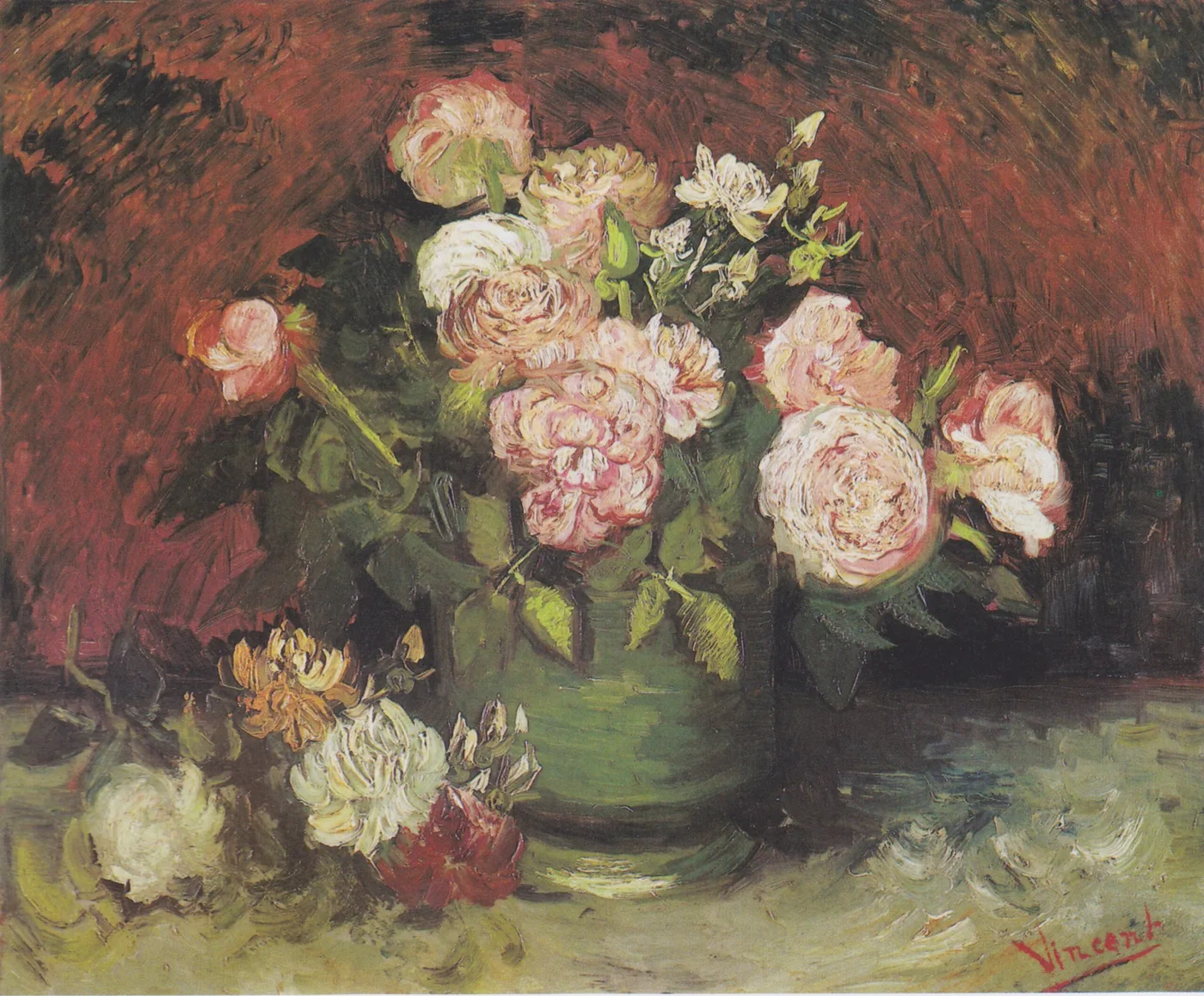
A round green bowl, wide and squat, holds the arrangement at the centre of the canvas. Pink peonies crowd against smaller white and blush roses, their heads pressed so close together that the eye has to search for where one flower ends and the next begins.
A few stems reach upward and outward past the main mass, loosening the bouquet’s silhouette so it never sets into a tidy dome. Green leaves and sepals thread between the blooms, cool notes against the warmer pinks.
Van Gogh set this concentrated shape against a plain warm ground, so nothing else in the picture competes with it. There is no window, no table setting, no other object to explain or place the flowers. The bowl simply exists, lit from somewhere in front, and the whole of the painting’s attention goes to it.
A second gathering on the table
Below the bowl, at the front of the canvas, more flowers lie loose on the pale tabletop. A white rose, a rust-orange bloom and a dark red one are scattered rather than arranged, as if set down while the main bunch was being built.
This second grouping does real work. It breaks the painting’s lower edge, keeps the bowl from feeling stranded in the middle of the canvas, and gives the eye a place to rest after it has travelled the crowded mass of blooms above.
The tabletop itself is painted thin and pale, almost bare in places, letting the ground of the canvas show through. It is a quiet passage that throws the density of the bowl into sharper relief.
The weight of the paint itself
Van Gogh loaded his brush and let the paint sit proud of the canvas. Petals are built from short, curved strokes of pink, white and cream, laid one against another until the surface has almost as much texture as colour.
Look closely at any single peony and the drawing dissolves into paint. Step back and it resolves into a flower again. That shift between the two ways of seeing, mark and image, is the picture’s real subject, more than the bouquet itself.
The green bowl is handled more broadly, with fewer, longer strokes that let its rounded form read clearly against the fractured detail above it. That contrast between a simply stated vessel and a densely worked bouquet is part of what keeps the composition legible.
The red ground
Behind the flowers the background is worked in dark red and rust, laid on in long, sweeping, almost circular strokes that arc around the bouquet like a rough halo. It is not a wall or a curtain rendered as such, just colour and motion.
Red behind pink is a hard pairing to hold, and Van Gogh pushes it hard here, letting the two clash rather than settling for a safer, softer backdrop. The heat of the ground makes the pale petals seem to come forward off the canvas.
Dimensions matter to how this reads in the original: at 71 by 59 centimetres, the bouquet sits close to life size, so the red ground has real presence rather than functioning as a background sliver. It is a field the flowers push against, not a border around them.
On a wall today
The original hangs in the Kröller-Müller Museum, one of a group of Paris flower still lifes Van Gogh made before Provence and the sunflowers that followed. It reads differently depending on how it is lit.
Under warm evening light the red ground deepens and the picture turns almost brooding, the pale blooms glowing out of it. Under cooler daylight the same canvas opens up, the individual strokes in the petals becoming easier to pick out one by one.
Hung somewhere it can be looked at closely, a kitchen, a bedroom, a dining room wall met at eye level, it rewards that kind of attention. This is a painting built for looking twice: once for the bouquet, and once for the paint that made it.
Sizes and materials for Bowl with Peonies and Roses are listed on its product page.
More from this collection
Bring this painting home
Choose a hand-painted oil reproduction for real brushwork, or an archival canvas print for a crisp museum-image edition. Every size preserves the original proportions.
View this work & options
Further reading
Verify the original in the Kröller-Müller Museum collection record and continue through related works in the catalogue.